









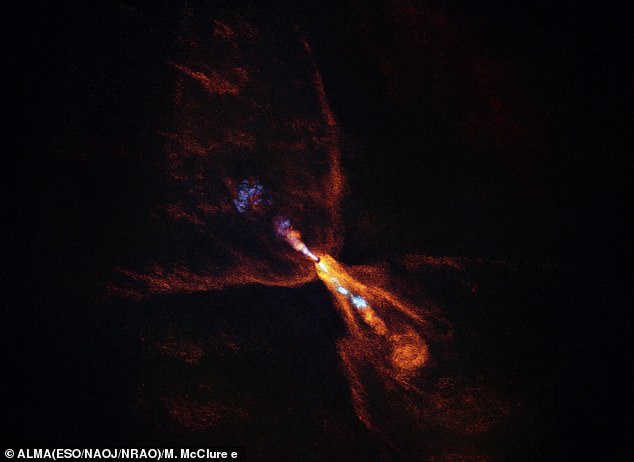
A New Window into the Birth of a Solar System
Scientists have captured the first-ever images of a new solar system forming, offering a rare glimpse into the early stages of planetary development. These groundbreaking images reveal the exact moment when planets began to take shape around a young star located 1,300 light-years from Earth. The star, named HOPS-315, is part of the constellation Orion and is surrounded by a ring of hot minerals that are just starting to clump together.
This discovery is significant because it provides a snapshot of what our own Sun might have looked like over four billion years ago. According to Professor Melissa McClure, lead author of the study and an astronomer at Leiden University, the properties of HOPS-315 closely resemble those of the Sun during its infancy. This makes the system a valuable resource for understanding how our solar system came to be.
Understanding Planetary Formation
Planets are believed to form within structures known as protoplanetary discs—spinning disks of gas and dust that surround young stars. While astronomers have often observed these discs or found evidence of massive, Jupiter-like planets, the precise moment when planets begin to condense has remained a mystery.
In our own solar system, the earliest materials that condensed near the region where Earth now orbits are preserved in ancient meteorites. These meteorites contain minerals rich in silicon monoxide, a chemical that only forms under the extreme heat of a young protoplanetary disc. The presence of such minerals is considered a key indicator of planetary formation.
The initial building blocks of planets, known as planetesimals, formed shortly after these crystalline minerals began to condense. However, this critical moment, referred to as the “t=0” point, had never been directly observed due to the challenges posed by young stars being obscured by thick clouds of cold gas.
Breaking Through the Cosmic Cocoon
Using advanced telescopes, scientists were able to peer through this cosmic cocoon and observe the planetary disk. The James Webb Space Telescope detected signals of silicon monoxide around HOPS-315, and the ALMA telescope in Chile helped pinpoint the source of these signals.
Professor McClure and her team published their findings in the journal Nature, highlighting that the chemicals surrounding HOPS-315 are beginning to cool. This cooling process is a crucial sign that the system is in the early stages of planetary formation.
The fact that the minerals exist in both solid and gaseous states is a strong indication that the system is at the t=0 moment. Researchers identified a small region in the disc where the chemical signals originated. This region forms a ring around the star, similar in distance to the asteroid belt in our solar system.
A Mirror of Our Own Solar System
Dr. Logan Francis, a co-author of the study and researcher at Leiden University, noted that the location of the minerals in this extrasolar system mirrors their position in our own solar system. This similarity suggests that HOPS-315 is undergoing a process of planet formation that closely resembles the one that led to the creation of Earth and other planets.
Professor Merel van ‘t Hoff, another co-author from Purdue University, emphasized the significance of this discovery. She stated that HOPS-315 offers one of the best opportunities to study the processes that shaped our solar system billions of years ago.
Implications for Future Research
This breakthrough opens up new avenues for research into the origins of planetary systems. By studying HOPS-315, scientists can gain deeper insights into the conditions and mechanisms that led to the formation of our own planet. As technology continues to advance, further discoveries like this will undoubtedly expand our understanding of the universe and our place within it.