









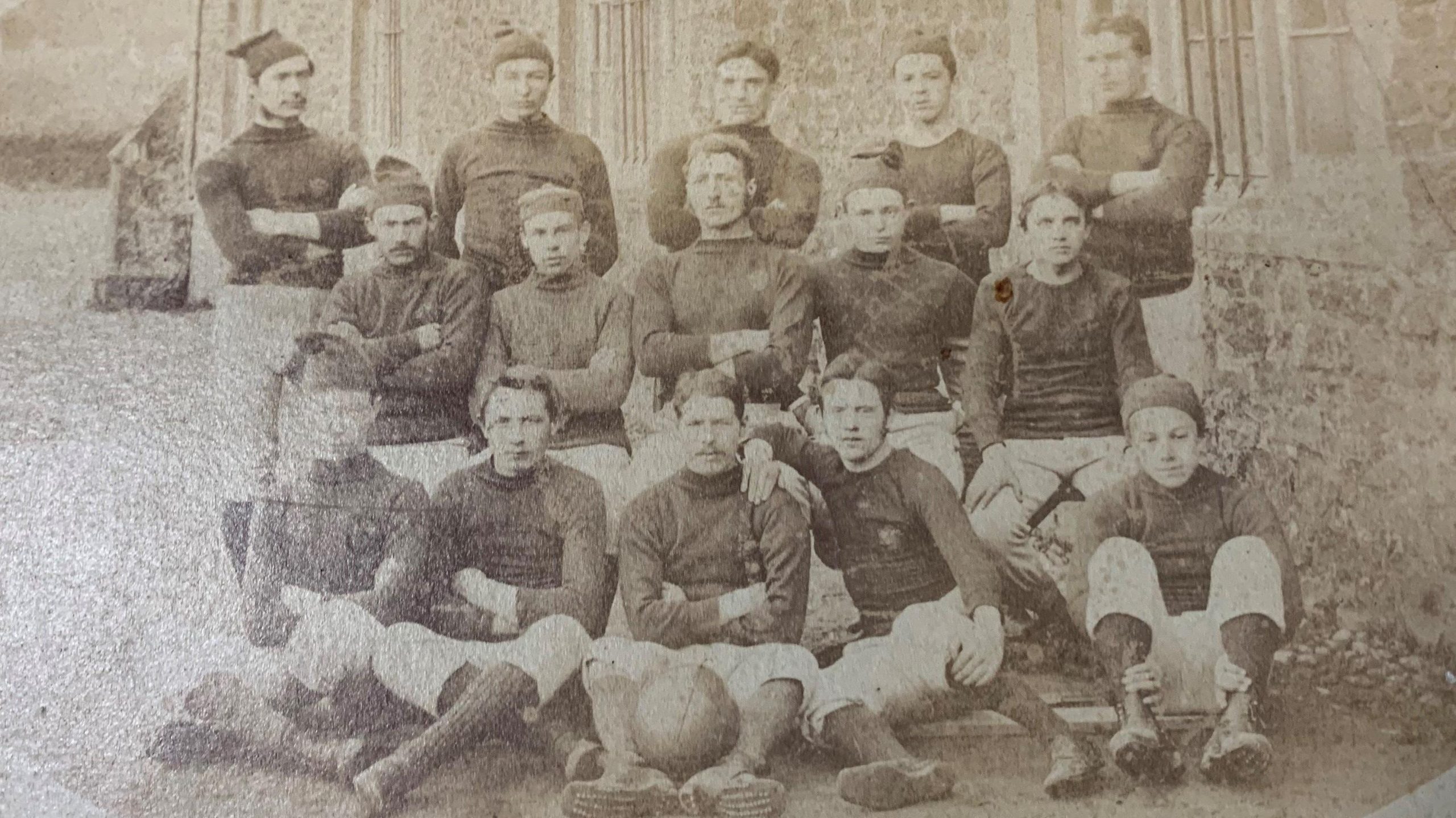
The Legacy of Rugby in Wales: A Shared Heritage
Almost 160 years after a historic rugby match took place, a town has finally been recognized as the birthplace of what would become Wales’ national sport. Lampeter, long celebrated as the home of rugby in Wales, is now sharing its legacy with Llandovery. This recognition came after extensive research by historians, leading the Welsh Rugby Union (WRU) to grant both towns equal status in the sport’s origins.
Lampeter has been acknowledged for its role in the 1866 match against Llandovery College in the village of Caio. However, following this new recognition, the town now features new entrance signs highlighting its historical connection with Llandovery, its college, and the formation of Welsh rugby.
The Reverend John Williams, the first warden of Llandovery College in 1848, is credited with introducing rugby to the town. He had previously served as the first rector of Edinburgh’s academy, where he was familiar with the game. Iestyn Thomas, former rugby coach at Llandovery College, explained that Williams brought rugby with him when he moved to Carmarthenshire.
“This led to Llandovery College playing against Lampeter College in 1866 on the fields of Glanrannell Farm in the village of Caio,” Thomas said. “Though there is little evidence today of that first derby, Caio can lay claim to being the venue for the first ever match in Wales played by two Welsh clubs or institutions.”
Thomas described the game as “quite a game.” It was held during the spring fair, where local farm laborers were looking for work with local farmers. They witnessed the game and joined in, forcing the referee to stop the match and remove them from the pitch.
Llandovery went on to excel in the world of rugby and sport. The college produced two players for the first Welsh international rugby fixture and was present when the WRU was created in 1881. Its rugby legacy continues today.
Dominic Findlay, the warden of Llandovery College, highlighted the college’s current connections. “Our director of rugby is Nathan Thomas, a former Welsh back row,” he said. “We are connected with old boys like Alun Wyn Jones and George North. We have just brought three boys into the professional game with the Scarlets.”
Findlay also noted that the current number 10, Carwyn Leggett Jones, recently played in the under-20s. “The future is hugely exciting,” he said. He added that many of the greats in Welsh rugby honed their skills at Llandovery College, with more than 50 students earning over 550 caps for Wales.
Carwyn James, the Welsh rugby coach, taught at the college from 1956 to 1969, leaving a lasting impact. Councillor Handel Davies expressed that Llandovery being officially recognized as a co-founder of rugby in Wales alongside Lampeter was “a huge honour.” He admitted it was a surprise to many, as people often thought the sign in Lampeter marked the birth of rugby.
Now, attention is turning to Caio, with one villager suggesting a plaque be placed on Glanrannell Field to mark its contribution as the site of the first competitive rugby match in Wales.
Why Is Rugby So Popular in Wales?
Rugby holds a special place in Welsh culture. Its roots run deep, with history and tradition playing a significant role in its popularity. The sport has seen numerous high points, including the 2005 Grand Slam, which remains a highlight in Welsh rugby history.
Despite its rich heritage, challenges remain. Recent developments, such as the potential cut to regional teams and community programs, have raised concerns among fans and players alike. As the sport continues to evolve, the legacy of places like Llandovery and Lampeter will remain central to its story.