









Introduction to Autonomous Delivery Innovation
In a groundbreaking move, the world of delivery services is witnessing the integration of advanced robotics. A robot dog named Milo has started its journey on the streets of Yorkshire as part of an innovative trial by Evri, a leading delivery company. This initiative marks a significant step towards revolutionizing how parcels are delivered to customers.
Milo: The Four-Legged Delivery Bot
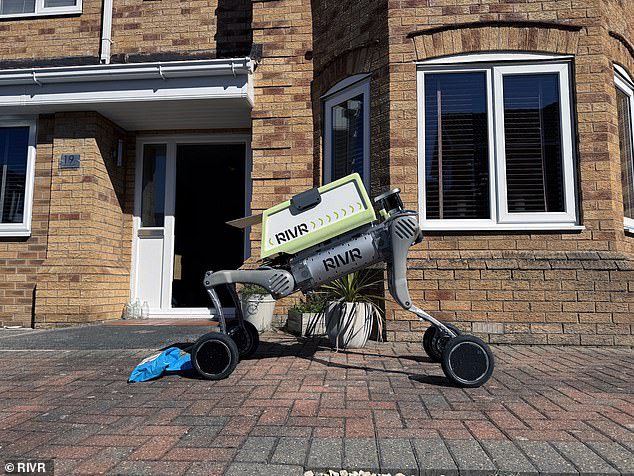
Milo, the four-legged delivery bot, has been trained to perform several tasks autonomously. It can jump in and out of the van, navigate to customers’ doors, and drop off packages without any assistance. This robot is set to join Evri’s regular drivers over the next fortnight as they make their rounds in Morley, Leeds.
Evri aims to use these robotic co-pilots to ease the workload on their human drivers. By taking over simpler tasks such as navigating to the door, Milo will allow drivers to focus on more complex jobs like parking or maneuvering through challenging areas. If the trials prove successful, Milo could soon be making deliveries across the country.
Technological Advancements Behind Milo
Developed by Swiss AI firm RIVR, Milo is equipped with four wheeled legs that enable it to navigate various terrains. Parcels are placed in a box on the robot’s back, which then takes them to the door for the courier to remove, or gently shakes them out onto the floor itself.
Milo uses a system of cameras and depth-sensing Lidar scanners to determine its location. Through AI, the robot processes this data to navigate around pedestrians, cyclists, and bins as it heads toward the customer’s door. Before entering real-world scenarios, Milo has already undergone extensive training through millions of simulations based on real-world data. This ensures that it is well-prepared to handle various situations and avoid obstacles.
Enhancing Last-Mile Deliveries
The primary goal of integrating Milo into the delivery process is to speed up what is known as ‘last mile’ and ‘last 100 metres’ delivery times. These phases are critical as vans approach their final destinations but often result in delays, congestion, and increased emissions. Currently, drivers spend a considerable amount of time moving between nearby drop-off points and returning to their vehicles.
By pairing drivers with autonomous robotic companions, RIVR and Evri aim to address this logistical challenge and ultimately eliminate the need for drivers to exit the van. RIVR envisions a future where robots can navigate sidewalks, open doors, hand off packages, and communicate with people as seamlessly as human couriers.
Expanding the Trial with Miniature Delivery Trucks
In addition to Milo, Evri is planning to trial an AI-powered miniature delivery truck in Barnsley, Yorkshire, this September. According to the company, these trucks will have the advantage of being able to wait up to 10 minutes for the customer to come to the door. This feature could be particularly beneficial for disabled customers who may find it challenging to collect packages.
The small robotic EV, developed by Delivers AI, will respond to customers who choose robotic delivery as part of a three-month trial. These robots will be capable of making deliveries 24 hours a day, even during the night.
Community Support and Future Prospects
Councillor Robin Franklin, Barnsley Council’s Cabinet spokesperson for Regeneration and Culture, expressed pride in hosting the trial run for this innovative program in Barnsley. He noted that this initiative could revolutionize home deliveries and wished Evri the best of luck with the trial.
As the trials progress, the potential for these technologies to transform the delivery landscape becomes increasingly evident. With continued advancements and successful implementations, the future of parcel delivery looks promising, driven by innovation and efficiency.