






South Korea’s Parliament Passes Controversial Labor Law Amid Business and Union Tensions
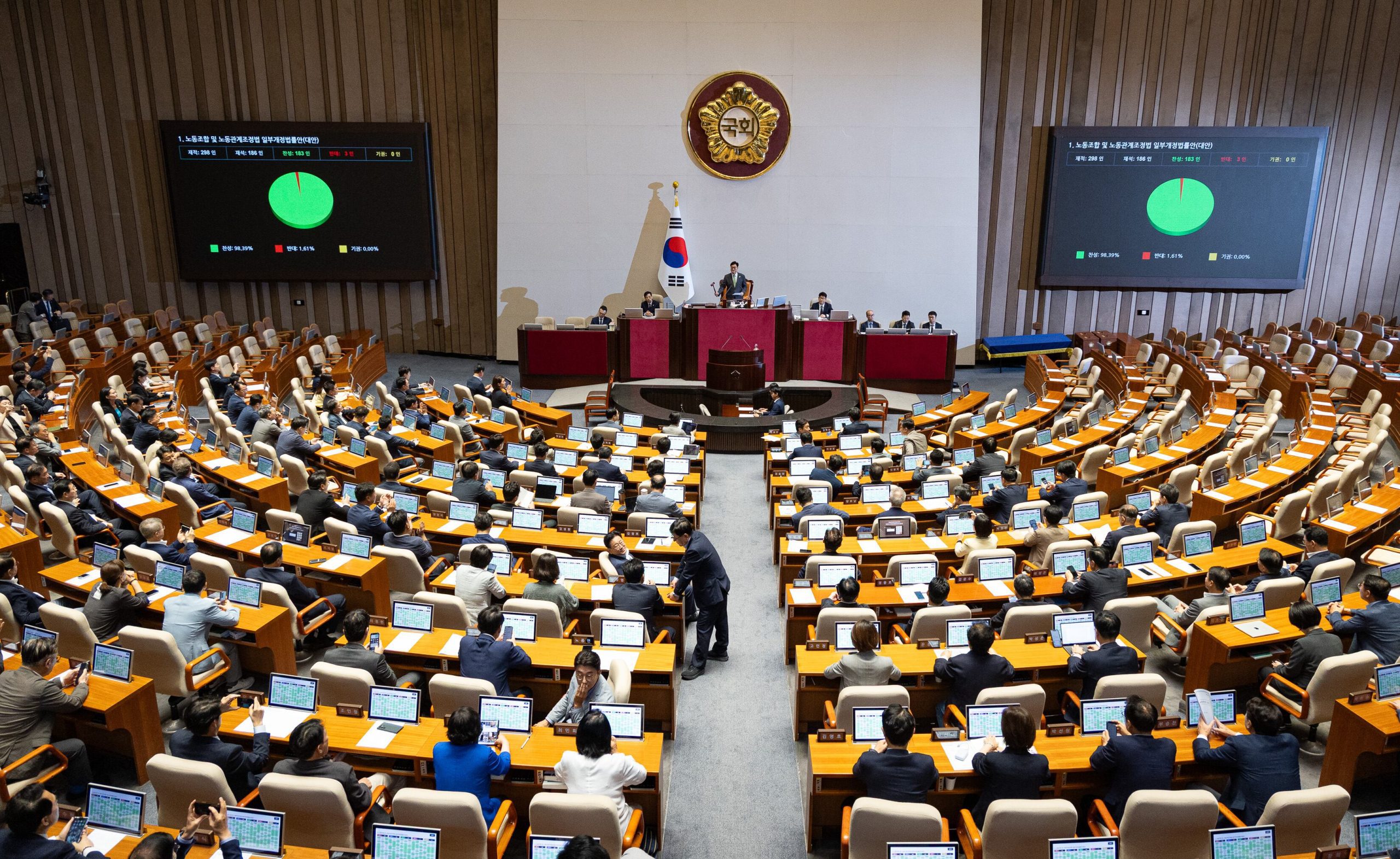
On August 24, South Korea’s parliament passed the so-called “Yellow Envelope Bill,” an amendment to the Trade Union and Labor Relations Adjustment Act. This move came despite strong opposition from business groups, who argued that the law would create significant challenges for companies and hinder economic growth. The legislation has sparked a heated debate between corporate leaders and labor unions, with each side presenting starkly different perspectives on its implications.
The bill amends the existing framework governing labor relations by expanding the definition of “employers” and permissible labor disputes. According to the revised law, anyone who can “substantively and specifically control working conditions” is considered an employer. Critics argue that this vague definition could lead to prolonged legal battles, particularly in industries with complex supply chains such as automotive and shipbuilding. In these sectors, parent companies may be held responsible for disputes involving their subcontractors, potentially leading to increased bargaining obligations.
Business groups have expressed deep concerns over the law’s potential consequences. Six major business organizations, including the Korea Chamber of Commerce & Industry, the Federation of Korean Industries, and the Korea Federation of SMEs, issued a joint statement expressing “deep regret” over the passage of the bill. They emphasized that the law lacks clarity on what constitutes an employer and how managerial decisions can be challenged. Without clear guidelines, they warned that confusion could spread across factory floors, disrupting operations and creating uncertainty.
The expanded scope of labor disputes under the new law also raises alarms among business leaders. It now includes core management decisions such as restructuring, mergers and acquisitions, and the establishment of overseas factories. These changes are seen as a threat to domestic investment and could encourage companies to relocate production abroad. Business executives fear that the law may act as a “time bomb,” discouraging long-term investments and weakening South Korea’s competitive edge.
Small businesses are particularly worried about the potential fallout. Even companies without formal union representation may face difficulties if parent companies cut contracts to avoid disputes. One small auto-parts manufacturer, for instance, was forced to take out a bank loan after its parent company refused to increase wages due to union pressure. Industry leaders believe such scenarios could become more common, threatening the survival of smaller firms.
Foreign investors have also voiced concerns. Hector Villarreal, head of GM Korea, reportedly warned the labor ministry during a meeting with executives from the auto, shipbuilding, and steel sectors that the law could significantly reduce South Korea’s competitiveness compared to other countries. His remarks were interpreted as a warning about the future of foreign investment in the country.
Unions Celebrate the Law as a Step Forward
While business leaders worry about the law’s negative impacts, labor unions view it as a major victory. The Korean Confederation of Trade Unions (KCTU), the largest umbrella organization for labor groups in the country, hailed the amendment as the “fruit of 20 years of struggle.” However, they also cautioned that “today is not the end but the beginning.”
The KCTU pledged to form a “real boss bargaining” task force and to push for 2026 to be recognized as the “first year of winning rights” for temporary and contract workers. They also vowed to hold employers accountable beyond the legal framework, using workplace actions to enforce their demands. Unions aim to leverage the law to advance longstanding goals, such as equal pay for equal work and the conversion of contract staff into full-time employees.
Beyond workplace issues, labor leaders are preparing to push for broader political reforms. Following the election of President Lee Jae-myung in June, the KCTU called on the government to adopt an ambitious agenda. This includes ensuring political rights for teachers and civil servants, passing an anti-discrimination law, and reforming South Korea’s chaebol- and export-driven economic model.
Ongoing Tensions and Future Outlook
The passage of the “Yellow Envelope Bill” marks a pivotal moment in South Korea’s labor landscape. While it represents progress for labor unions, it has raised serious concerns among business leaders and foreign investors. The coming months will likely see continued negotiations, legal challenges, and political debates as both sides seek to shape the future of labor relations in the country. The outcome of these discussions will have far-reaching implications for South Korea’s economy and workforce.