


The Impact of Trump’s Budget Legislation on Public Perception
President Donald Trump’s recent budget legislation has faced significant backlash from voters, despite its passage through Congress. The bill, which includes his signature tax cuts and other provisions, has been met with mixed reactions, highlighting a growing divide in public opinion.
Key Provisions of the Bill
The $3.3 trillion measure extends the 2017 tax cuts and introduces several new elements aimed at supporting American families. These include eliminating taxes on tips and overtime, doubling the child tax credit, and creating a $1,000 ‘Trump investment account’ for newborns. This initiative was previously referred to as MAGA accounts, emphasizing its connection to Trump’s campaign promises.
However, the bill also includes substantial cuts to essential programs such as Medicaid, the Supplemental Nutrition Assistance Program (SNAP), and renewable energy initiatives that were expanded under former President Joe Biden. These reductions have raised concerns among critics who argue that the bill disproportionately affects lower-income Americans.
Public Approval and Disapproval
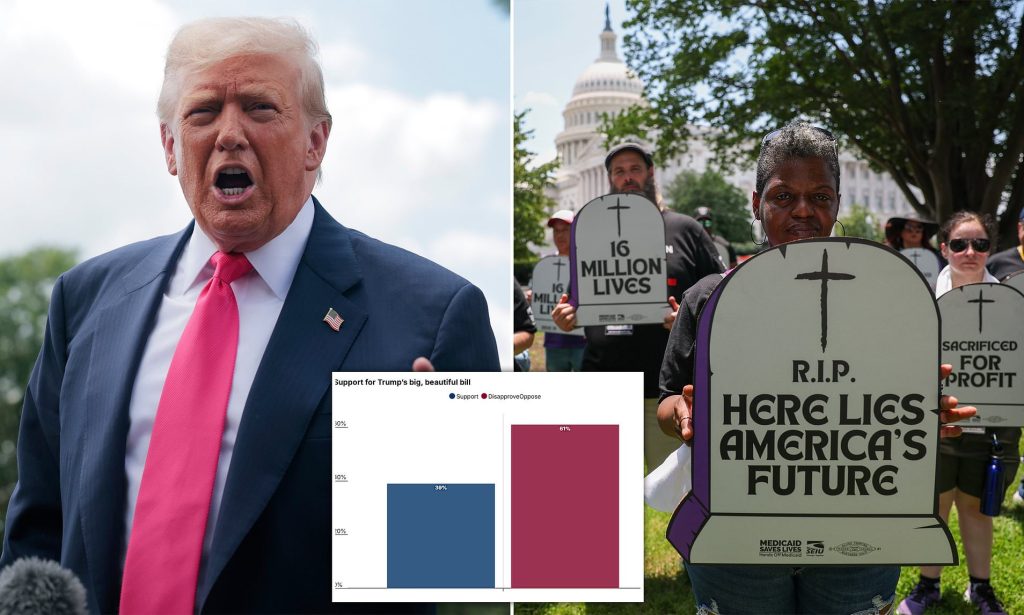
Public approval of Trump’s handling of the federal budget has declined significantly. A recent CNN/SSRS poll revealed that only 37 percent of Americans support Trump on this issue, with 63 percent expressing disapproval. This marks a sharp drop from March, when he had 48 percent approval and 52 percent disapproval.
Even before the bill’s passage, there were signs of trouble. A mid-June poll by J.L. Partners found that just over a quarter of Americans, or 28 percent, supported the measure. The nonpartisan Congressional Budget Office estimated that the bill would add $3.9 trillion to the national debt, a figure the White House disputed by criticizing the CBO’s analysis.
Legislative Process and Political Strategy
Republicans managed to pass the bill using special ‘reconciliation’ procedures designed for budget reduction. This allowed them to bypass the Senate filibuster, ensuring the measure’s enactment despite opposition from some members of their own party. However, the bill remains unpopular with voters, with 39 percent supporting it and 61 percent opposing it, according to the CNN poll.
Democrats argue that the impact of the bill will become more apparent once the Medicaid and food stamp cuts take effect starting in 2027. They warn that these changes could lead to significant hardship for millions of Americans, particularly those relying on these programs for basic needs.
Campaign Efforts and Public Response
Despite the controversy, Trump has not launched a major campaign to promote the bill. He mentioned the possibility of traveling “a little bit” but suggested that the bill’s reception has been so positive that further efforts may not be necessary. His recent trip to Pennsylvania was framed as an energy event, though it also served as a platform to rally support for the legislation.
Vice President JD Vance is actively involved in promoting the bill, participating in an event in West Pittston, Pennsylvania, near Joe Biden’s childhood home. The White House has also introduced an interactive map to help Americans estimate their potential savings under the new law. Users can input their weekly salary, overtime pay, and tips to calculate yearly savings, though the tool does not address the CBO’s concerns about healthcare losses.
Political Implications
The bill’s passage has had a noticeable impact on Trump’s overall approval ratings. In the latest poll, his approval stood at 42 percent, with 58 percent disapproval. This represents a decline from previous months, with his handling of the economy and health care policy both receiving low approval ratings.
While Trump performed better on tax-related issues, with 44 percent support and 56 percent opposition, the broader implications of the bill continue to shape public perception. As the political landscape evolves, the long-term effects of this legislation remain uncertain, with ongoing debates about its impact on the nation’s fiscal health and social safety nets.