









Buzz Aldrin’s Controversial Comments Reignite Moon Landing Conspiracy Theories
As the world commemorates the 59th anniversary of the Apollo 11 moon landing, a series of resurfaced interviews with Buzz Aldrin have sparked renewed interest in long-standing conspiracy theories questioning the authenticity of the historic mission. These clips, which have gone viral on social media, have led some to believe that Aldrin may have admitted the United States never actually reached the moon.
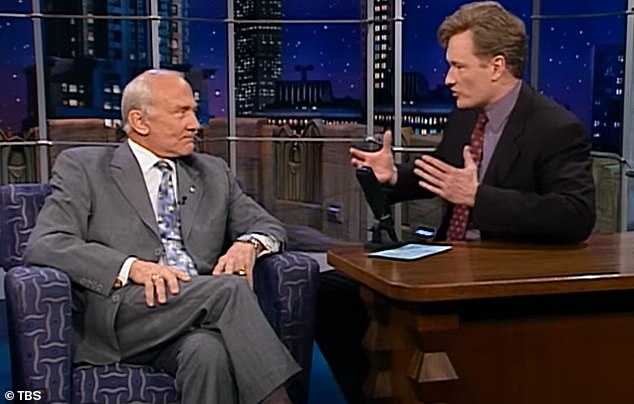
Aldrin, who was the second person to walk on the lunar surface after Neil Armstrong, has spent decades discussing the Apollo 11 mission. However, two recent interviews have reignited skepticism among those who doubt the moon landing ever happened. In one of these interviews, aired on the Conan O’Brien Show in 2000, Aldrin made a surprising comment that has since been widely interpreted as an admission of fakery.
During the interview, O’Brien recalled watching the moon landing as a child and asked if he had seen it. Aldrin responded sharply, saying, “No, you didn’t. There wasn’t any television, there wasn’t anyone taking a picture. You watched an animation.” This exchange left O’Brien stunned and has since gained millions of views online, fueling speculation about the legitimacy of the mission.
Another clip from 2015 features a young girl asking Aldrin why no one has returned to the moon. His response, “Because we didn’t go there, and that’s the way it happened,” has been taken out of context by some conspiracy theorists. The clip, which was widely shared on social media, cuts off before Aldrin clarifies his statement. He later explained that the reason no further missions have occurred is due to funding and shifting government priorities, not because the original mission was staged.
Despite these claims, NASA has consistently maintained that the Apollo 11 mission was real. The agency points to various forms of evidence, including telemetry data, moon rock samples, and the testimonies of thousands of engineers and scientists involved in the project. The Apollo 11 mission launched on July 16, 1969, from Kennedy Space Center in Florida, with Commander Neil Armstrong, Lunar Module Pilot Buzz Aldrin, and Command Module Pilot Michael Collins aboard.
On July 20, 1969, Armstrong and Aldrin landed on the moon in the Eagle module, while Collins remained in orbit. Armstrong became the first human to step onto the lunar surface, delivering his famous line: “That’s one small step for man, one giant leap for mankind.” The event was broadcast globally and viewed by an estimated 600 million people, though skeptics have long questioned the authenticity of what was shown.
The doubts surrounding the moon landing began to gain traction in the mid-1970s, fueled by public mistrust following events like Watergate and the Pentagon Papers. Over the years, conspiracy theories have persisted, citing inconsistencies in lighting, suspicious interviews, and alleged staged sets. However, NASA has repeatedly refuted these claims, emphasizing the overwhelming evidence supporting the mission’s reality.
Aldrin’s recent comments have once again brought attention to these theories, even though he was referring to animations used by broadcasters during the original moon landing coverage. In the Conan O’Brien interview, he was discussing how the footage was intercut with real footage, not claiming the entire mission was fake.
The 2015 clip, where Aldrin explains the reasons behind the lack of subsequent lunar missions, highlights the challenges of maintaining long-term space exploration. He emphasized the importance of resources and funding, stating that new missions require new equipment and support.
While the conspiracy theories surrounding the moon landing continue to circulate, they remain largely unsupported by credible evidence. The Apollo 11 mission stands as a testament to human ingenuity and technological achievement, and its legacy continues to inspire future generations of scientists, engineers, and explorers.