


The Decline and Revival of Ghana’s Sugar Industry
Sugarcane production in Ghana began in the 1960s, following the country’s independence in 1957. Asutsuare and Komenda in Cape Coast were among the early regions known for sugarcane farming, with the Volta and Eastern Regions later joining the industry. During this time, sugar factories in Komenda and Asutsuare were established to support industrialization and meet domestic demand.
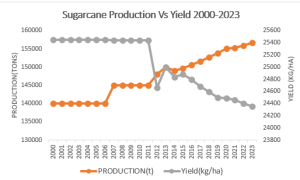
Ghana reached its peak sugarcane production in 1977, producing 270,000 tonnes, which significantly reduced the need for sugar imports. However, from the 1980s onwards, the sector experienced a sharp decline, with production levels continuing to fall even further after 2011 due to consistently low yields.
In 2016, the government undertook efforts to revive the industry by rebuilding the Komenda Sugar Factory with a $35 million loan from the EXIM Bank of India. This initiative aimed to boost local sugar production and reduce the massive import bill. Unfortunately, the factory struggled to operate effectively, as it could only source about 7% of the required sugarcane due to feedstock shortages. Smallholder farmers also faced challenges, as the price offered—GHS 60 per tonne (roughly USD 10)—was considered unprofitable, making it difficult for them to sustain their operations.
The situation echoed past failures in the 1980s when high production costs, water shortages, and energy issues led to the collapse of both the Komenda and Asutsuare sugar factories, despite their earlier success in 1977.
Government Efforts and Recent Developments
In August 2024, the government, led by then Trade Minister Hon. K.T. Hammond, announced that the Komenda Sugar Factory would be leased to West African Agro Limited, an Indian firm, for 15–20 years as a last-ditch effort to revitalize the facility. This move initially sparked hope among farmers and stakeholders.
By March 2025, the Minister for Trade, Agribusiness, and Industry, Hon. Elizabeth Ofosu-Adjare, emphasized the importance of revitalizing the Komenda Sugar Factory as part of the government’s Industrialisation Agenda during a visit. Despite these assurances, by May 2025, frustration grew among farmers who felt that no tangible progress had been made.
The Sugarcane Farmers Association of Ghana issued a public statement, expressing disappointment over the lack of action two months after the minister’s visit. They noted that the factory was not included in the 2025 national budget and felt deceived by political promises. The association demanded immediate steps, including the appointment of a new board with farmer representatives, to get the factory operational again.
The Half-Billion-Dollar Sugar Import Challenge
Ghana currently spends approximately $500 million annually on imported sugar, a significant outflow of foreign exchange for a commodity that could be produced domestically. The government has acknowledged this issue and aims to reduce reliance on imports while boosting local production.
In early 2025, Trade Minister Hon. Elizabeth Ofosu-Adjare reaffirmed plans to “reduce the importation of sugar and enhance local production” through the revitalization of the Komenda Sugar Factory. This initiative is part of a broader economic vision that includes integrating the factory into a 24-Hour Economy policy and supplying it with raw materials through a “Feed The Industry” project.
Under this plan, government funding and support would help local farmers scale up sugarcane cultivation as dedicated suppliers to the factory. If successful, this could create around 7,500 jobs in the region and significantly cut down on sugar imports. However, translating intentions into results remains a challenge, as the Komenda saga has shown a pattern of ambitious announcements followed by limited action on the ground.
Challenges Faced by Smallholder Sugarcane Farmers
While policymakers debate strategies, smallholder sugarcane farmers face the reality of the industry’s dysfunction. They encounter multiple obstacles that have kept local sugar production at a trickle:
- Unfair Pricing and Market Uncertainty: Farmers have repeatedly faced broken promises, such as in 2022 when Komenda’s factory management failed to honor purchase agreements, leaving cane unharvested and farmers uncompensated.
- Information Asymmetry: There is a persistent gap in information and coordination along the value chain, leaving farmers unable to plan their production effectively.
- Climate and Agronomic Risks: Sugarcane is a water-intensive crop, yet most Ghanaian smallholders rely on rain-fed cultivation, making them vulnerable to climate variability.
- Weak Institutional Support: Smallholder farmers lack institutional backing, including access to extension services, formal training, and credit facilities.
Lessons from Africa’s Sugar Producers
Successful integration of smallholder farmers into Africa’s sugar value chain is increasingly seen as a foundation for industrial transformation and rural empowerment. Countries like Egypt, South Africa, Eswatini, and Mauritius have implemented effective strategies that offer valuable lessons for Ghana.
Egypt, for example, has shown what is possible when smallholders are equipped with the right tools and support. State-backed extension services and public-private partnerships have improved access to seeds, fertilizers, and reliable markets. South Africa has built one of the continent’s most sophisticated sugar systems, anchored by a cane pricing structure that rewards quality and stability. Eswatini and Mauritius have also achieved success through modernization efforts and cooperative frameworks.
Ghana’s sugarcane yields have remained persistently low, hovering just above 20,000 kg/ha from 2000 to 2023, while peer countries achieve yields two to five times higher. This yield gap highlights the urgent need for targeted policy interventions and adoption of best practices to unlock Ghana’s potential.
A Vision for Sustainable Sugar Production
A model known as the Sugarcane Food Forest Programme offers a practical, scalable approach to transforming smallholder farming into a resilient, high-yield, and market-driven system. This model elevates smallholder sugarcane farmers from mere suppliers to strategic partners, central to the long-term sustainability and competitiveness of the entire sugar sector.
Robust collaboration among the government, private sector, civil society, and farming communities is essential for realizing this vision. Strategic investments in climate-smart irrigation, digital agricultural innovation, and inclusive market systems are vital for unlocking productivity, profitability, and resilience across the sugar value chain.
By drawing on proven strategies and fostering meaningful transformation, Ghana can accelerate its journey towards sustainable sugar production and rural prosperity, ultimately reducing its reliance on costly sugar imports.