


A Vision for a Pluralistic Palestinian State
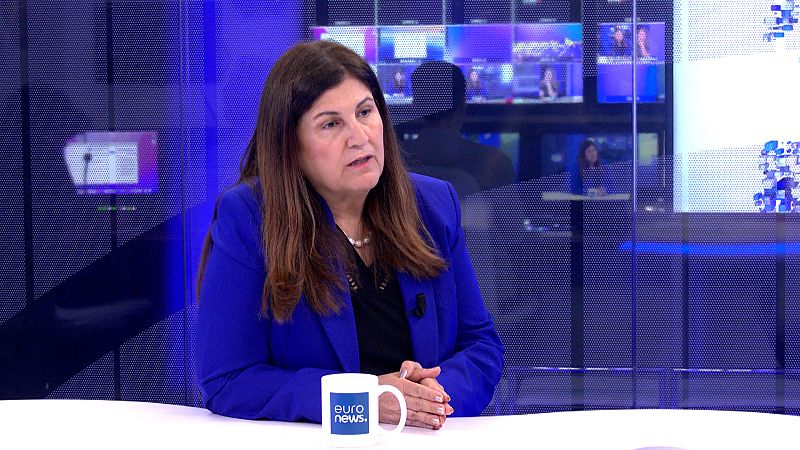
The possibility of a Palestinian state emerging is being discussed with a focus on its potential characteristics. According to the Palestinian foreign minister, if such a state were to come into existence, it would be a pluralistic society that values women’s roles and adheres to international law, including the security of Israel. This vision was shared in an exclusive interview with Euronews.
“I’m a woman, and I’m Minister of Foreign Affairs, and I am Christian, and from Armenian origins,” said Varsen Aghabekian-Shaheen. “It would be a pluralistic society. There will be a place for women.”
She emphasized that the future state would respect “international law” and any agreements signed by Palestine with its neighbors. However, she also criticized the EU for its inaction regarding the ongoing conflict in Gaza and the violence in the West Bank, calling it “shocking and disappointing.”
Aghabekian-Shaheen described the situation as dire, stating, “We see children brutally murdered while in tents while awaiting medical care from another tent.” The war in Gaza began in response to the Hamas terror attack on October 7th, which has led to widespread devastation and loss of life.
Despite the challenges, Aghabekian-Shaheen believes there is still hope for a contiguous Palestinian state, with the Palestinian Authority (PA) in control of both Gaza and the West Bank. She acknowledged the long-standing issue of corruption within the PA and the Palestinian Liberation Authority (PLA), which is the legally recognized representative of the Palestinian people. Efforts are underway to root out this corruption.
“There is also the question of credibility and influence,” she noted. While some Palestinians support Hamas, demonstrations against the group continue, and confidence in the performance of the PA is declining, according to the Palestinian Policy and Survey research centre.
Aghabekian-Shaheen stated, “Corruption is everywhere. And remember, we are under occupation, and occupation corrupts.” She added, “Funding from outside corrupts, not being able to direct your organizations the way you want corrupts.” However, she emphasized that these are not excuses but rather part of a broader reform and development agenda aimed at curbing corruption and ensuring transparency.
The realization of a Palestinian state remains a distant possibility given the ongoing violence and humanitarian crisis in Gaza, as well as sustained violence against and expulsion of Palestinians in the West Bank. Additionally, the U.S. ambassador to Israel, Mike Huckabee, has indicated that his country no longer supports the internationally agreed-upon two-state solution. He believes Israel is entitled to formally occupy the lands in the West Bank due to historical and biblical links.
Huckabee suggested that any potential Palestinian state could be forged from an existing Muslim country rather than the territories designated by several UN resolutions for a future Palestinian state—namely, the West Bank, Gaza, and East Jerusalem. However, neighboring Arab countries have expressed their stance, indicating they would not take in millions of Palestinians and continue to advocate for a two-state solution.
Jordan, Lebanon, and to a lesser extent, Egypt and Syria, are already home to large populations of Palestinian refugees from the 1948 and 1967 wars with Israel. Aghabekian-Shaheen reiterated her belief in the two-state solution, stating, “We keep the hope alive because we are two-staters and we believe that that two-state solution is the only viable solution.”
She also highlighted the importance of Arab countries like Saudi Arabia in pushing for a Palestinian state. Aghabekian-Shaheen believes that Saudi Arabia and other Arab countries will pause plans to normalize relations with Israel unless the Jewish State negotiates a state for Palestinians.
Saudi Arabia was close to formally normalizing relations with Israel days before the Hamas terrorist attack on October 7th. In a meeting with Israeli Prime Minister Benjamin Netanyahu, former U.S. President Donald Trump mentioned his intention to create the “Riviera” of the Middle East, leading to swift responses from Arab states on the issue of Palestinian displacement.
In July, Saudi Arabia and France will co-chair an international conference on a two-state solution in New York at the ministerial level, highlighting the continued global interest in finding a peaceful resolution to the conflict.