


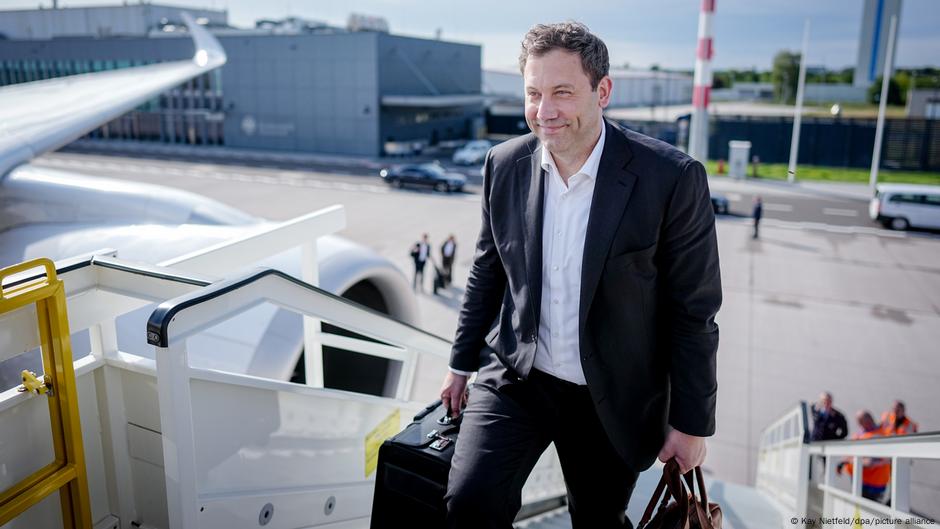
German Vice-Chancellor Calls for Closer Ties with the Global South
German Vice-Chancellor Lars Klingbeil has emphasized the importance of strengthening relationships with the Global South as he prepares to attend a G20 meeting in South Africa. This call comes amid growing concerns about Germany’s role in international trade and global cooperation, particularly in light of increasing influence from countries like Russia and China.
Klingbeil, who is also the leader of the Social Democratic Party (SPD), highlighted the need for Berlin to focus on developing new partnerships and reinforcing existing ones. He pointed out that many nations in the Global South have a strong interest in stable trade relations and adherence to international law. However, he noted that Germany has been neglecting these relationships for too long, allowing other powers to fill the void.
To address this, Klingbeil proposed involving more African countries in the “Compact with Africa” initiative, which was launched during Germany’s G20 presidency in 2017. He also called for increased private investment in African states, emphasizing the need for concrete offers and mutual respect in building these partnerships.
During his visit to Durban, Klingbeil plans to tour South Africa’s largest harbor and meet with German businesses operating in the country. South Africa currently holds the G20’s rotating presidency and will host the G20 summit in Johannesburg in November.
Far-Right Gains in New Polls
In a recent YouGov poll, Germany’s far-right Alternative for Germany (AfD) has made significant gains, narrowing the gap with the conservative CDU/CSU bloc. The AfD now stands at 25% support, while the CDU and its Bavarian sister party, the CSU, dropped slightly to 27%. If an election were held today, the centre-left Social Democrats (SPD) would remain at 14%, while the environmentalist Greens fell to 11%.
The survey, conducted between July 11 and 14, included 1,820 eligible voters. It was carried out shortly after a Bundestag vote to appoint constitutional court judges collapsed due to a coalition rift between the CDU/CSU and SPD. While it is unclear whether this event influenced the results, political analysts suggest that such events often take time to reflect in public opinion.
Germany Moves to Boost Pandemic Readiness
Germany is taking steps to enhance its pandemic response by incorporating updated World Health Organization (WHO) rules into national law. The Cabinet approved draft legislation that will implement recent changes to the WHO’s International Health Regulations. These rules aim to improve information-sharing during outbreaks and strengthen laboratory and healthcare capacities globally.
Health Minister Nina Warken stated that the coronavirus pandemic has shown the importance of being better prepared for health crises. The new measures require countries to report potential international health emergencies to the WHO and maintain core capacities such as lab diagnostics and risk communication. The law will not limit Germany’s sovereignty or its ability to impose domestic protective measures.
Environmental Group Launches Citizen-Action Project on Air Pollution
Environmental Action Germany (DUH) has launched a citizen-action project to identify areas where nitrogen dioxide (NO2) could be present in dangerous amounts. The project allows all German residents to submit suggestions for where air quality measurements should be taken. Participants will receive small plastic tubes to place at selected sites, with results evaluated in a laboratory in October.
Nitrogen dioxide, primarily emitted by diesel vehicles, can cause eye irritation and damage to mucous membranes in the respiratory tract. High concentrations are linked to bronchitis, pulmonary edema, and cardiovascular disease. DUH estimates that 28,000 people die annually from illnesses related to high exposure to NO2.
More People in Germany Living Alone
New data from Germany’s federal statistics office, Destatis, shows that 17 million people — or 20.6% of the population — now live alone in their own homes. This represents an increase from 17.1% (14 million people) two decades ago. Older individuals are most likely to live alone, with 34% of those over 65 living solo. Among those aged 85 and older, the share jumps to 56%.
Young adults between 25 and 34 also stand out, with 28% living alone — well above average. Women are slightly more likely than men to live alone (21.2% versus 20%). Compared to the EU average of 16.2%, Germany’s share of solo households is high, with only Lithuania, Finland, Denmark, Estonia, and Sweden having higher rates.
Living alone can come with challenges, including loneliness. One in four people living alone reports feeling lonely frequently, compared to 16.3% of the general population. Additionally, people living alone are more at risk of poverty, with 29% considered at risk in 2023 — nearly twice the rate for the total population.
Women’s Share on German Company Boards Slips Slightly
A new study by Women in Supervisory Boards (Fidar) shows a slight decline in the proportion of women on supervisory boards at German-listed companies. Women held 37% of seats at 179 listed firms, down from 37.3% last year. A quarter of companies had an equal number of men and women on their boards.
At the executive level, the situation improved slightly, with women holding 19.9% of management board positions — up from 19.3% a year earlier. Germany introduced a binding 30% quota for women on supervisory boards in 2016, and large listed firms must now have at least one woman and one man on their boards.
China Drops Sanctions on German Lawmaker Ahead of EU Summit
China has lifted its sanctions against German Green Party politician Reinhard Bütikofer, following a decision by EU officials. The move is seen as part of Beijing’s efforts to reengage with the European Parliament ahead of an upcoming EU-China summit in Beijing.
Bütikofer, who previously chaired the parliament’s China delegation, criticized China’s approach as “arbitrary” and lacking political coherence. He noted that other EU targets, including Berlin’s Mercator Institute for China Studies, remain blacklisted. The sanctions, imposed in 2021, barred Bütikofer and others from entering China or conducting business there.
German States Push for Fairer Summer Break Rotation
Calls for reforming Germany’s summer holiday timetable are gaining momentum, with several states pushing for an end to what they see as an unfair advantage for Bavaria and Baden-Württemberg. These two southern states always start their school breaks last, thanks to traditional Catholic Pentecost holidays.
While most German states rotate their summer holiday slots each year to ease travel chaos and spread demand for holiday accommodation, Bavaria and Baden-Württemberg maintain their late break. Critics argue that families in other states face peak prices and packed roads, while parents in the south can avoid the rush by taking advantage of the early summer Pentecost period.
Bavaria’s Premier Markus Söder dismissed calls for change, stating that the holiday rhythm is part of Bavaria’s DNA. Baden-Württemberg also shows no sign of budging, despite occasional complaints about the weather during its late break.