


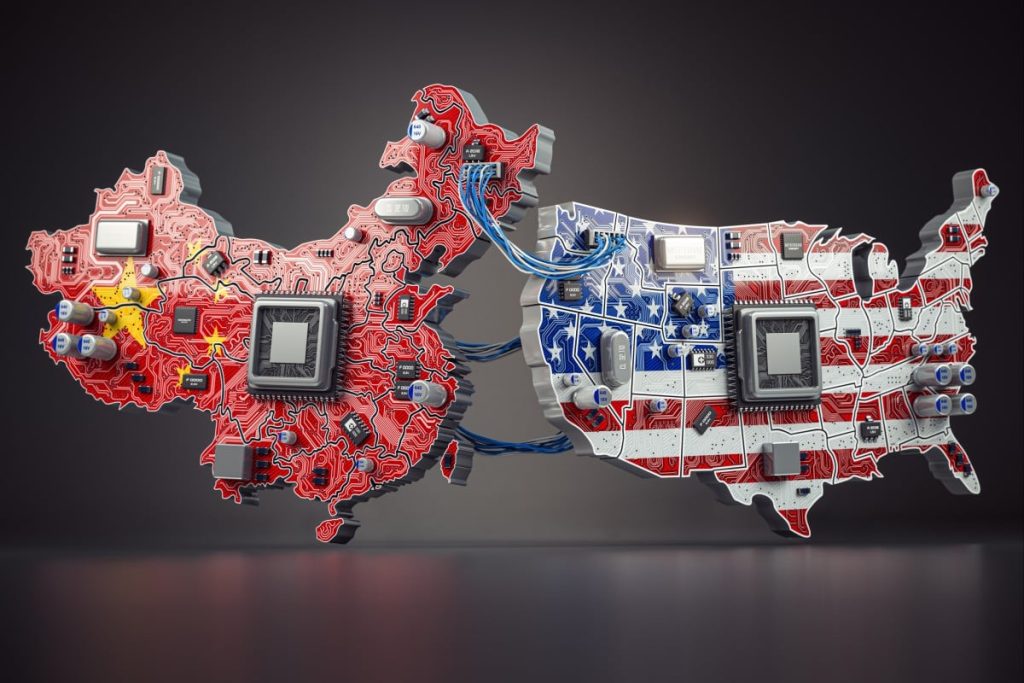
A Shift in US-China Trade Dynamics
The recent decision by the United States to ease export restrictions on certain advanced chips has sparked interest among experts, who view it as a promising sign that high-level negotiations between the two countries are steering their bilateral relations in a more constructive direction. This move is part of a broader set of trade agreements with China and marks a significant development in the ongoing dialogue between Washington and Beijing.
The resumption of license application reviews for Nvidia’s H20 AI and Advanced Micro Devices’s MI308 AI chips comes ahead of upcoming talks between senior officials from both nations. Despite the long-standing strategic stand-off over technology and export controls, this development signals a potential thaw in relations.
Zhuang Bo, a global macro strategist at Loomis Sayles Investment Asia, highlighted that this move is a clear win for China. He described it as effectively resetting the clock to March, before rare earths became a geopolitical chokepoint. According to Zhuang, this development indicates that Beijing is inching closer to the G2-style negotiations it has long sought, framed in official rhetoric as a call for “mutual respect and equality.”
While the reality on the ground has not changed much, the situation has not deteriorated, he added. The possibility of a Xi-Trump summit later this year could be crucial, as it might lead to a partial agreement.
Resumption of Chip Exports
On Tuesday, AMD announced that the US Department of Commerce was reviewing its license applications to export MI308 chips to China, with sales expected to resume once approved. Similarly, Nvidia hopes to resume deliveries of its made-for-China H20 GPUs soon. In a statement, the company said the US government has assured them that licenses will be granted.
In an interview with Bloomberg, US Secretary of the Treasury Scott Bessent described the move as “part of a mosaic” of trade agreements that emerged from separate rounds of high-level talks in Geneva and London. He referred to it as a “negotiating chip,” emphasizing that both sides had things they wanted.
Exports of rare earths have become a flashpoint in the intensifying US-China trade rivalry in recent months. Beijing tightened controls on shipments in April, seen as a countermeasure to US restrictions on advanced semiconductor exports and rising tariffs. Bessent confirmed that China had resumed rare earth magnet exports to the US, although volumes have not yet returned to pre-April levels. He also noted that Nvidia’s H20 chips could be exported if Chinese manufacturers were producing equivalent chips.
Strategic Implications
US Commerce Secretary Howard Lutnick linked the resumption of chip sales to the rare earth deal. He stated that Nvidia’s H20 chips are “not our second-best stuff, not even our third-best” but only the fourth. His reasoning was that selling enough American technology to Chinese developers would make them “addicted” to the American technology stack.
Bessent emphasized the need to shift focus to China “opening its markets” and increasing “domestic and consumer production there.” He warned against the emergence of a digital Belt and Road initiative, where other countries or China might substitute for American chip manufacturers. He expects to meet China’s vice-premier in a third country in the coming weeks.
Cui Fan, a professor of international trade at the University of International Business and Economics, noted that easing H20 export controls is a positive step for both China and the US. He pointed out that the US has long followed a policy of marginal control, relaxing restrictions when China develops similar technologies to squeeze the market share of Chinese competitors.
Despite rapid advancements in China’s domestic AI chips, Cui highlighted that domestic production still struggles to meet demand, particularly in terms of capacity and general-purpose performance. He believes the relaxation of H20 controls provides more room for coordination between domestic and international resources, fostering greater synergy across the supply chain.
Broader Economic Considerations
Morgan Stanley’s report suggested that the H20 decision, along with media reports about Donald Trump considering a visit to China, could indicate a more positive direction in bilateral relations. However, the investment bank cautioned that macroeconomic weaknesses in China persist, including deflationary pressures and a housing slump. Further clarity is needed from upcoming Politburo meetings and economic data releases.
This development underscores the complex interplay of trade, technology, and geopolitics between the US and China. As both nations navigate these challenges, the path forward remains uncertain, but the recent steps signal a potential shift toward cooperation.