


The Growing Crisis of Renewable Energy in South Korea
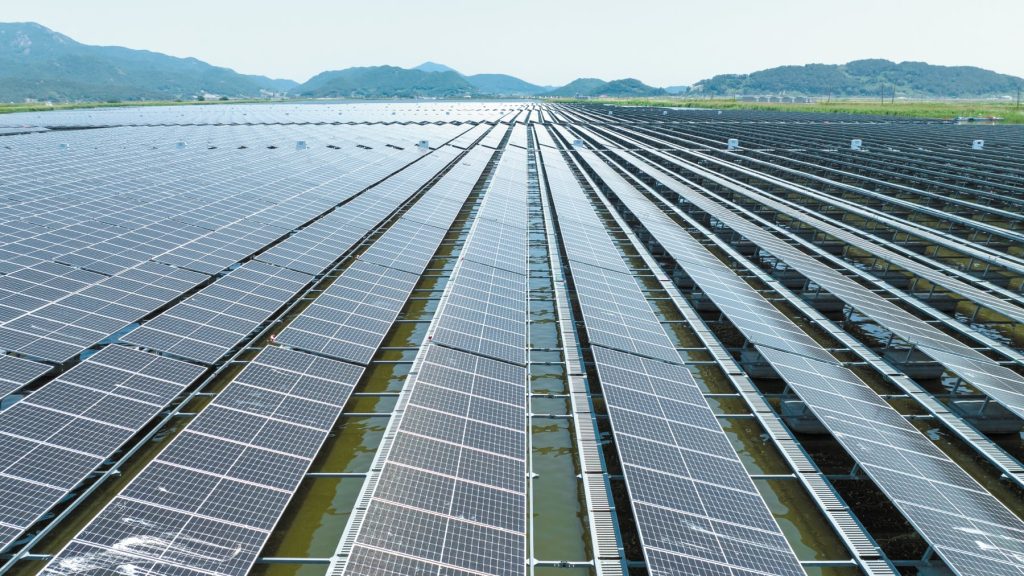
A solar farm in South Jeolla Province is nearing completion, but its future remains uncertain. The facility faces a critical challenge: the local power grid lacks the capacity to handle its output. As a result, it risks becoming obsolete almost immediately after being operational. This issue is not isolated; similar problems plague other renewable energy projects across the country. Transmission bottlenecks have effectively blocked many facilities from connecting to the grid, leaving them idle and unused.
In another part of the country, a solar power system installed years ago near a livestock farm now sits abandoned. Local residents opposed the construction of transmission lines, which prevented the facility from being connected to the grid. The solar panels remain in overgrown fields, generating no electricity. This situation highlights a growing problem in South Korea’s renewable energy sector: the mismatch between the rapid expansion of renewable projects and the slow development of the power grid.
A Policy Shift with Unintended Consequences
The push for renewable energy in South Korea began under the administration of then-President Park Geun-hye in October 2016. At that time, the Ministry of Trade, Industry and Energy announced plans to guarantee grid access for small-scale renewable energy producers with a capacity of 1 megawatt or less. The policy aimed to ensure that Korea Electric Power Corp. (KEPCO) would provide grid access to struggling small-scale producers. However, it was the Moon Jae-in administration that aggressively pushed the initiative forward, especially as it pursued a nuclear phase-out policy.
As the government rolled out large-scale incentives to promote renewables as a substitute for nuclear power, small operators rushed to apply for grid connections. An official at a solar power plant in the Honam region, which includes South Jeolla and North Jeolla Provinces, recalled that officials from the power authorities assured them not to worry and to proceed with investments, promising that transformers would be installed near the site within a few years.
The Honam Region’s Renewable Boom
The Honam region experienced one of the most significant booms in renewable energy investment. With abundant sunlight, sprawling plains, strong coastal winds, and relatively low land prices, the area was seen as an ideal location for solar and wind power facilities. According to the Korea Energy Agency (KEA), the installation cost per megawatt stands at 1.3 billion won ($940,000) for solar power, 2.9 billion won ($2.1 million) for onshore wind, and 6 billion won ($4.3 million) for offshore wind.
However, the inherent volatility of solar and wind energy—dependent on weather conditions—makes a robust power grid essential for stabilizing supply and delivering electricity where it’s needed. According to the Institute for Energy Economics and Financial Analysis (IEEFA), while South Korea’s installed renewable energy capacity increased sixfold between 2013 and 2023, actual power generation only tripled. Over the same period, transmission and distribution networks expanded by just 14% and 22%, respectively. This means that while renewable installations surged, grid development lagged far behind.
The Grid Connection Backlog
This imbalance has led to a significant grid connection backlog. In the Honam region alone, there is a backlog of 4.2 gigawatts—equivalent to the output of four nuclear reactors. Nationwide, the total amount of renewable power waiting to be connected has reached a record-high 8.9 gigawatts.
Energy experts warn that President Lee Jae-myung’s core energy pledges could further strain the already bottlenecked grid system. During his campaign, Lee laid out sweeping renewable energy initiatives, including the creation of dedicated RE100 industrial zones, expanding rooftop solar programs, scaling up the so-called “sunlight pension,” and establishing a U-shaped renewable energy belt. Last month, presidential policy chief Kim Yong-beom unveiled the initial blueprint for the RE100 zones. The new administration has also announced plans to fast-track the expansion of the sunlight pension program.
A Looming Challenge
These pledges all point to a sharp increase in renewable power generation. Meanwhile, the government has yet to present a concrete plan to accommodate the additional supply—either through expanding the power grid or by addressing public opposition to transmission infrastructure in affected regions.
Cho Sang-min, a professor at the Graduate School of Energy Convergence at Korea Polytechnic University, said, “If more renewable energy plants are built without corresponding grid expansion, the backlog of unconnected electricity will skyrocket. We’ll see more frequent reductions in nuclear output and forced curtailment of existing power plants.” This warning underscores the urgent need for a comprehensive strategy to address the growing gap between renewable energy production and grid capacity.