


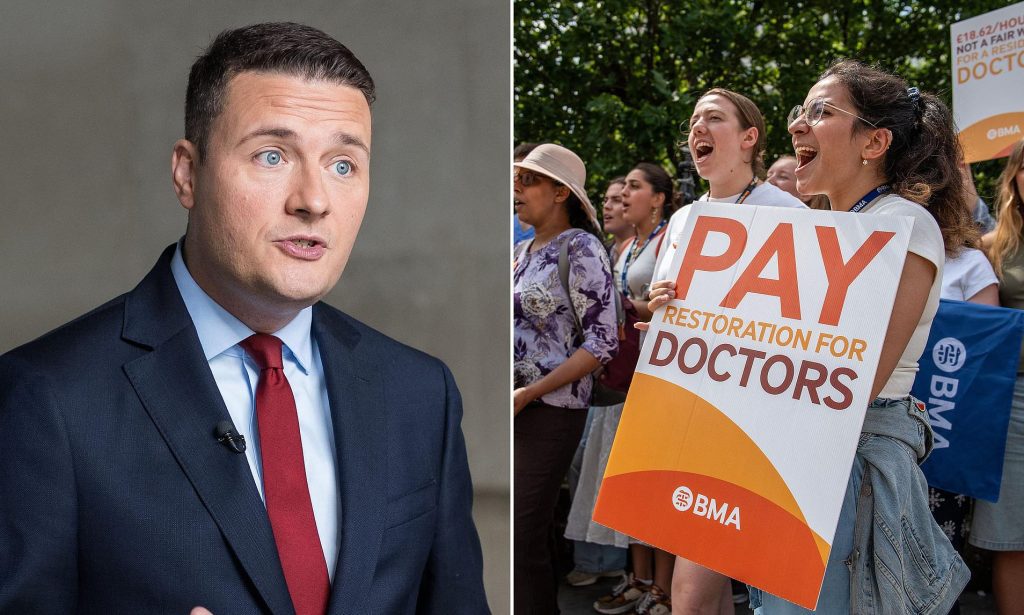
Health Secretary Faces Backlash Over Restrictions on Physician Associates
Wes Streeting, the UK’s Health Secretary, is facing a new challenge from a medical union as he continues to resist demands from militant doctors who are striking over pay. The controversy centers around his decision to limit the role of physician associates (PAs) within the NHS, a move that has sparked significant criticism and legal threats.
The Health Secretary’s decision to reduce the use of PAs in the NHS came after an independent review recommended a significant narrowing of their responsibilities. PAs, who undergo less extensive training than doctors, were previously allowed to see patients who had not yet been diagnosed. However, this practice has now been banned by Mr. Streeting and NHS England. The move has raised concerns among MPs, who warn that it could exacerbate existing pressures on the healthcare system.
MPs have expressed worries that the combination of the PA restrictions and a five-day strike by doctors will leave patients at greater risk and make it more difficult to address the backlog of appointments. They argue that thousands of patients may miss critical care due to these changes.
In response, the United Medical Associate Professionals (UMAPs), the union representing PAs, has sent letters before action to Mr. Streeting and NHS England. These legal warnings suggest that the government’s decision could lead to a judicial review.
Conservative MP Sir Ashley Fox criticized the government’s approach, stating that the strikes might put patients at greater risk now that PAs and anaesthetist associates (AAs) have been effectively sidelined. He accused the government of lacking a long-term strategy and instead giving in to the demands of the British Medical Association (BMA) without any conditions.
Mr. Streeting commissioned a review into how PAs are used within the NHS, amid concerns that they were substituting for doctors inappropriately. The review, led by Professor Gillian Leng of the Royal Society of Medicine, acknowledged that PAs have filled gaps in doctors’ schedules but called for major changes in their roles and supervision. It recommended that PAs should not see undifferentiated or untriaged patients—those who have not yet been assessed by a doctor.
Stephen Nash, general secretary of UMAPs, described the decision to scale back PAs’ roles as “totally unjustified” and warned that it would make it harder for patients to access NHS appointments. He argued that the Leng Review found no evidence that PAs are unsafe or ineffective and that the government’s actions amount to unfair dismissal of over 3,500 highly trained professionals.
The pre-action letters sent by UMAPs claim that the government’s decision undermines the profession of PAs and AAs, increases the likelihood of redundancies, and changes employment terms without proper consultation. Former health minister Lord Hunt emphasized that PAs are “highly trained, safe, and effective” and that they should not be sidelined when the NHS needs more support than ever.
A spokesperson for the Department of Health and Social Care stated that the review was launched to ensure patients receive the highest quality care and maintain confidence in the health system. They also noted that Mr. Streeting has agreed to implement all recommendations from the Leng Review.
Meanwhile, resident doctors, previously known as junior doctors, continue their strike, which began on Friday. Mr. Streeting has accused the BMA of using “hardline tactics” that “punish patients for no good reason.”
Calls for Better Recovery of Funds from Foreign Patients
In another development, senior MPs have urged the government to do more to recover millions of pounds owed to the NHS by foreign patients. A recent investigation revealed that hospitals wrote off £256 million in unpaid bills from health tourists over seven years.
Geoffrey Clifton-Brown, chairman of the Public Accounts Committee, has called for clarity on what measures are being taken to ensure that care provided to foreign patients is properly charged and collected. He also demanded an update on progress made since the government pledged in 2017 to recover £500 million annually from overseas patients.
Data from April showed that only a third of £621 million owed had been paid, with £44 million written off in the past year. With the number of foreigners seeking planned treatment on the NHS doubling, Sir Geoffrey stressed that the importance of recovering this money has never been greater.