


Rising Living Costs in Tokyo Highlight Challenges for Young Workers
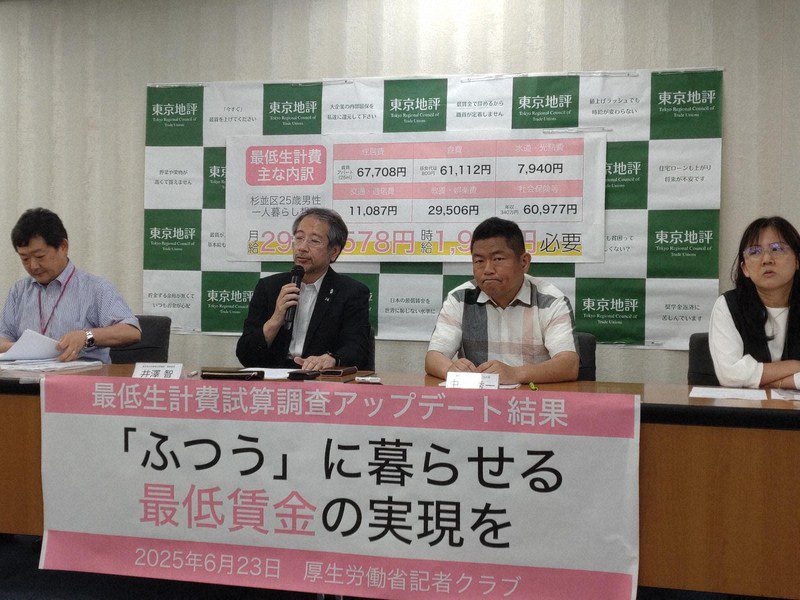
A recent study by the Tokyo Regional Council of Trade Unions has revealed that a single 25-year-old living in Tokyo’s Setagaya Ward requires nearly 300,000 yen per month to maintain a modest but ordinary lifestyle. This figure represents a significant increase compared to previous years and far exceeds the minimum wage set for 2025 in the city.
According to the research, a man would need 296,560 yen monthly, while a woman would require 287,089 yen. These figures include taxes and cover essential expenses such as food, housing, and personal care. To meet these costs, a man would need to earn at least 1,706 yen per hour, and a woman 1,652 yen per hour, assuming 173.8 working hours per month. In comparison, Tokyo’s minimum wage for 2025 is set at 1,163 yen per hour, highlighting a stark gap between income and living expenses.
The study was led by associate professor Shuichi Nakazawa from the University of Shizuoka Junior College and updated a 2019 survey on workers’ living conditions. The new data reflects changes in prices, the economic impact of the COVID-19 pandemic, and evolving lifestyle trends. Researchers conducted surveys with 191 workers and gathered insights from individuals in their 20s and 30s.
Key Changes in Monthly Expenses
One of the most notable increases was seen in food expenses. Men spent 61,112 yen monthly, up 16,751 yen from 2019, while women spent 48,019 yen, an increase of 12,161 yen. The daily cost to meet 90% of required calories, including discretionary items, rose to 1,502 yen for men and 1,188 yen for women.
Lifestyle changes also influenced spending patterns. With more people working remotely and relying on digital services, expenses on internet subscriptions and entertainment have grown. For instance, culture and entertainment costs—covering music and video streaming subscriptions (2,000 yen) and day trips (increased from 3,333 yen to 8,000 yen)—rose to 29,506 yen for men and 29,546 yen for women, about 4,000 yen higher than in 2019.
Personal care expenses also saw a shift, with men increasing their spending by around 500 yen to account for growing use of cosmetics, which were previously associated mainly with women. Wedding attendance costs dropped significantly, with men now budgeting 25,000 yen and women 35,000 yen annually. Year-end party expenses fell from 1,250 yen to 1,000 yen per month for both genders, while annual gift-giving expenses increased from 45,000 yen to 50,000 yen.
Housing costs were based on a 25-square-meter private rental in Setagaya Ward, a popular area among young people. The lowest available rent was 68,750 yen per month, up 3,125 yen from 2019, including prorated renewal fees.
Broader Implications and Calls for Change
Overall, the minimum monthly living cost—including taxes—increased by 37,089 yen for men and 30,898 yen for women compared to 2019. Associate professor Nakazawa emphasized that this is not a luxurious lifestyle but one that includes everyday activities like entertainment and social gatherings. He pointed out that the gap between the minimum wage and actual living costs is alarming, forcing many to work multiple jobs just to survive.
Nakazawa, who oversees minimum living cost studies across 27 prefectures, noted that while housing is expensive in major cities, high car maintenance costs in regional areas balance out overall living expenses. The rise of online shopping has further contributed to this trend. “If living costs are nearly the same across Japan, the minimum wage should be standardized nationwide and set at a level that allows for a normal life,” he said.
The full report can be accessed on the Tokyo Chihyo website.