


South Korea’s Shipbuilding Industry as a Strategic Asset in U.S. Trade Talks
South Korea’s shipbuilding industry is becoming a central element in the ongoing tariff negotiations between Seoul and Washington. The U.S. Secretary of Commerce, Howard Lutnick, has shown significant interest in South Korea’s proposed shipbuilding collaboration during recent discussions with Minister of Trade, Industry and Energy Kim Jung-kwan.
Shipbuilding has been a key priority for President Donald Trump’s agenda to revitalize American manufacturing and counter China’s growing maritime influence. Since the Biden administration took office, the U.S. has sought to strengthen shipbuilding partnerships with allies such as South Korea and Japan. In April, Trump reaffirmed this commitment by signing an executive order aimed at restoring American maritime dominance. The order outlines efforts to rebuild the domestic shipbuilding industry, expand alliance-based cooperation, and enhance naval power and supply chain resilience.
The South Korean government is reportedly preparing to elevate its bilateral relationship from basic technology cooperation to a full-fledged technology alliance. This initiative includes areas such as defense, energy, and semiconductors. With the U.S. engaged in strategic competition with China across critical sectors, Seoul is positioning itself as an essential partner.
During negotiations, South Korean trade officials have emphasized the country’s technological advantage over Japan in shipbuilding. They argue that South Korea offers Washington a more advanced and comprehensive industrial partnership. Japan recently finalized a deal with the U.S., focusing on the construction and modernization of U.S.-based shipyards under its $550 billion investment fund. Jang Sang-sik, head of the International Trade Research Institute at the Korea International Trade Association, noted that Japan, limited by its technical capacity, can only offer investment cooperation, whereas South Korea can become a full-spectrum technology partner in shipbuilding.
The South Korean government has gathered investment and cooperation proposals from leading domestic shipbuilders, including HD Hyundai and Hanwha Ocean. Industry sources indicate that equity investment in aging U.S. shipyards is one of the most frequently discussed options. The goal is to modernize outdated infrastructure and deploy skilled South Korean labor to improve productivity.
Part of the large-scale investment fund Washington is seeking—estimated at $400 billion—could be used to support the entry of South Korean small and mid-sized shipbuilding suppliers into the U.S. market and help establish a local shipbuilding ecosystem. Additional acquisitions or new shipyard construction by South Korean firms are also being considered. However, a representative from one Korean shipbuilder noted, “U.S. shipyards available for sale are rare, and with the Trump administration’s policies subject to change, there is reason to proceed cautiously.”
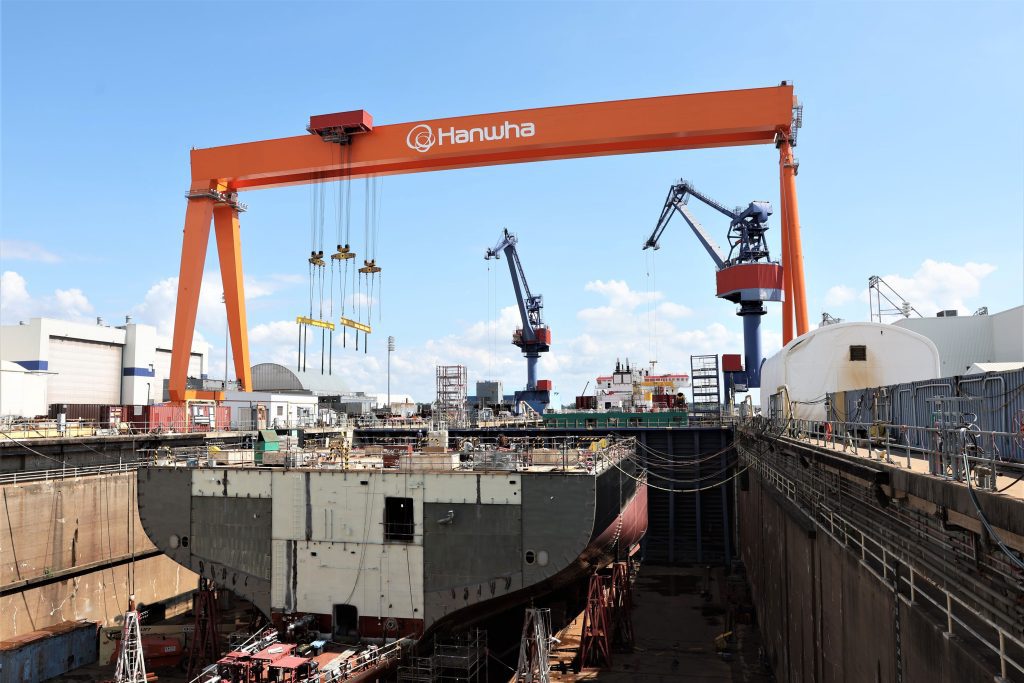
Joint shipbuilding projects involving South Korean and American shipyards are also being explored, covering both commercial and naval vessels. HD Hyundai is working with U.S.-based shipbuilding group Edison Chouest Offshore (ECO) on plans to jointly build medium-sized containerships at ECO’s domestic shipyard through 2028. Hanwha, which owns the Philadelphia Shipyard, has already launched joint construction of a liquefied natural gas (LNG) carrier, assigning the project to Hanwha Ocean’s Geoje yard in South Korea.
Although U.S. law officially restricts outsourcing the construction and maintenance of naval and commercial vessels to foreign entities, one workaround under discussion involves issuing “golden shares” to the U.S. government—granting it veto rights over key decisions. The model is similar to the approach used when Japan acquired U.S. Steel.
Another proposed framework involves modular production, as recommended in May by the Center for Strategic and International Studies (CSIS). Under this model, major components such as hull sections, propulsion systems, and navigation modules would be manufactured in South Korea and then shipped to the United States for final assembly. The approach is seen as a way to enhance production efficiency while alleviating the U.S. shipbuilding sector’s chronic shortages in infrastructure and skilled labor.