


U.S. Policymakers Press Allies to Take a Clear Stance in U.S.-China Rivalry
Recent developments in Washington signal a growing consensus among U.S. policymakers—spanning both Congress and the executive branch—that key allies, including South Korea, must adopt a more definitive position in the escalating competition between the United States and China. This shift reflects a broader movement within the U.S. political landscape, particularly among figures aligned with the Trump administration, who have become increasingly vocal in rejecting what they see as an unsustainable approach: maintaining security ties with the U.S. while simultaneously engaging economically with China.
This strategy, often referred to in South Korea as anmi-gyeongjung (security with the U.S., economy with China), has come under scrutiny from various U.S. officials. The sentiment is not just theoretical but is being actively promoted by influential members of Congress and the executive branch, who argue that such a dual approach undermines the strength of the U.S. alliance system.
A Strong Warning from a Key U.S. Official
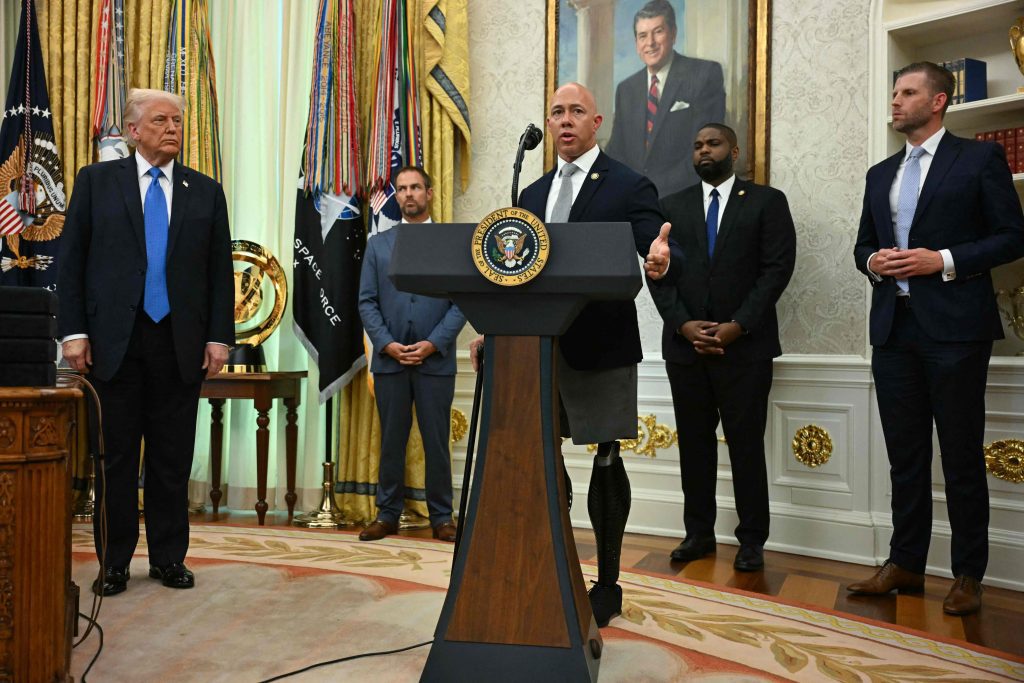
On July 24, Representative Brian Mast, the Chairman of the House Foreign Affairs Committee, delivered a pointed message during a virtual address to a conference hosted by the Gold Institute for International Strategy in Washington, D.C. Mast, a five-term Republican from Florida and an Afghanistan War veteran, criticized those in South Korea who attempt to maintain ties with both the U.S. and China. He stated, “Some in South Korea try to satisfy both the United States and China. But if you try to hold on to both sides, in the end, everyone gets hurt.”
His comments were made in response to a question from a South Korean participant about the future of the U.S.-ROK alliance, indicating that his remarks were not pre-scripted but rather a reflection of a broader sentiment within the U.S. security establishment. Mast emphasized that efforts to accommodate both Washington and Beijing would be seen as an insult by the U.S. and could ultimately weaken the alliance.
A Call for Strategic Responsibility
Mast’s influence over U.S. foreign policy is significant, given his committee’s authority over foreign affairs and aid appropriations. As a prominent figure in the Trump-aligned “Make America Great Again” (MAGA) movement, he has emerged as a strong advocate for a post-unipolar vision of American alliances—one that demands more explicit alignment from traditional partners.
He argued that the U.S. should be recognized as the only partner that offers values no other country can. “We should never be used,” he said. “If all allies do is tell us what they need from America, then we never arrive at a true partnership.” This statement was widely interpreted as a call for allies like South Korea to take greater strategic and financial responsibility in addressing challenges posed by China.
Mast also used a metaphor to illustrate his point: “When many people lift something heavy together, some will groan, but in truth, not everyone is making an effort. This is similar to the dynamics among states.” His implication was clear: some allies benefit from U.S. security guarantees without contributing proportionally, which he views as strategic free-riding.
Echoes of a Broader Movement
Mast’s remarks align with those of other MAGA-aligned figures. In a May speech, Pete Hegseth warned that “many countries are tempted to pursue economic cooperation with China and defense cooperation with the United States.” He added, “We will not allow our allies and partners in this critical region to become subordinated to China”—a message aimed at Indo-Pacific states that Washington believes are hedging between the two global powers.
Similarly, Steve Bannon, former White House chief strategist and an influential voice on the American right, told The Chosun Ilbo in June that “it is impossible for South Korea to balance between the U.S. and China” and urged Seoul to adopt a more decisive posture to “ensure China cannot exert influence.”
These statements reflect a broader trend in U.S. foreign policy, where traditional allies are being encouraged—or pressured—to take a clearer stance in the U.S.-China rivalry. The message is clear: the U.S. expects its allies to support it fully, not just when it suits their interests.