


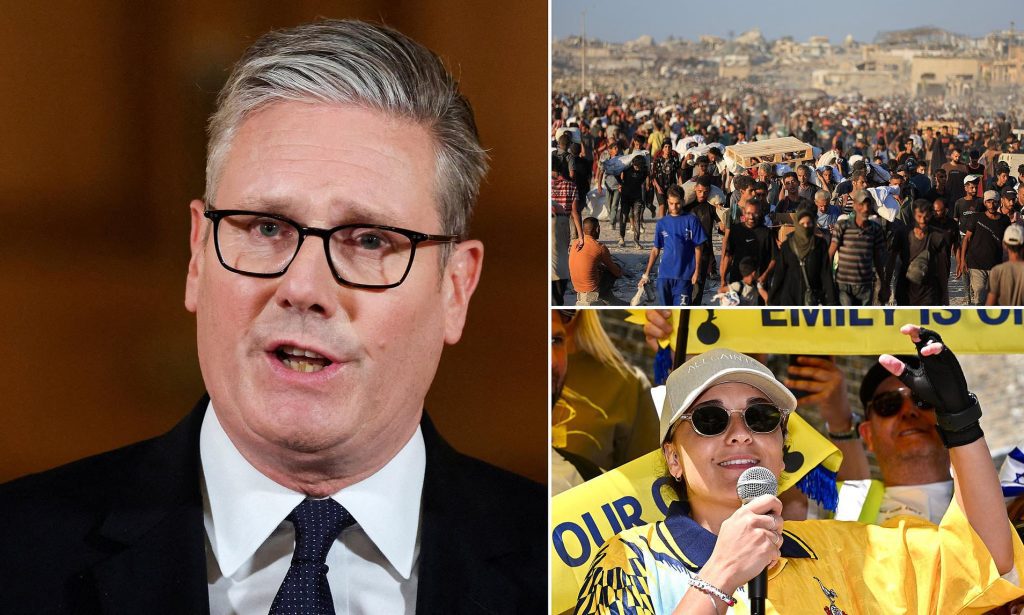
UK’s Recognition of Palestine Sparks Concerns Over Hostage Situation
The recent decision by the UK to recognize Palestine at the United Nations General Assembly in September has raised significant concerns among British families whose loved ones are still held hostage in Gaza. These families argue that the move could potentially leave the hostages “rotting in Hamas dungeons” and have called on Prime Minister Keir Starmer to reconsider his approach.
During a meeting with Foreign Office officials, representatives from four British families sought clarity on whether conditions would also be imposed on Hamas regarding the release of the hostages. According to a statement released by their lawyers, it became evident during the meeting that the UK government’s policy does not prioritize the release of the hostages. Instead, the decision to recognize Palestine will be based on a broader assessment of conditions, which may not include the fate of the captives.
The families expressed their deep concern, stating that the UK’s vision for peace might involve their relatives continuing to suffer in captivity. They emphasized that while the UK is considering recognition of Palestine, the release or non-release of the hostages would not factor into this decision. This has led to fears that political considerations may overshadow the urgent need to secure the safe return of the hostages.
Sir Keir Starmer outlined specific conditions that Israel must meet before the UK would refrain from recognizing Palestine. These include allowing more aid into Gaza, halting land annexation in the West Bank, agreeing to a ceasefire, and committing to a long-term peace process. While he urged Hamas to immediately release all remaining Israeli hostages, disarm, and accept that they will play no role in the governance of Gaza, he did not explicitly state that these actions would influence the recognition decision.
The families have varying views on the future political settlement but share a common priority: keeping the hostages above political games. Their lawyers have urged the Prime Minister to change course before it is too late. Sir Keir has stated that he particularly listens to the voices of hostages, following criticism of his plans from Emily Damari, a British-Israeli woman who was held captive by Hamas. The families of Ms. Damari and freed hostage Eli Sharabi were among those who met with the Foreign Office.
Additionally, relatives of Nadav Popplewell and Oded Lifshitz, who both died while in captivity, as well as Yocheved Lifschitz, who was released, were present at the meeting. Their presence highlighted the tragic reality faced by many families and underscored the urgency of the situation.
In contrast, US President Donald Trump has expressed disagreement with Sir Keir’s plans, as well as those of France and Canada, who have also pledged to recognize Palestine. White House press secretary Karoline Leavitt stated that Mr. Trump believes recognizing Palestine at this time would reward Hamas, which she described as the true impediment to a ceasefire and the release of all hostages.
Marco Rubio, the US Secretary of State, criticized Sir Keir’s pledge as “clumsy,” suggesting it has reduced the chances of a ceasefire. Meanwhile, pro-Palestinian groups are planning a “siege” on Labour MPs, councillors, and staff in an effort to push the party toward a stronger stance against Israel. The Palestinian Youth Movement has instructed “solidarity groups” across the UK to participate in a national day of action against the party.
As the situation continues to evolve, the pressure on the UK government to address the concerns of the families and ensure the safety of the hostages remains high. The delicate balance between political recognition and humanitarian concerns is now at the forefront of public discourse.