


Global Reach of Seismic Waves
An earthquake of significant magnitude has been detected across vast distances, demonstrating the far-reaching effects of seismic activity. The tremor, which occurred off the coast of Russia, was felt more than 4,700 miles away in Upstate New York. This event highlights how seismic waves can travel great distances and be recorded by sensitive instruments.
According to data from the US Geological Survey (USGS), the earthquake struck approximately 84 miles east-southeast of Kamchatska at around 7:24pm EST. With a magnitude of 8.8, it is ranked as the sixth strongest earthquake ever recorded. Meteorologist Howard Mange noted that shockwaves from this megaquake were picked up by a seismometer in Binghamton, New York.
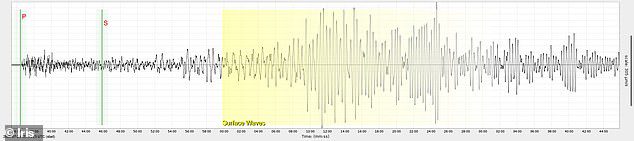
The first waves to arrive were the primary waves, or P-waves. These are the fastest seismic waves, traveling in the same direction as the wave itself, similar to sound waves. They typically arrive first following an earthquake. In this case, the P-waves reached the seismometer about 11 minutes after the initial quake.
Approximately 22 minutes after the event, secondary waves, or S-waves, were detected. These slower waves move particles side-to-side and cannot travel through liquids. Finally, around 36 minutes after the quake, the slowest but often most powerful surface waves arrived in New York.
“These waves travel as a group around the surface of the earth and are usually the largest waves seen on the seismogram,” Mange explained. “The further away the earthquake, the more spread out the surface waves are in time.”
Alex Nikulin, associate professor at Binghamton University, added that an earthquake of this power is capable of sending waves around the world multiple times. “Importantly, they are not felt at that point by humans because you’ve attenuate out most of the frequencies that would have been felt, but they’re felt by sensors,” he said.
He also mentioned that this was the largest recorded in the region since 1952, referring to the 9.0 magnitude earthquake that hit Kamchatka, Russia—similar to the tremor that struck this week.
Seismic Energy Spreads Across the Nation
Scientists collected data from earthquake sensors across the United States, showing how the seismic energy rippled out from the epicenter like waves from a stone thrown into water. Within the first second, seismic stations closest to the epicenter, primarily in Alaska and western coastal Canada, began detecting the earthquake’s P-waves.
Between one and five seconds after the quake, the seismic waves surged eastward, reaching stations throughout the western US, including California, Oregon, and Washington. From five to ten seconds, the waves extended into central states such as Montana, Wyoming, and the Dakotas, covering a vast swath of the continent.
Although wave intensity started to decrease, the shaking remained noticeable. Some wave energy even traveled along global paths, reaching stations from opposite directions. Between ten and twenty seconds, the seismic activity reached the Midwest and East Coast, including Minnesota, Illinois, New York, Pennsylvania, and the Carolinas.
Surface waves dominated this phase, responsible for the lateral shaking felt over wide areas, despite a gradual decline in wave amplitude. In New York, seismometers lit up across the state. The Adirondacks and Catskills likely experienced slightly different wave propagation due to the terrain, but scientists observed a uniform spread across the area.
The seismic waves would have traveled through the Hudson Valley, potentially affecting areas like Poughkeepsie and Kingston, though with diminishing intensity.
Long-Term Effects of Major Earthquakes
Large earthquakes, like the one that hit this week, are known to redistribute stress along fault lines, sometimes increasing the strain on already vulnerable zones. If those areas are near their breaking point, the added pressure could trigger aftershocks or even fresh quakes, not just locally, but potentially in distant regions connected by geological stress transfer.
In rare cases, shifting stress can also activate entirely separate fault systems, making this kind of global disturbance more than a geological curiosity. For example, in 1992, a major 7.3 magnitude earthquake hit California, and within hours of the mainshock, seismic activity increased in places up to 750 miles away, including Yellowstone National Park and western Nevada.
When an 8.8 magnitude quake rocked Chile in 2010, the seismic waves triggered activity in Mexico and Southern California. These events illustrate how a single earthquake can have widespread and long-lasting impacts on the global seismic network.