





Calls for EU Action Against Israel Amid Famine Warnings in Gaza
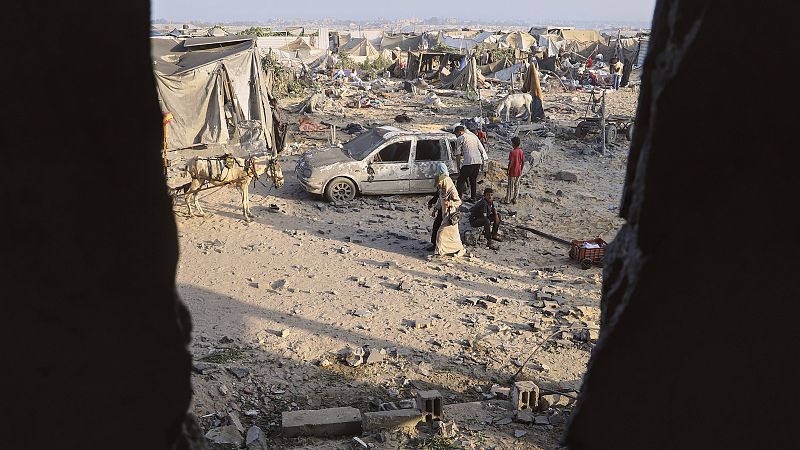
A coalition of 58 cross-party Members of the European Parliament (MEPs) is urging the European Union to take decisive action against Israel. The group is demanding the suspension of the EU’s trade deal with Israel and the imposition of sanctions on the Netanyahu-led government. This call comes as a UN-backed organization warns of signs of famine and widespread starvation in the Gaza Strip, raising urgent concerns about the humanitarian crisis in the region.
In a joint statement released exclusively by Euronews, the lawmakers emphasize that the Israeli government’s actions “blatantly breach the Geneva Convention and international humanitarian law.” They are calling for accountability for these violations and also urge Hamas to immediately release any Israeli hostages still held captive in Gaza after being taken during the October 7, 2023 attacks.
The statement highlights the gravity of the situation, stating, “Future generations will judge today’s leaders on their response, or lack thereof, to the atrocities in Gaza. Failing to act now will be remembered as a moral stain on humanity.” It further stresses that “the time for moral cowardice is over, and action must be swift.”
The coalition explicitly calls for sanctions on the Israeli government, a move that the EU has so far avoided. However, several allies, including the United Kingdom and Norway, have already sanctioned two Israeli ministers—Itamar Ben-Gvir and Bezalel Smotrich—who are considered extremist. On Tuesday, the Netherlands imposed travel bans on both ministers in response to the deepening crisis in Gaza.
The signatories also urge the European Commission to suspend the EU’s Association Agreement with Israel. This agreement outlines the trading and political relations between the EU and Israel and is often seen as one of the most effective tools available to pressure Israel into improving the humanitarian situation in the Gaza Strip.
A previous review by the EU’s diplomatic arm found indications that Israel had breached its human rights obligations under the Association Agreement. However, this did not lead to any concrete measures beyond discussions between the EU’s top diplomat, Kaja Kallas, and her Israeli counterpart, Foreign Minister Gideon Sa’ar. These talks resulted in an agreement from Israel to increase humanitarian aid to Gaza. Despite this, concerns about the situation on the ground have continued to grow.
On Monday, the European Commission took a step by proposing the partial suspension of Israel’s access to the EU’s Horizon Europe research and innovation programme. However, the MEPs argue that such measures are insufficient and warn that “mere words of condemnation are inadequate.”
The statement is signed by representatives from 15 of the EU’s 27 member states, including Germany, France, Italy, and Spain, as well as six different political groups ranging from The Left to the centre-right European People’s Party (EPP). This broad-based support reflects the growing urgency among EU lawmakers to address the crisis.
Israel’s war against Hamas in Gaza has exposed deep political divisions within the European Union. However, the worsening humanitarian situation is prompting lawmakers from ideologically opposed groups to unite in calling for more decisive EU action.
MEP Evin Incir, who represents the centre-left Socialists and Democrats (S&D) group, emphasized that “MEPs from across the spectrum of pro-European, pro-democratic parties have united behind this statement.” She added that more signatories were expected to support the statement in the coming hours.
“Our concerns are directed at both the European Commission and EU member states, who all need to be more decisive in their response to the unfolding humanitarian crisis,” she said.
The statement is issued as the Integrated Food Security Phase Classification (IPC), a global watchdog monitoring hunger with the backing of governments and the UN, reports “mounting evidence” that “widespread starvation, malnutrition, and disease are driving a rise in hunger-related deaths” in the besieged territory.
Israeli government officials have either denied the existence of famine in Gaza or shifted blame onto others. Reports of armed gangs looting aid deliveries and selling them on the black market have further complicated the situation, potentially worsening the crisis.