


The Unpredictable Nature of Race Strategies in Formula 1
Formula 1 has long been known for its unpredictable race strategies, and the recent Hungarian Grand Prix was no exception. Drivers and teams often rely on pre-race predictions and data from tire manufacturers like Pirelli to plan their approach. However, as history has shown, these plans can quickly change based on real-time events during the race.
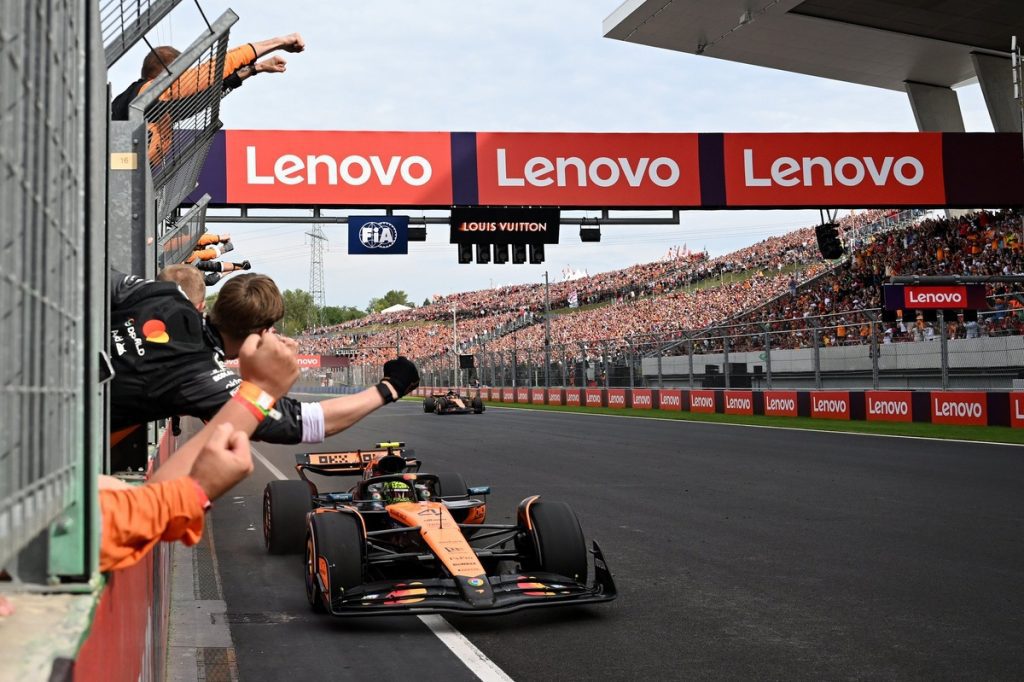
At the Hungaroring, Lando Norris found himself in a situation where his initial strategy was forced into an unexpected one-stop approach due to a poor start. This ultimately worked in his favor, allowing him to secure a strong finish. He wasn’t the only driver affected by this shift—Max Verstappen, according to Red Bull’s Helmut Marko, could have finished fifth or sixth instead of ninth if he had opted for a single pit stop rather than two.
Pirelli’s Predictions vs. Reality
Before the race, Pirelli emphasized that a two-stop strategy would be the most effective option. Their motorsport manager, Mario Isola, stated that a one-stop strategy was roughly 10 seconds slower, depending on the track conditions and tire degradation. He also noted that cooler temperatures might reduce this gap slightly, but the preference remained for a two-stop approach.
However, the actual race dynamics were influenced by events on the opening lap. Norris, starting from third on the grid, attempted to overtake his teammate Oscar Piastri at Turn 1 but ended up losing positions to George Russell and Fernando Alonso. This set the stage for a different strategy to emerge as the race progressed.
The Impact of Early Race Events
Norris struggled to escape the “dirty air” from Russell’s Mercedes, which made it difficult for him to gain any ground. Meanwhile, Alonso began to pick up pace, creating a challenge for both McLaren and Ferrari. This development opened up the possibility of a one-stop strategy for Norris, which eventually became his only viable option.
McLaren’s baseline strategy for Piastri was a two-stop plan aimed at overtaking Charles Leclerc. However, as the race unfolded, the momentum shifted toward a one-stop approach. Piastri, initially hesitant about stopping once, started considering the possibility of extending his stint to gain an advantage over Leclerc.
Strategic Adjustments and Team Decisions
Andrea Stella, McLaren’s team principal, explained that the team didn’t initially believe a one-stop strategy was feasible. However, as the race progressed, they began to see potential in this approach. “We didn’t think the one-stop would have been possible still,” Stella admitted, crediting Norris for his strong performance with used tires.
Despite the changes in strategy, McLaren maintained that they aimed to give Piastri a fair chance to compete with Norris. They wanted to ensure that Piastri had enough tire performance to overtake Leclerc while still keeping the race competitive.
Tactical Maneuvers and Pit Stop Decisions
As the race continued, McLaren attempted to create confusion by telling Piastri to pit on a specific lap. This move was meant to force Ferrari to respond, but instead, Piastri extended his stint for six more laps. This decision allowed Norris to inherit the lead after Russell pitted, giving him a crucial advantage.
Piastri, however, lost significant time while extending his stint, which ultimately cost him the opportunity to overtake Leclerc. Despite this, he managed to use his tire performance to pass the Ferrari driver on the road.
Final Thoughts on Strategy and Team Dynamics
Stella emphasized that the team did not favor Norris over Piastri. Instead, they aimed to provide both drivers with a fair chance to succeed. “We wanted to make sure that, thinking about Leclerc, we were not deviating too much from an optimal two-stop,” he said.
The Hungarian GP highlighted how unpredictable Formula 1 races can be, with strategies shifting rapidly based on in-race events. While Pirelli’s pre-race analysis provided a general guideline, the reality of the race required quick decisions and adaptability from both drivers and teams.