


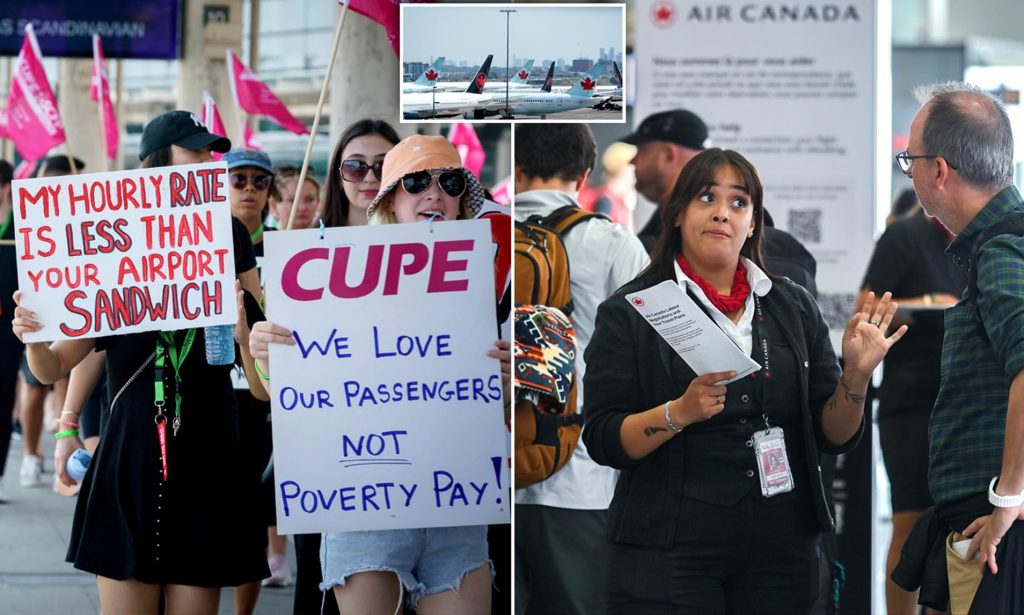
Government Intervenes in Air Canada and Union Dispute
The Canadian government has taken a decisive step to address the ongoing conflict between Air Canada and its flight attendants, who have been on strike for several days. This dispute has led to significant disruptions, with hundreds of flights grounded and thousands of passengers affected. The situation escalated when 10,000 flight attendants walked out, causing a full suspension of operations on Saturday. This move is expected to impact around 130,000 customers daily.
Government Steps In
In response to the growing crisis, Jobs Minister Patty Hadju intervened by ordering binding arbitration. This legal process involves a neutral third party making a final decision that both parties must accept. The intervention was aimed at resolving the contract dispute between Air Canada and the Canadian Union of Public Employees (CUPE), which represents over 10,000 flight attendants.
Hadju expressed disappointment that both sides were unable to resolve their differences and emphasized the need to protect the country’s ‘stability and supply chains.’ By invoking Section 107 of the Canada Labor Code, the government compelled both parties to return to the bargaining table to end the strike.
Union’s Response
The union quickly responded to the government’s action, accusing the Liberal Party of violating their charter rights. They warned that the government’s intervention sets a dangerous precedent. Wesley Lesosky, President of Air Canada Component of CUPE, criticized the government for not addressing the issue through legislation and claimed that the intervention would lead to unpaid labor from underpaid flight attendants while the airline continues to profit.
Impact on Air Canada and Travelers
Air Canada, the largest airline in the country, reported that the strike would disrupt approximately 500 flights daily, leading to delays, cancellations, and other travel issues. The feud escalated after the union rejected the airline’s request to enter into government-directed arbitration, which would eliminate their right to strike and allow a third-party mediator to decide the terms of a new contract.
According to a press release, the airline stated that the travel disruptions were ‘necessary’ following the union’s 72-hour strike demand for higher wages and pay for time spent working while planes are on the ground. The industrial action began around 1am ET, instantly grounding all 700 daily flights operated by Air Canada.
By 10am, more than 13,000 Air Canada flights were delayed, and 988 were cancelled, according to FlightAware tracking data. The airline strongly advised passengers not to travel to the airport and reiterated its commitment to negotiating the renewal of its collective agreement with the union.
Passenger Reactions and Public Outcry
Travelers reacted angrily to the airline’s statement, arguing online that Air Canada is ‘treating customers with total disdain’ and ‘refusing to take responsibility for its own shortcomings in labor relations.’ Some supported the striking workers, demanding fair compensation for flight attendants.
Ongoing Negotiations
Air Canada and CUPE have been negotiating for about eight months but have yet to reach a tentative agreement. Both sides claim they remain far apart on key issues. The airline’s latest offer included a 38 percent increase in total compensation, including benefits and pensions over four years, which it said would make flight attendants the best compensated in Canada.
However, the union pushed back, stating that the proposed 8 percent raise in the first year did not adequately address inflation concerns. This ongoing disagreement highlights the complexity of the negotiations and the challenges faced by both parties in reaching a resolution.