


Welsh Language Takes Center Stage at Edinburgh Fringe Festival
Thousands of attendees at the Edinburgh Fringe Festival may be expecting to see performances in German, French, or Spanish. However, for one performance duo, it is the Welsh language that takes center stage as they bring the audience on a journey into the heart of Celtic folklore.
Ffion Phillips, part of the Harebell Tellers, emphasizes her passion for sharing place-based stories that connect audiences with the language and culture of the land. Creu Cymru, an organization promoting performing arts in Wales, highlights that Welsh and bilingual shows offer global audiences the chance to experience the “richness of their heritage.”
Every year, Welsh performers join over 3,500 acts from around the world at the festival, which includes comedy, cabaret, street performances, and spoken word. The Harebell Tellers specialize in storytelling, presenting folklore and mythological tales through the traditional art of narrative.
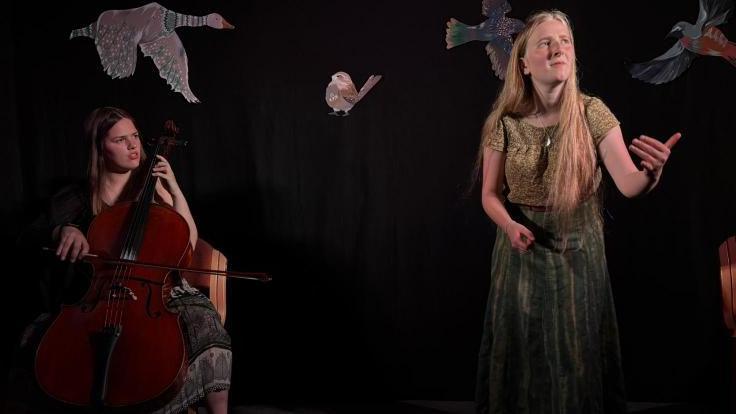
Ffion Phillips, from Conwy, and Ailsa Dixon, from Scotland, integrate both Welsh and Scottish languages into their performances. Ffion notes that many at the Fringe have never heard the Welsh language before. She finds it remarkable to introduce this living, breathing language into venues that rarely encounter it.
For Welsh speakers, it creates a beautiful point of connection. Ffion enjoys weaving stories in a way that allows English-speaking audiences to follow along, immersing them in the world of the tale.
Ffion has been storytelling since she was eight years old and began incorporating the Welsh language shortly after. Her repertoire primarily consists of Welsh folklore and myth. As a Welsh speaker in daily life, she has always loved telling stories bilingually.
Their show, Aderyn/Bird, delves into bird mythology, dreams, and fate. Over three weeks in August, the streets and venues of Edinburgh transform into a vibrant hub of arts and culture.
Emily Davis, another performer, is currently showcasing two shows: Blodwen’s in Town and Escape the Rat Race. Through song, Emily, from Newport, Pembrokeshire, shares her story of moving from west Wales to London and escaping corporate life, all viewed through the lens of Blodwen.
The show explores the cultural shocks experienced when transitioning from a small village in west Wales to a new environment, navigating a different world while leaving behind a support system. Emily started her theatrical career ten years ago after completing a cabaret course but found it challenging to perform as herself, leading her to create an alter ego.
“Blodwen is me, but without all the self-doubt and emotional baggage,” she says. The 41-year-old draws inspiration from her own life and works in an office when not performing. The variety of her performances extends to the diverse audiences she encounters.
“Some days you might get two people at the show, other days 50 people will turn up, and others come because it’s raining outside. Every day is different,” she explains.
Stand-up comedian Stuart Thomas is performing at the Edinburgh Fringe for the first time, sharing his experiences growing up on a sheep farm in Port Talbot. His show, Bad Fatty, focuses on changing stereotypes by discussing his Welsh identity and body image.
“People sometimes hear my accent and don’t expect much from me, but you can use that in comedy and play with it. It’s a fun thing to do to change perceptions,” he says. Although he now lives in Salford, he has not forgotten his Welsh roots.
“It’s great to share a bit about Wales and have Welsh representation at the festival. The Fringe is a global showcase and people come from all over the world,” he adds. His show also touches on topics such as body image, sexuality, and mental health.
Stuart, who works as a software engineer designing apps, got into stand-up after the Covid lockdown and has since performed in over 200 locations across the UK.
Louise Miles-Payne, Director of Creu Cymru, states that the Fringe provides a platform for Welsh stories and language in a unique setting. It offers performers a chance to test their work, showcase their talent, and ensure that the voices of Wales are heard, celebrated, and understood on a global stage.
The Edinburgh Fringe Festival continues until 25 August, offering a vibrant celebration of arts and culture.