


Ongoing Struggles in the Aftermath of Severe Flooding in Pakistan
Rescuers are working tirelessly to recover bodies from the wreckage left behind by flash floods triggered by heavy monsoon rains across northern Pakistan. In the past 48 hours, at least 344 people have lost their lives, according to local authorities. The impact of the disaster has been particularly severe in the mountainous Khyber Pakhtunkhwa province, where 328 deaths were reported. Most of these fatalities occurred due to flash floods and collapsing structures, with at least 120 others injured.
Residents in the affected areas describe the situation as apocalyptic. One local shared with AFP that it felt like “the end of the world” was approaching, as the force of the water shook the ground. Over 2,000 rescue workers are currently engaged in recovery efforts and relief operations across nine districts. However, heavy rainfall, landslides, and damaged roads continue to hinder aid delivery, especially for transporting heavy machinery and ambulances.
Bilal Ahmed Faizi, a spokesman for the provincial rescue agency, highlighted the challenges faced by the teams. “Due to road closures in most areas, rescue workers are traveling on foot to conduct operations in remote regions,” he said. He also mentioned that while efforts are underway to evacuate survivors, very few people are relocating because many are still dealing with the loss of relatives or loved ones trapped in the debris.
The provincial government has declared several districts—Buner, Bajaur, Swat, Shangla, Mansehra, and Battagram—as disaster-hit areas. The meteorological department has issued a heavy rain alert for the northwest region, urging residents to take precautionary measures. Additional casualties were reported in Pakistan-administered Kashmir and the Gilgit-Baltistan region, bringing the total death toll higher. A tragic incident also occurred when a local government helicopter crashed during a relief mission, killing five people, including two pilots.
The Impact of an Unusual Monsoon Season
The monsoon season typically brings about three-quarters of South Asia’s annual rainfall, which is essential for agriculture and food security. However, it also leads to destruction through landslides and flash floods. This year’s monsoon season started earlier than usual and is expected to last longer, according to Syed Muhammad Tayyab Shah, a representative of the national disaster agency. He warned that the next 15 days could see even more intense monsoon activity.
In Buner district, where dozens have died and been injured, resident Azizullah described the experience as “doomsday.” He recounted hearing a loud noise as if the mountain was sliding, rushing outside to witness the entire area shaking. “The ground was trembling due to the force of the water, and it felt like death was staring me in the face.”
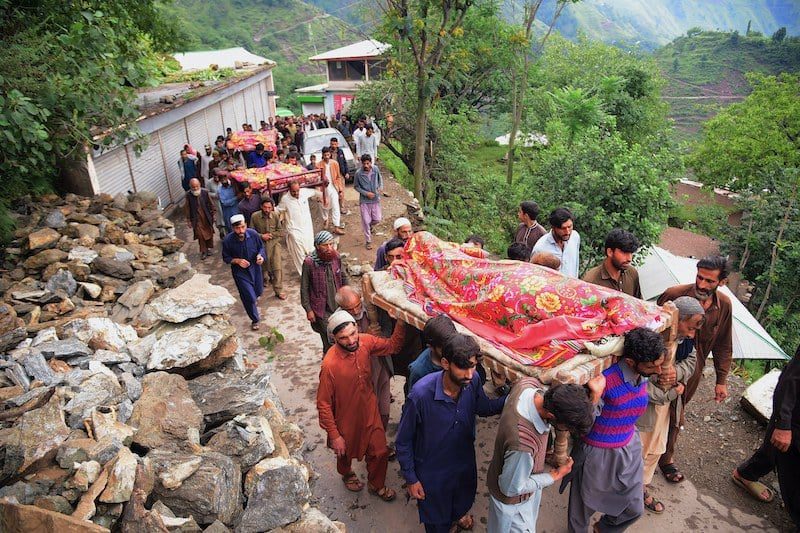
In Bajaur, a tribal district near Afghanistan, a crowd gathered around an excavator digging through a mud-soaked hill. Funeral prayers began in a nearby paddock, with people grieving over several bodies covered by blankets. Meanwhile, in the picturesque district of Swat, roads were submerged in muddy water, electricity poles were grounded, and vehicles were half-buried in mud.
The torrential rains that have hit Pakistan since the start of the summer monsoon have been described as “unusual” by authorities. So far, more than 650 people have died, and over 880 have been injured. In July, Punjab, home to nearly half of Pakistan’s population, recorded 73% more rainfall than the previous year, resulting in more deaths than in the entire previous monsoon season.
Climate Change and Increasing Vulnerability
Pakistan is one of the most vulnerable countries to the effects of climate change, and its population is increasingly facing extreme weather events. The monsoon floods of 2022 submerged a third of the country and claimed around 1,700 lives. Villagers in Buner continue to search through the rubble overnight, as the community remains deeply affected by the trauma of the disaster.
Saifullah Khan, a 32-year-old schoolteacher, described the situation as “reeling from profound trauma.” He expressed uncertainty about who in his small village is alive and who is dead. “I help retrieve the bodies of the children I taught, and I keep wondering what kind of trial nature has imposed on these kids,” he added. The emotional toll of the disaster continues to weigh heavily on those who remain.