









Africa’s Economic Growth and Agricultural Potential
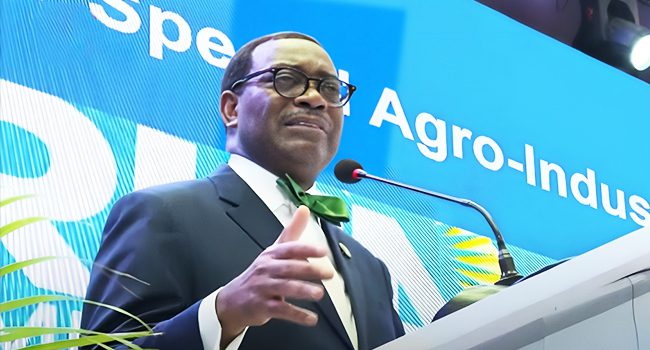
The outgoing president of the African Development Bank, Akinwumi Adesina, highlighted significant economic progress in Africa during a presentation at the 2025 Standard Chartered Bank Africa Summit held in Lagos. He stated that in 2025, Africa accounted for 12 out of the 20 fastest-growing economies globally, showcasing the continent’s increasing economic influence.
Adesina emphasized that the African Development Bank and its partners have mobilized $2.2 billion (approximately N3.4 trillion) to implement special agro-industrial processing zones in Nigeria. These initiatives are part of broader efforts to stimulate economic growth and development across the continent.
According to Adesina, Africa’s economic growth is projected to rise from 3.3% in 2024 to 3.9% in 2025 and further to 4.0% in 2026. He noted that 21 African countries are expected to exceed 5% growth in 2025, with some even surpassing 7%. Despite these positive trends, he acknowledged that per capita GDP growth remains below the level needed to achieve substantial inclusive growth and prosperity for Africa’s 1.4 billion people.
This gap prompted the AfDB to launch its High 5 strategic programs a decade ago. Adesina attributed the growth to rapid population expansion across the continent. With the world’s largest youth population, Africa has seen increased consumption of goods and services, contributing to economic momentum.
Agriculture as a Key Sector
Adesina stressed that Africa plays a critical role in global food security, as 65% of the world’s uncultivated arable land is located on the continent. He pointed out that what Africa does with its agriculture will significantly impact the future of food production worldwide.
He estimated that the food and agriculture market in Africa is set to reach $1 trillion by 2030. This presents vast opportunities for agribusinesses and Agri-tech companies to leverage digital tools to enhance productivity and incomes.
Expanding access to digital services was another key focus for Adesina. He cited a collaborative effort between the AfDB and Mastercard aimed at providing digital access to information and markets for 300 million farmers. The initiative includes deploying funds for Phase 2 of the Special Agro-Industrial Processing Zones, covering 24 states.
Expanding Agro-Industrial Zones
Adesina recalled that the bank and its partners had supported the launch of the special agro-industrial processing zones in the first eight states: Ogun, Oyo, Cross River, Imo, Kaduna, Kwara, Kano, and Abuja. As a former agriculture minister, he emphasized that the initiative would transform Nigeria’s agricultural sector by improving food security, boosting domestic production, and creating thousands of jobs.
He underlined the importance of investments in unlocking Africa’s agricultural potential, particularly in enhancing the value of agricultural commodities. To achieve this, he advocated for the development of industrial platforms that enable the continent to move up the agricultural value chain.
Financial Commitments and Collaborations
The AfDB is investing heavily in the development of Special Agro-Industrial Processing Zones across Africa, supported by infrastructure to facilitate the establishment of industries that process and add value to a wide range of agricultural products.
The bank has committed over $934 million toward the development of these zones, with an additional $938 million mobilized from partners such as the International Fund for Agricultural Development, the Islamic Development Bank, Japan International Cooperation Agency, and the West African Development Bank.
In collaboration with these partners, the AfDB launched the Alliance for Special Agro-Industrial Processing Zones, which has secured $3 billion in commitments to accelerate the development of these zones across Africa.
Adesina also revealed that the development of special agro-industrial processing zones is ongoing at 27 sites across 11 countries in Africa, reflecting the continent’s growing commitment to sustainable and inclusive economic growth.