


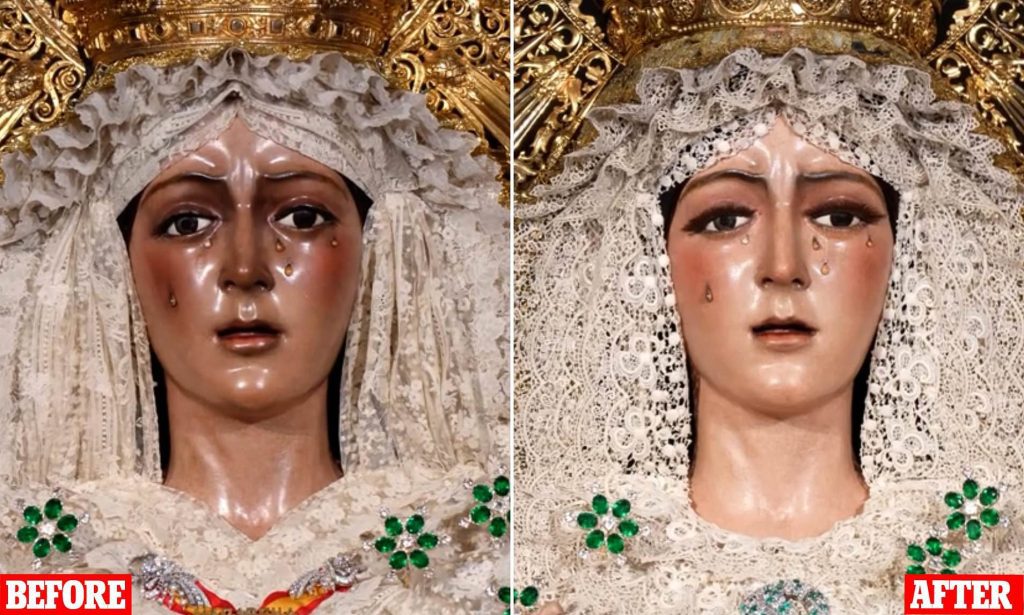
The Controversial Restoration of La Macarena
The recent restoration of an iconic 17th-century statue of the Virgin Mary, known as La Macarena, has sparked significant controversy among worshippers in Seville, Spain. This beloved wooden effigy, standing at 5 feet 9 inches tall, was sent for routine maintenance in June. However, upon her return, many faithful devotees were left stunned and upset, claiming she looked like she had undergone a “botched plastic surgery.”
La Macarena is a cherished figure in Seville, especially during the city’s Holy Week parades. Her usual restorer, Francisco Arquillo Torres, an 85-year-old professor at the University of Seville, had been entrusted with her care for years. However, this time, the restoration process led to a major backlash.
The changes made to La Macarena included longer eyelashes, alterations to her complexion, and tweaks to her skin and nose. These modifications caused many to no longer recognize her face. One worshipper told El Pais, “Her facial expression has completely changed. It pains me deeply to say it, but she looks like a poor copy of the original.” Another added, “It was like she got makeup. And the Macarena cannot be made up!”
The situation escalated when a woman accused Mr. Arquillo of “murdering” the Virgen live on television. This incident led to widespread protests in Seville and instability within the Brotherhood of the Macarena, the group responsible for protecting her image.
Hundreds of angry worshippers gathered outside the Basilica de la Macarena, demanding the resignation of the brotherhood’s leader. In response, the church issued an apology and closed for half a day to make last-minute adjustments. When the basilica reopened, La Macarena had shorter eyelashes, but this did little to ease the unrest. Many still felt her facial expression had worsened.
Pedro Manzano, known as Seville’s “doctor” to the divine, has now taken on the responsibility of fixing La Macarena’s botched makeover. He described the task as “a big responsibility,” adding, “If people don’t like what you do, they can come at you on the street.” Despite his efforts, it is expected that La Macarena will not reappear above the Basilica for several months.
This controversy echoes similar incidents in the past. In 2012, Cecilia Giménez, an 82-year-old woman, attempted to restore the “Ecce Homo” fresco in Borja, northern Spain. Her attempt resulted in a painting dubbed “Monkey Christ,” as her brushwork obliterated the face of Jesus, transforming it into something resembling a hedgehog or a hairy monkey.
Another recent case involved a Polish village where a botched renovation of a 1820 shrine of Jesus and the Virgin Mary left the Blessed Mother looking like a “Simpsons” cartoon character. The Virgin Mary statue now has oversized mitten-like hands, exaggerated eyes, and a crooked frown accentuated by bright red lipstick. Meanwhile, Jesus appears to be wearing grey underpants, and both figures have been repainted with an unnatural yellow hue.
Locals expressed their outrage over the restoration, with some calling it “desecration.” A Facebook post from the Conservator of Monuments read, “A rather rare depiction of the Virgin Mary looking upwards. Another example of good intentions… Let’s hope that in the near future this valuable object will receive professional conservation, because it deserves it very much.”
The unknown restorer also painted over the shrine’s original German inscription, replacing it with markings written in black marker pen. One outraged viewer commented, “The times of the greatest barbarity and ignorance of Spirit and Reason have come.” Another said, “I would take a risk and notify the prosecutor’s office about offending religious feelings. Because this is nothing more than an example of desecrating an object of religious worship.”
These incidents highlight the delicate balance between preservation and restoration, emphasizing the need for skilled professionals to handle such sacred artifacts with care and respect.