


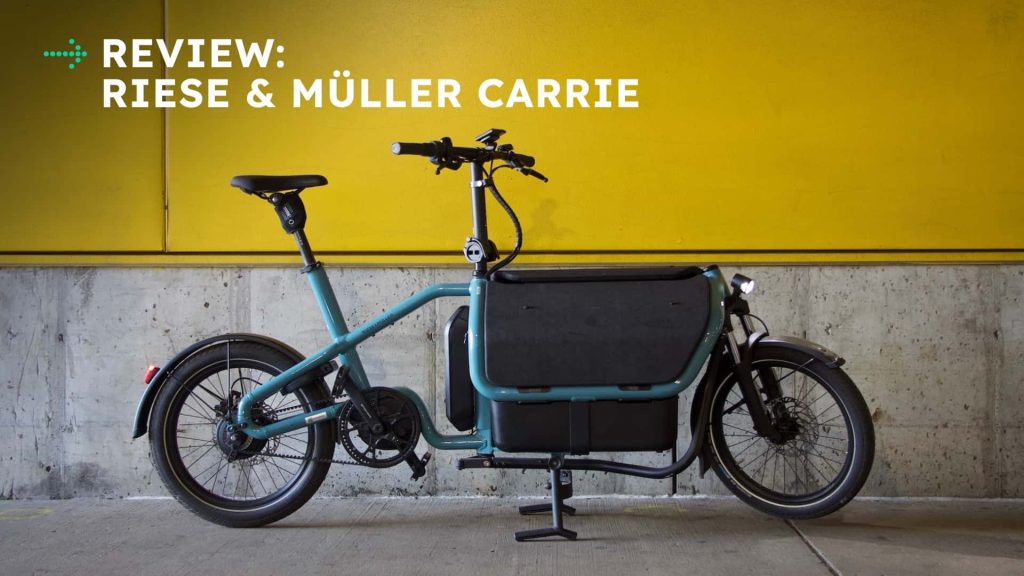
A Compact and Capable Electric Cargo Bike
Electric cargo bikes are gaining popularity in American cities, offering a unique blend of cargo capacity and electric assistance. This combination makes them an appealing alternative to cars and public transit for short errands. Additionally, most e-bikes are enjoyable to ride, making them a fun option for daily use.
I had the opportunity to test Riese & Müller’s Load4 75 front-loader cargo e-bike earlier this year. While I enjoyed riding it and filling it with bulk items from Costco or the garden store, it was challenging to maneuver in and out of my apartment. The price tag of $14,000 also made me question its value.
Enter the Carrie, a high-end German brand’s compact e-cargo bike. Designed with a smaller footprint than the Load, the Carrie offers a clever folding basket up front, promising everyday utility in a more convenient package. It is also 40% less expensive than the Load. Could this be the solution?
Technical Specifications
The Riese & Müller Carrie E-Bike comes equipped with a battery that can be either 545 Wh (standard) or 725 Wh (optional). With the standard battery, it offers a range of 57-77 miles. The drivetrain features a Bosch Performance Line mid-drive motor, Gates drive belt, and Enviolo continuous hub. Charging takes approximately 2-3 hours on a 110V outlet. The base price of the model tested was $9,489, which includes a 545 watt-hour battery. An upgrade to the 725 Wh battery is available for $255.
Design and Functionality
The Carrie is a compact, pedal-assist cargo e-bike. Its standout feature is the optional $509 folding “Flex Box,” which measures 18 inches wide when closed but expands to 29.5 inches when open. The bike is 82 inches long, fitting almost as well as the Load4’s wheelbase. Despite its size, it provides 4.7 cubic feet of cargo space with the Flex Box open, which is significantly less than the Load’s 13.5 but still enough for a small child or groceries.
The Carrie is rated to carry up to 176 pounds (80 kg), making it unsuitable for another adult. Surprisingly, it is only five pounds lighter than the Load at 78.7 instead of 84. The smaller price tag is a plus, though it still isn’t cheap at $9,489 with a 545 watt-hour battery.
Riding Experience
The Carrie shares many advantages of R&M’s larger front-loader e-bikes. It has a low center of gravity and a powerful Bosch motor, making it a joy to ride. Overall, it was comfortable, maneuverable, and quick off the line. However, I missed the full-suspension design of the Load over rougher roads. The Carrie has a suspension fork up front and an optional suspension seatpost, which was included on my tester.
As a Class 3 pedal-assist e-bike, the Carrie does not have a throttle but provides electric boost up to 28 miles per hour. There is a “walk” mode that gives a small assist when rolling the bike. In practice, it cruises around 20-22 mph, which is fast enough to keep pace with traffic and navigate New York’s protected bike paths.
Transmission and Performance
The Carrie uses an Enviolo continuous hub in its rear wheel, eliminating distinct gears. If you’ve ridden a CitiBike or other bikeshare bike, you’ve experienced this type of transmission. You simply grip and twist a dial on the handlebars, and pedaling becomes easier or harder. It takes some getting used to if coming from traditional gears, but it is intuitive for most riders.
The variable ratio, combined with the Bosch e-motor’s five pedal-assist settings, makes the Carrie capable of handling hills and bridge inclines. Like the Load, it avoids chain cleanings with a carbon belt drive.
Practicality and Maneuverability
Being able to fit the Carrie through doorways and into my apartment without solving a geometric proof was a game-changer. I found myself taking the Carrie on more trips, even riding it to the InsideEVs office, where it fit easily in our small elevator. For apartment-dwellers and those without garages, the Carrie is a much more practical option.
Pros and Cons
The Carrie’s smaller profile is ideal for city living. The space and off-bike maneuverability issues I had with the Load were gone, while most of the day-to-day utility was preserved. The shorter length and width made it easier to park curbside and in traditional bike racks. Using the folding cargo box was straightforward—two levers release the side panels, and they click firmly into place.
While the cargo box isn’t huge, it can fit a backpack, three large bags of groceries, and some sodas without issue. It’s not the monster Costco hauler the Load is, but how often do you need 30 rolls of paper towels?
Conclusion
Whether the Carrie is right for you depends on how you value compactness and maneuverability versus all-out capability. For my childless household of two living in an apartment, the Carrie was a perfect-sized runabout. However, if I had kids and a garage, I might be swayed by the Load’s versatility.
At roughly $11,500 fully equipped, the Carrie still represents the high-end, niche side of the e-bike market. It is a thoughtfully designed, creative product that performs its intended functions well and brings joy. However, the value proposition may not work out for most folks.
One thing I’ve learned in my e-bike adventures is just how fun these things make everyday errands and commuting. I’m curious to try some more affordable, mass-market e-bikes from Tern, Gazelle, and more. What should I review next?