

White House Responds to Press Coverage of Trump’s Diplomatic Efforts
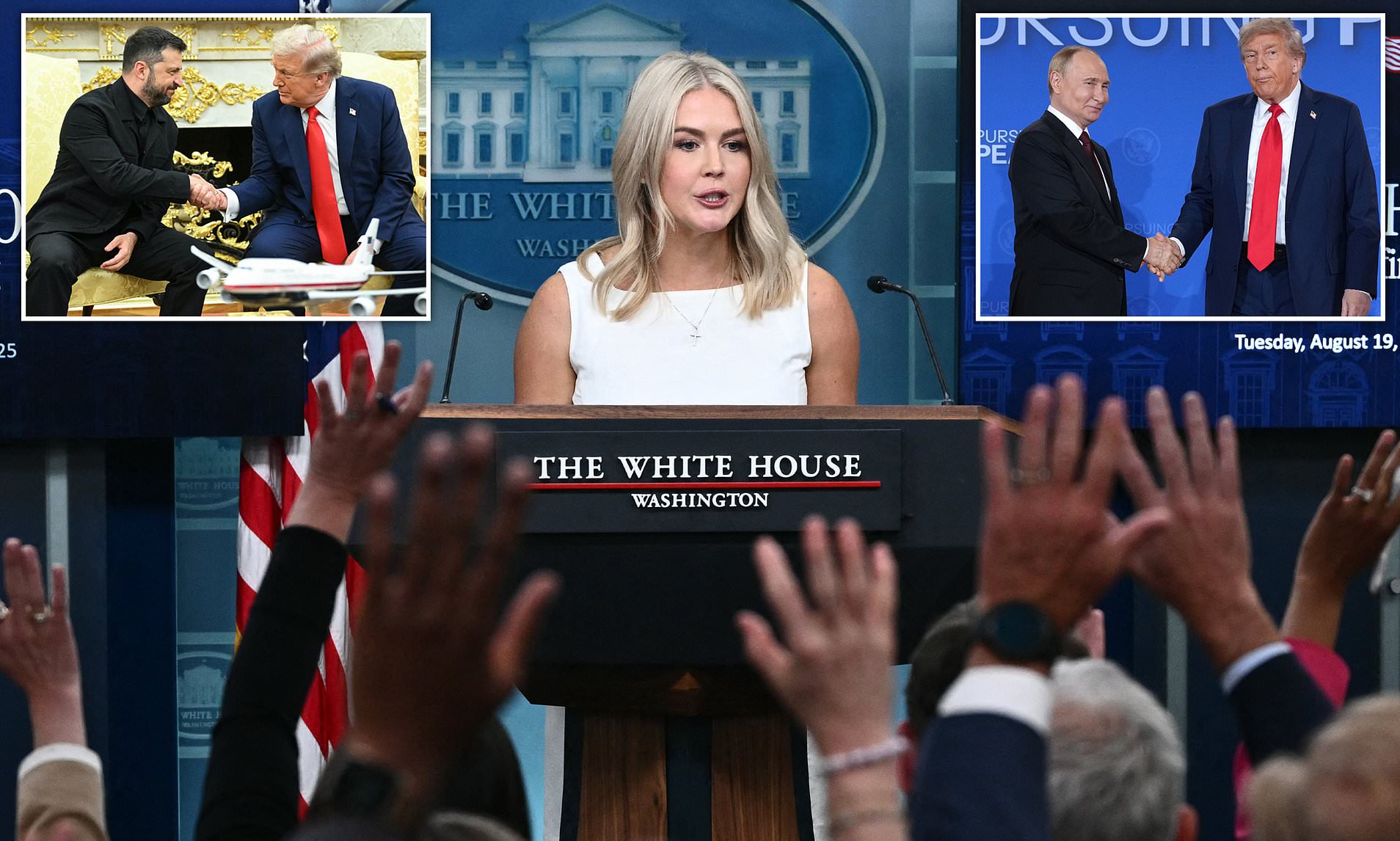
The White House has taken a strong stance against media coverage surrounding the recent diplomatic efforts led by former President Donald Trump, particularly concerning his discussions with Russian President Vladimir Putin and Ukrainian President Volodymyr Zelensky. The press secretary, Karoline Leavitt, defended the president’s actions and emphasized the significance of the ongoing negotiations.
Leavitt confirmed that Putin had agreed to a one-on-one meeting with Zelensky, which she described as a major step toward a potential peace deal brokered by Trump. This development came after a series of high-profile meetings in Washington, D.C., where world leaders gathered to discuss the conflict between Russia and Ukraine.
The president took time out from his meetings with Zelensky and other global leaders to call Putin and update him on the progress made during the summit. Trump explained that he felt it would be disrespectful to make the call during the meeting with other leaders, highlighting his commitment to maintaining proper decorum in diplomatic settings.
Several prominent figures attended the White House meetings, including British Prime Minister Keir Starmer, European Commission President Ursula Von der Leyen, French President Emmanuel Macron, Italian Prime Minister Giorgia Meloni, and German Chancellor Friedrich Merz. Their presence underscored the international interest in finding a resolution to the ongoing conflict.
During these discussions, a reporter from the New York Times questioned why Trump did not take the call with Putin while the other leaders were present. Leavitt responded sharply, suggesting that only someone from the New York Times would ask such a question. She emphasized that the decision to take the call separately was not disrespectful but rather a strategic move to ensure the focus remained on the broader discussions.
Leavitt also provided clarity regarding Putin’s agreement to meet with Zelensky, stating that the Kremlin had been vague about the details of the promise. When asked to confirm the meeting, she simply replied, “He has, and I just answered that question for you.”
Trump announced on social media that he had spoken with Putin and that they had begun the process of arranging a bilateral meeting. He outlined the steps needed to set up the meeting, emphasizing the importance of open dialogue between the two leaders.
However, the Russian side appeared less transparent. Russian Foreign Minister Sergey Lavrov described the process as “step by step, gradually,” starting from the expert level and moving through necessary stages. This contrast highlighted the differing approaches taken by the two sides in the negotiation process.
Leavitt criticized the press for what she called negative coverage of the president’s meeting with Putin, arguing that the discussions were highly productive. She claimed that the outcomes prompted Zelensky and other leaders to travel to Washington, D.C., to discuss further details.
She also condemned former President Joe Biden for what she described as an “America last foreign policy” that did not leave room for peace in the conflict. Leavitt asserted that Trump rejected this approach and instead focused on pursuing peace throughout his second term.
Trump expressed his belief that a bilateral meeting between Putin and Zelensky was essential to resolving the war and rebuilding their relationship. He stated that without such a relationship, efforts to negotiate peace would be futile. “It takes, in this case, two to tango; they have to have a relationship otherwise we’re just wasting our time,” he said.