


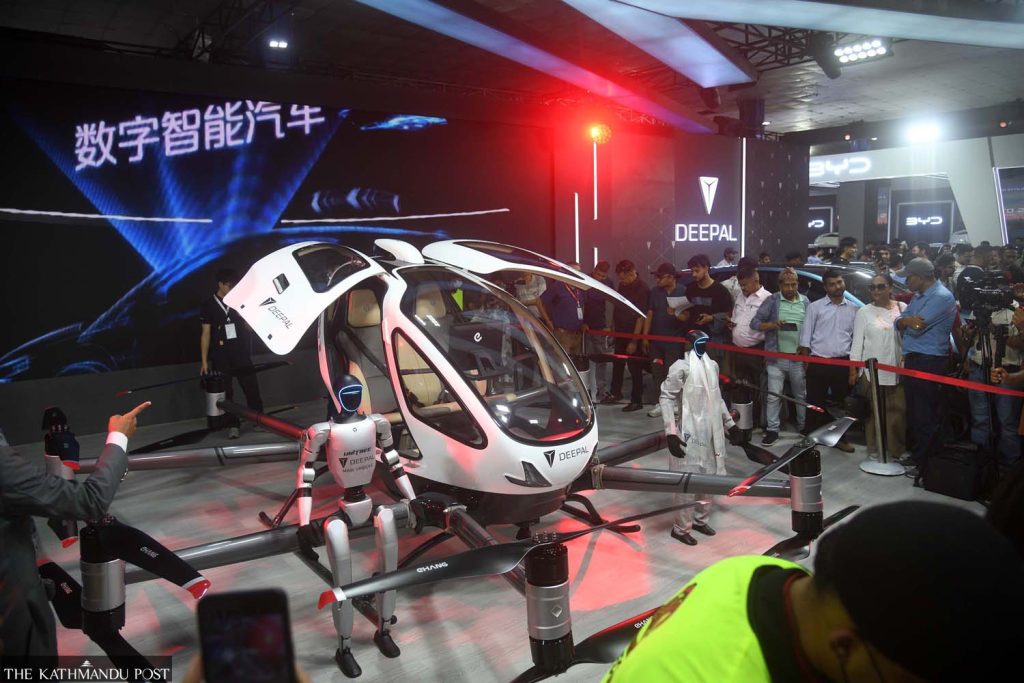
A Glimpse into the Future of Transportation
At this year’s NADA Automobiles Association of Nepal Auto Show, a flying taxi captured the attention of attendees, transforming what was typically a display of new vehicles into a preview of future transportation possibilities. The event, held in Kathmandu, showcased the Deepal Flying Taxi, an electric vertical take-off and landing (eVTOL) aircraft that quickly became the highlight of the exhibition.
The two-seater model, developed by Chinese automaker Changan and aviation company EHang, was brought to Nepal just days before the show and immediately drew large crowds. Visitors, entrepreneurs, and even Prime Minister KP Sharma Oli were captivated by the futuristic vehicle. Bishnu Kumar Agrawal, managing director of MAW Group, the authorized distributor of Changan vehicles in Nepal, explained that the flying taxi can be controlled from a single command area without the need for a pilot inside.
Changan, considered China’s second-largest competitor in the automobile industry after BYD, refers to the model as a “drone car designed for urban air mobility.” The EH216-S model on display is a two-seater capable of carrying up to 600 kilograms, reaching speeds of 135 kilometers per hour, and flying for 30 kilometers or 25 minutes on a single charge. It features eight motors, ensuring safety even if six fail. The transparent carbon-fibre cabin offers a panoramic view of the sky, enhancing the user experience.
“This aircraft is designed for urban air mobility,” said Agrawal. “It is fully automated, with advanced safety systems built into it.” After the exhibition, the flying taxi will return to China. However, its sale in Nepal, priced at a minimum of Rs80 million, has not yet begun. The display aims to inspire scientific curiosity and innovation among Nepal’s youth.
Agrawal highlighted the broader implications of the technology. “This is more than a flying car; it marks a step towards the future of transportation. Just as human mobility evolved from walking to trains, the next frontier is the sky. With planned development, Nepal could use this technology to transform tourism, emergency services, and urban planning,” he said. He also mentioned that China is finalizing flight preparations, and the UAE will soon deploy the model.
The Civil Aviation Authority of Nepal (CAAN) acknowledged the potential of flying cars. “With rising traffic congestion and urbanization worldwide, flying cars can offer faster, safer, and more environment-friendly travel. In a mountainous country like Nepal, its potential is even higher. However, before they can operate here, essential infrastructure—including charging stations, designated air corridors, traffic management systems, and aviation regulations—must be established,” said Gyanendra Bhul, spokesperson for CAAN.
Vivek Sikaria, managing director of MAW Vriddhi Commercial Vehicle, emphasized the practical applications of flying taxis. “It is ideal for point-to-point travel, tourism observation, and surveys. Deepal’s stall attracted the largest crowd at the exhibition. Nepali youth showed great enthusiasm, closely observing the taxi, asking questions, and taking photos and videos.”
In addition to the flying taxi, MAW introduced humanoid robots in Nepal. “These robots interact directly with visitors, perform human-like activities, and offer a realistic experience,” Sikaria said.
Globally, the concept of flying taxis is gaining momentum. The New York Times reported that in 2020, Hyundai and Uber announced plans to develop fully electric flying taxis in Las Vegas as part of the future of urban air rides. Automakers and aviation entrepreneurs have promised mass production of flying cars for decades.
The Deepal model has been in production for four years. According to Sikaria, around 400 units have already been sold in China. As the technology continues to evolve, the potential for flying taxis to reshape urban mobility and transportation remains significant.