









Neanderthals and Early Humans Interbred Earlier Than Previously Believed
A groundbreaking study has revealed that Neanderthals and early humans interbred as far back as 140,000 years ago, significantly earlier than previously thought. This discovery challenges the long-held belief that such interbreeding occurred only around 60,000 to 40,000 years ago. The evidence comes from the fossil of a five-year-old child found in the Skhul Cave on Mount Carmel in what is now northern Israel.
The fossil, likely belonging to a female, was first discovered over 90 years ago. Recently, a team of researchers from Tel Aviv University and the French Centre for Scientific Research conducted advanced tests on the remaining bones, including a CT scan of the skull. Their findings have shed new light on the complex relationship between these two human species.
Professor Israel Hershkovitz, the lead author of the study, emphasized that genetic research over the past decade has shown that Neanderthals and Homo sapiens exchanged genes. “Even today, 40,000 years after the last Neanderthals disappeared, part of our genome—two to six per cent—is of Neanderthal origin,” he explained. However, this exchange was believed to occur much later. The newly analyzed fossil, however, predates those events by tens of thousands of years.
The child’s skull exhibits features that resemble Homo sapiens, particularly in the curvature of the skull vault. Yet, it also displays characteristics typical of Neanderthals, such as the intracranial blood supply system, a lower jaw, and an inner ear structure. This combination makes the remains the earliest known human fossil to show traits of both species.
This finding adds to a growing body of evidence that Neanderthals inhabited the region as far back as 400,000 years ago. It suggests that they encountered early humans who began migrating out of Africa around 200,000 years ago. The resulting population, which researchers have named ‘Nesher Ramla Homo’ after the archaeological site where the fossil was found, appears to be a product of interbreeding between the two groups.
The child represents the earliest physical evidence of mating between Neanderthals and Homo sapiens. While a similar case was discovered in Portugal in 1998, the ‘Lapedo Valley Child’ dates back only 28,000 years, making the Skhul child over 100,000 years older.
Previously, anthropologists attributed the fossils found in the Skhul Cave to an early group of Homo sapiens. However, this new study reveals that some of these fossils may have been the result of continuous genetic mixing between local Neanderthals and incoming Homo sapiens.
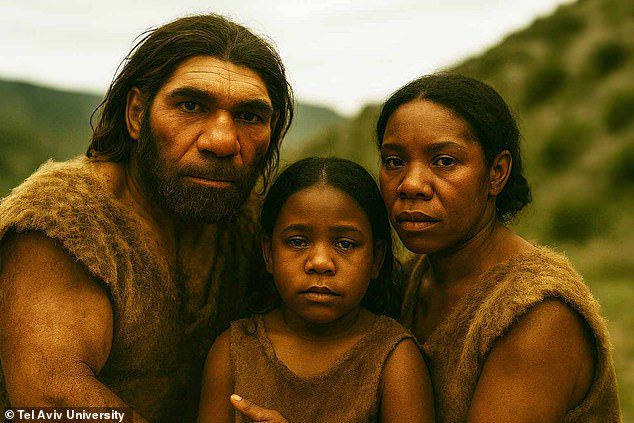
Hybrid children, according to scientists, would likely inherit traits from both parents. This could mean they had the long arms and short legs of a Neanderthal combined with the smaller skull of a Homo sapiens. They might also have exhibited strong Neanderthal facial features alongside the upright posture and long legs of modern humans. In some cases, hybridization could even lead to the development of unique traits not seen in either parent.
Anne Dambricourt-Malassé, a paleoanthropologist at the French National Centre for Scientific Research and co-author of the study, described the girl’s skeleton as providing insight into what hybrids might have looked like. She noted that the girl had a powerful neck, a forehead less bulging than that of Homo sapiens, and a slight subnasal prognathism, which would have given her a jaw similar to the famous ‘Habsburg chin.’
Her spine suggested she stood more upright than Neanderthals, who typically walked with a curved back. However, her jaw, spine, and pelvis showed clear Neanderthal influences.
The study, published in the journal l’Anthropologie, highlights the complexity of human evolution and the deep connections between different hominin species. It offers a new perspective on how early humans and Neanderthals interacted and influenced each other genetically and biologically over thousands of years.