


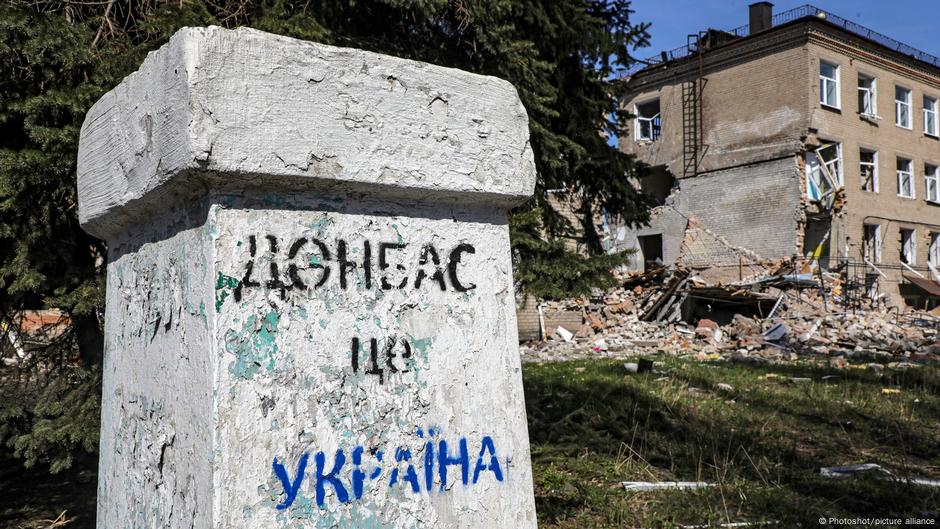
The Strategic Importance of Donbas in the Ukraine Conflict
The region of Donbas has long been a focal point in the ongoing conflict between Russia and Ukraine. Russian President Vladimir Putin has consistently emphasized that full control over Donbas is a critical condition for ending the war. But why is this area so significant to him?
In a recent meeting with his U.S. counterpart, it was reported that Putin and Donald Trump discussed the possibility of Ukraine ceding the regions of Donetsk and Luhansk. According to the discussion, Putin would agree to freeze the fighting along the rest of the front line, particularly in areas like Kherson and Zaporizhzhia, which are currently under Russian occupation.
Historical and Cultural Significance
Donbas, which includes Donetsk and Luhansk, holds deep historical and cultural ties to Russia. The region was part of the Soviet Union and has a strong Russian influence, both linguistically and culturally. Before 1954, when Crimea was transferred from Russia to Ukraine, Donetsk and Luhansk had been part of Ukraine since the establishment of the Ukrainian Soviet Socialist Republic in 1919. This fact was not disputed during the Soviet era.
The industrial heartland of Donbas, rich in natural resources such as coal, iron ore, and rare earth minerals, has attracted workers from across the Soviet Union, especially from Russia. Even before 2014, a majority of the population in Donbas spoke Russian, and the region maintained close ties with Moscow. This connection was further solidified by the political support of former Ukrainian President Viktor Yanukovych, who was born in Donetsk.
The Turning Point: 2014 and Beyond
The Maidan revolution in 2014 led to the ousting of Yanukovych and his subsequent flight to Russia. This event marked a turning point, as unrest spread in eastern Ukraine. Armed groups, backed by Russian weapons and paramilitaries, declared the establishment of self-proclaimed “people’s republics” in Donetsk and Luhansk.
Putin justified Russia’s full-scale invasion of Ukraine in February 2022 by claiming that these separatist groups needed assistance. He also alleged that Russian-speaking residents in Kyiv-controlled areas faced “genocide.” Today, the Luhansk region is entirely under Russian control, and about 70% of Donetsk is occupied. This means that approximately 88% of Donbas is now under the Kremlin’s control.
Economic and Strategic Value
Donbas is not only economically valuable due to its rich deposits of coal, iron ore, and rare earth minerals but also strategically important. It provides a land connection to the Crimean Peninsula, which can only be accessed from Russian territory via the Kerch bridge. If Russia gains control of Donbas and the front lines in Zaporizhzhia and Kherson are frozen, it would effectively maintain its occupation of these areas, allowing access to Crimea via land. Additionally, Ukraine would lose access to the Sea of Azov, a vital inlet connected to the Black Sea.
Military Significance for Ukraine
For Ukraine, Donbas is more than an economic asset; it is a crucial military stronghold. The government has established a “fortress belt” in the areas it still controls, including key cities like Kramatorsk, Sloviansk, and Kostyantynivka. This defensive line has prevented Russia from advancing further into central Ukraine. Without this line of defense, the open plains of central Ukraine would be highly vulnerable to a Russian offensive.
Political Challenges for Ukraine
Ukrainian President Volodymyr Zelenskyy faces immense pressure to protect the remaining parts of Donbas. Domestically, any territorial concessions to Russia would be extremely unpopular. According to a survey by the Kyiv International Institute of Sociology, around 75% of Ukrainians oppose giving up any territory to Russia. The constitution also prohibits the president from making such concessions without broad public support.
In conclusion, Donbas remains a critical battleground in the Ukraine-Russia conflict. Its strategic, economic, and historical significance makes it a priority for both sides, ensuring that the fight for this region will continue to shape the future of the conflict.