


Revolutionary Airborne Wind Power System Set to Transform Energy Generation
Chinese scientists are making significant strides in airborne wind turbine technology, with the development of a megawatt-level system that could revolutionize energy generation in remote areas and disaster zones. This innovative project, led by Beijing SAWES Energy Technology Company, is being hailed as a breakthrough that could bring sustainable power to regions where traditional infrastructure is lacking.
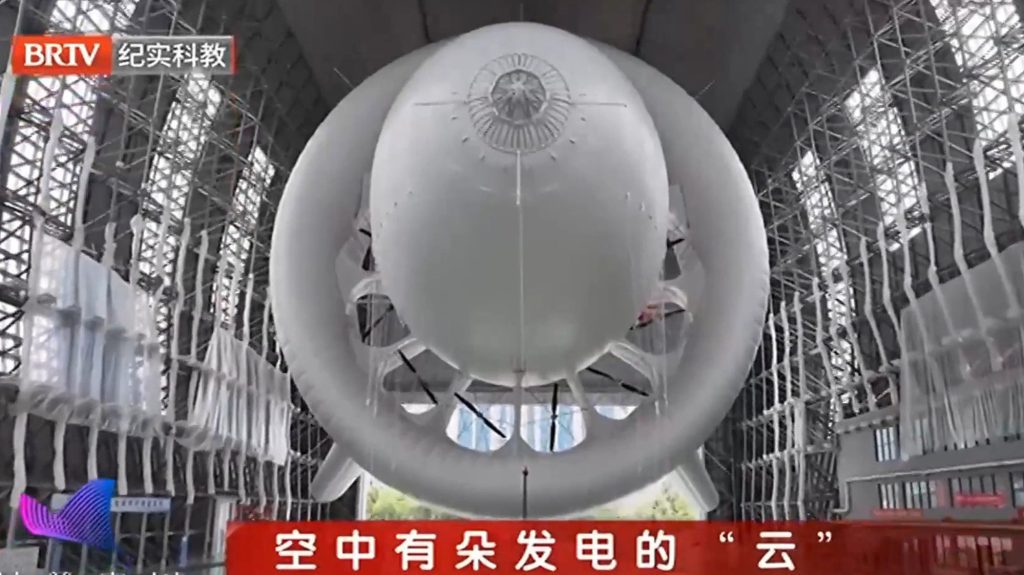
The floating wind power generation system resembles an airship and is designed to harness high-altitude winds, which are stronger and more consistent than those found at ground level. Unlike conventional wind turbines, which are limited to capturing wind energy within 200 meters of the Earth’s surface, this system lifts generators into the sky like kites, enabling them to tap into powerful winds at higher altitudes.
A New Era of Wind Energy
The system uses a helium-filled aerostat to lift lightweight power generation equipment to a predetermined height, where it converts high-altitude wind energy into electricity. This electricity is then transmitted to the ground through a tethered cable. According to Weng Hanke, chief technology officer of SAWES, the technology has the potential to produce up to 27 times more power compared to ground-based systems due to the increased wind speed at higher altitudes.
Weng highlighted that at 1,500 meters, wind speeds are three times faster than at ground level, making it a highly efficient source of energy. He also emphasized that high-altitude wind is more consistent, allowing for steadier energy generation than traditional turbines. Once these systems are built in large numbers, the cost of power could become comparable to that of conventional wind turbines.
Historical Foundations and Technological Breakthroughs
The theoretical foundation for this technology dates back to 1957 when renowned scientist Qian Xuesen proposed the “ejector diffuser duct” theory, suggesting that adding a ring structure around a wind turbine could significantly improve its efficiency. Weng’s team has built upon this principle, achieving a critical engineering breakthrough with their unique duct structure.
This design combines a main airbag with a ring wing, accelerating airflow diffusion and increasing wind energy use efficiency by over 20 percent. The S1500 system, which boasts a generation capacity of 1 megawatt, employs 12 micro-generators positioned at the center of the duct. Each micro-generator is composed of carbon fibre blades and a specially designed motor, making the entire unit less than 1 tonne—90 percent lighter than a conventional wind turbine.
Safety and Reliability
Safety is a key consideration in the system’s design. Ground-based radar monitors the flight environment, while built-in sensors maintain the airbag’s stability. In the event of extreme wind fluctuations, the system can rapidly descend within five minutes, ensuring safe operation even in challenging conditions.
Dun Tianrui, founder and CEO of SAWES, noted another major breakthrough: the team has made significant progress in solving the issue of gas leakage from the aerostat. These innovations could potentially allow the floating system to remain operational in the air for more than 25 years.
Applications and Future Goals
The system is particularly well-suited for disaster relief, as it can be deployed quickly to power emergency equipment on-site. It also addresses the challenge of providing power to isolated locations such as remote islands and oilfields. Batch production is already underway in Yueyang, Hunan province, with SAWES securing contracts and orders totaling more than 500 million yuan (US$70 million) by July.
Looking ahead, Dun said the company’s ultimate goal is to operate in the stratosphere, approximately 10,000 meters high, where wind is 200 times more powerful. At that altitude, the cost of electricity could be reduced to one-tenth of current levels.
Conclusion
With continued advancements in technology and growing interest in renewable energy solutions, airborne wind power systems like the S1500 represent a promising future for sustainable energy generation. As research progresses and production scales up, these systems could play a crucial role in meeting global energy demands while supporting communities in need.