


The Evolving Role of Drones in Modern Warfare
The rapid advancement of drone and robot technology is reshaping the landscape of modern warfare. From robot dogs to high-tech drones, leading military powers like China and the United States are developing systems that could play significant roles on the battlefield in the near future. However, despite these developments, humans remain central to decision-making and combat operations.
China has made it a priority to modernize its military, with a focus on unmanned operations. Chinese leader Xi Jinping emphasized the importance of these technologies, urging the People’s Liberation Army to accelerate their adoption. Similarly, the United States has proposed a “hellscape” strategy in Asia, involving swarms of drones around Taiwan to defend the island in the event of an attack. Prominent figures such as Elon Musk have argued that investing in advanced crewed weapon systems is no longer practical, suggesting that drones are the future of warfare.
Despite the advantages of autonomous weapons, including reduced human casualties and costs, major military powers continue to invest in expensive crewed systems. These include sixth-generation fighter jets that work closely with drones known as “loyal wingmen” to achieve air superiority. This model remains attractive despite the risks associated with AI in warfare. Additionally, countries like China, the US, and others are expanding their naval power through crewed systems such as aircraft carriers, which serve as strategic deterrents beyond their coastlines.
Analysts emphasize that traditional systems cannot always be replaced due to limitations such as vulnerability to jamming and ethical concerns surrounding autonomous systems. Kateryna Bondar, an AI and military expert at the Centre for Strategic and International Studies, noted that while drones are becoming increasingly important, they have not replaced people or traditional platforms. In air and maritime domains, manned platforms remain at the core, with future fighter jets likely to control swarms of autonomous systems but still being crewed and central to force projection.
Lessons from the Conflict in Ukraine
The conflict in Ukraine has highlighted the capabilities of drones in modern warfare. Both sides have deployed unmanned systems on a massive scale, with Ukraine using drones to target Russian ships in the Black Sea. For example, Ukrainian drones sank Russia’s Caesar Kunikov amphibious landing ship and Ivanovets missile corvette. More recently, over 100 Ukrainian drones struck airbases deep inside Russia, destroying several nuclear-capable long-range bombers.
However, the use of drones also comes with challenges. Ukraine may be losing about 10,000 drones per month due to jamming, and analysts note that drones are not a silver bullet. Timothy Heath, a senior international defense researcher at the RAND Corporation, pointed out that while drones have been effective, manned aircraft still play an important role. Manned aircraft can command and control drones from the air, offering better situational awareness and reducing the risk of jamming.
Bondar emphasized that despite the sophistication and scale of drone use, victory on the battlefield still depends on factors such as the volume of fire, logistical sustainment, and combined arms operations. She added that in open waters, uncrewed surface and underwater vehicles offer new capabilities but are controlled and coordinated from a manned vessel, which remains the strategic and command hub.
The Concept of Manned-Unmanned Teaming
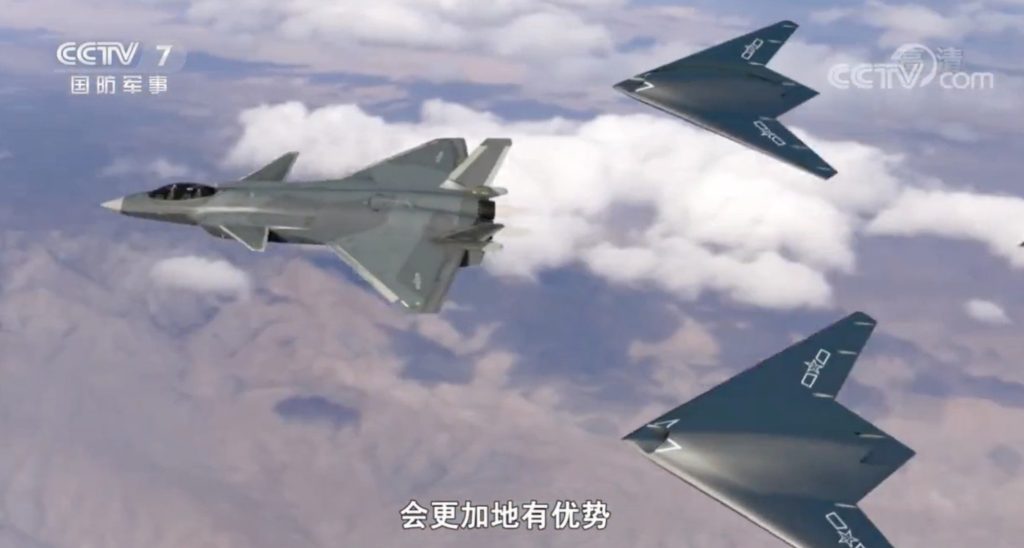
As militaries develop more advanced drones and sophisticated ways to use them, they are also exploring the concept of manned-unmanned teaming, where humans and autonomous systems work together. In the US, the F-47 sixth-gen fighter jet aims to be a “system of systems” with a manned aircraft controlling drones. China is believed to be pursuing a similar approach with its sixth-gen fighters, which could operate alongside drones.
The PLA is also exploring the use of “loyal wingmen” drones in tandem with its J-20 stealth fighters, particularly the new two-seat J-20S. This approach is also being pursued by Britain, Italy, and Japan under their Global Combat Air Programme. Meanwhile, the Future Combat Air System, led by France, Germany, and Spain, aims to create a cutting-edge “system of systems” to underpin Europe’s air superiority into the 2040s and beyond.
Russia, though not officially launching a sixth-generation aircraft program, is developing a heavy unmanned combat aerial vehicle called Okhotnik to fly in coordination with its fifth-generation Su-57 fighter jet. According to Bondar, manned-unmanned teaming remains worth investing in because it combines the best of both worlds: human judgment and machine speed.
Ethical and Technical Challenges
While drone swarms have already made their way onto modern battlefields, they face several limitations. Bondar noted that challenges such as payload, range, communications, and AI remain real. The more payload a drone carries, the shorter its range. True autonomy, especially in contested, GPS-denied environments, is extremely hard to achieve.
Heath highlighted the vulnerability of drones to jamming, noting that some rely on wired communications with human controllers, which limits their operational range. Fu Qianshao, a retired PLA Air Force equipment expert, emphasized that in complex battle conditions, human judgment is crucial. Machines cannot yet make nuanced decisions, and autonomous targeting can lead to misjudgments, including attacking civilians by mistake.
Military use of drones also poses ethical challenges. Bondar stated that AI-driven decision-making is not advancing rapidly among major military powers, and it should not. The real challenge lies in ethical and institutional considerations, raising questions about how far AI should be allowed to go and who gets to decide that.
Thorsten Jelinek, an expert on artificial intelligence, argued that international guard rails are urgently needed. He suggested an agreement on restricting AI for combat or at least informing the other side about capabilities. The United Nations has called for progress on a global framework to regulate autonomous weapons, aiming to produce guiding principles as early as next year.
In conclusion, while drones are redefining roles and reshaping tactics, they remain part of a broader combined system rather than a substitute for manned systems. The future of warfare will likely involve a balance between human judgment and machine capabilities, ensuring that technology serves as an extension of human intent rather than a replacement.