


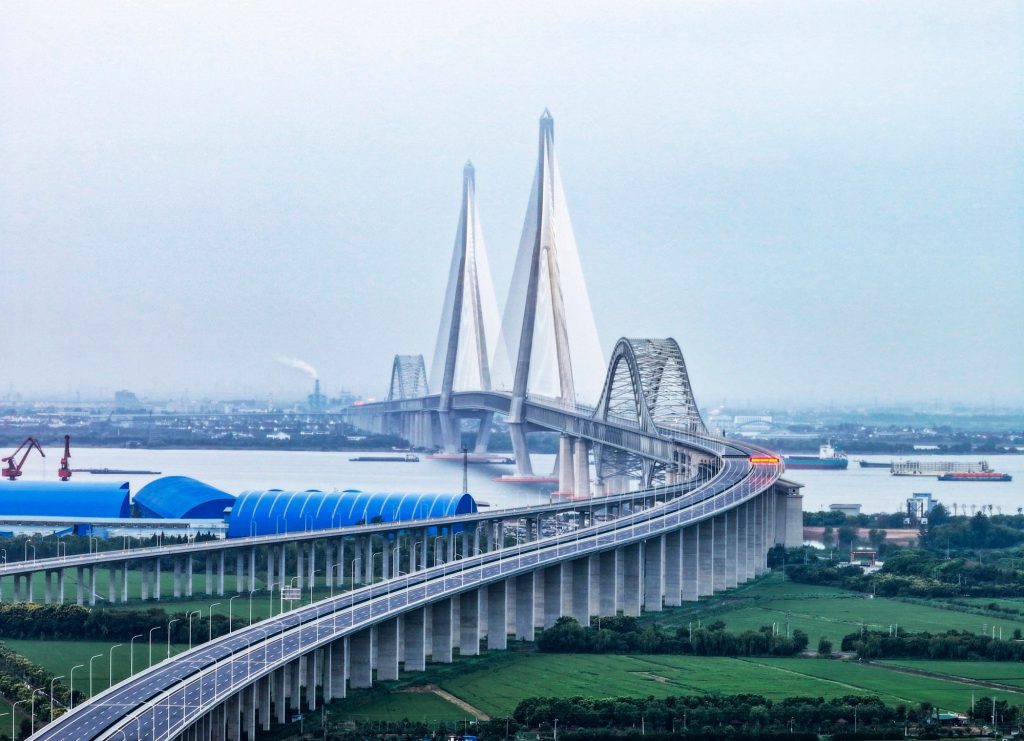
A Groundbreaking Achievement in Bridge Engineering
The Changtai Yangtze River Bridge has made history by becoming the world’s longest cable-stayed bridge, marking a significant milestone in engineering and infrastructure. Located in Jiangsu province, eastern China, this remarkable structure connects the cities of Changzhou and Taizhou, drastically reducing travel time from over an hour to just 20 minutes. The bridge spans an impressive 10.3 kilometers (6.4 miles) with a main span of 1,208 meters (3,960 feet). It is the first river crossing to carry an expressway, regular road, and intercity railway all on the same structure.
A Unique Design for Modern Mobility
One of the most distinctive features of the bridge is its asymmetrical lower deck. On one side, there is a high-speed railway capable of reaching 200 km/h (124 mph), while the other side accommodates regular road traffic. This side-by-side layout is a first in large-span bridges and was designed to improve efficiency and reduce urban land use. Traditionally, rail systems are placed in the center due to their weight, but this approach created challenges for integrating with the city’s road network.
To solve this issue, engineers had to find a way to maintain balance without compromising the design. Qin Shunquan, chief scientist at China Railway Group and lead designer of the bridge, explained that the team developed innovative techniques to adjust the cable tensions on the railway side. This allowed the deck to remain level despite the weight imbalance. By calibrating each prefabricated segment during production, they ensured that the deck would naturally straighten once assembled.
Innovations That Redefine Engineering Standards
The construction of the Changtai Yangtze River Bridge posed numerous challenges that pushed engineers to develop new tools and methods. One such innovation was the satellite-guided tower crane used to lift materials precisely onto the bridge towers. Additionally, the team built the world’s largest bridge-deck crane, which can move along the span and position massive segments with millimetre-level accuracy.
Project leader Zhong Aixiu, from state-owned China Communications Construction Company, highlighted the importance of these innovations. He noted that the project required engineers to think outside the box and create solutions tailored to the specific needs of the bridge. This included designing a foundation capable of withstanding the powerful currents of the Yangtze River, as well as implementing diamond-shaped towers made of steel and concrete for added stability.
Flexible joints were also introduced to accommodate temperature changes, ensuring the bridge remains resilient under varying conditions. These features demonstrate the advanced engineering behind the project and its commitment to safety and longevity.
A New Era in Bridge Construction
Cable-stayed bridges, like the Changtai Yangtze River Bridge, rely on a main deck supported by cables running to one or more towers. The previous record holder for the longest main span was the Russky Bridge in Vladivostok, Russia, with a span of 1,104 meters (3,620 feet). However, the Changtai Yangtze River Bridge surpasses this with its impressive 1,208-meter span.
While suspension bridges can achieve even longer spans, they are typically used for different purposes. Famous examples include the Golden Gate Bridge in San Francisco and the 1915 Canakkale Bridge in Turkey, which holds the record for the longest single span at 2,023 meters.
Future Developments Along the Yangtze River
According to CCTV, there are currently around 150 bridges along the 3,000-kilometer main stretch of the Yangtze River. China aims to increase this number to 240 by 2035, averaging one bridge every dozen kilometers. This ambitious plan underscores the country’s commitment to improving connectivity and supporting regional growth.
The completion of the Changtai Yangtze River Bridge not only sets a new standard in bridge engineering but also highlights the potential for future innovations in infrastructure. As technology continues to evolve, so too will the ways in which we connect and interact with our environment.