


The Escalation of Tensions in Europe
UK Defence Secretary John Healey has raised concerns that Vladimir Putin is testing the West after Russian drones violated Polish airspace, prompting a multinational response. This incident has led to widespread alarm and a significant escalation in tensions across Europe. Over eight million Poles were ordered to seek shelter as the drones flew overhead, with debris from one downed device causing severe damage to a home. Poland’s Prime Minister, Donald Tusk, condemned the unprecedented breach of airspace, stating it brings the country closer to open conflict than at any time since the Second World War.
Poland invoked NATO’s Article 4, which allows any member to call for urgent consultations if they feel their territorial integrity, political independence, or security is at risk. NATO Secretary General Mark Rutte issued a stark warning to Putin, urging him to stop violating allied airspace and emphasizing that NATO stands ready to defend every inch of its territory.
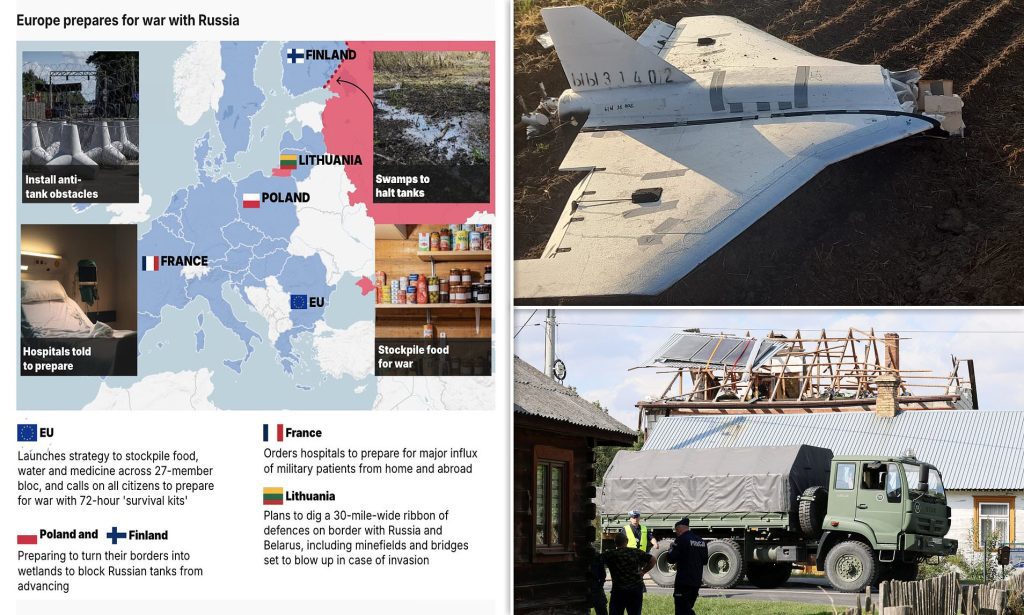
During this event, up to four of the 19 Russian drones were shot down by Polish and NATO aircraft, marking the first time Kremlin drones have been downed while flying above NATO territory. These drones were part of a larger overnight attack on Ukraine, where Russia launched 415 drones. As Europe braces for an imminent war with Russia, countries are taking drastic measures to prepare for potential crises, including stockpiling essential goods like food, water, and medicine.
Several EU nations are implementing defensive strategies, with Finland and Poland leading the charge by calling for the restoration of bogs and marshes to create natural barriers against Russian tanks. This approach not only serves as a defense mechanism but also contributes to environmental conservation. Peatlands, which naturally store large amounts of carbon dioxide, are being prioritized for restoration to combat climate change and enhance national security.
Germany’s Chancellor Friedrich Merz warned that Putin’s ‘imperialist plan’ would not end with the conquest of Ukraine but could be just the beginning. Meanwhile, Brussels has launched a ‘stockpiling strategy’ to ensure the continuity of key goods across Europe in the face of potential crises such as energy blackouts, pandemics, and climate change. The EU is also pushing for every household to have a three-day survival kit, including matches, ID documents, bottled water, energy bars, and a flashlight.
France’s government has instructed health bodies to prepare for a ‘major engagement’ by March 2026, anticipating a potential flood of military patients from home and abroad. Ukrainian President Volodymyr Zelensky has warned that Putin could attack a NATO country within the next five years, criticizing the alliance for a slow spending ramp-up. However, the threat could emerge much sooner, with Healey remarking that ‘Putin hit a new level of hostility against Europe’ after the Polish incursion.
Russia claims it did not plan to attack any targets in Poland, but Warsaw’s defense minister dismissed theories about an accidental malfunction. ‘Russian drones have veered into Polish airspace before – not just drones but also cruise missiles,’ Radoslaw Sikorski said. ‘When one or two drones does it, it is possible that it was a technical malfunction, but in this case there were 19 breaches, and it simply defies imagination that could be accidental.’
The use of wetlands as a defensive measure has historical precedence. In February 2022, Ukraine flooded 2,800 hectares of land to repel Russian advances, creating an impenetrable swamp that left advancing tanks stuck in the mud. Now, there are growing calls in Europe to accelerate the restoration of bogs and marshes as a measure to combat climate change and bolster defense.
Peatlands, which store large amounts of carbon dioxide, are being prioritized for restoration to slow climate change, promote biodiversity, and prepare border nations for potential war with Russia. As part of Poland’s £1.9 billion Eastern Shield development project, swamplands and forests close to its borders with Russia will be expanded. This initiative aims to leverage the natural environment as an ally in enhancing defense infrastructure.
In addition to expanding swampland, Poland has added protective minefields to a 20-kilometre stretch of land bordering Russia and Belarus. The country plans to increase its armed forces to 300,000 troops within a few years. Finland, too, is considering rewetting peatlands near its eastern border, recognizing the dual benefits of environmental conservation and defense.
Scientists argue that restoring bogs on NATO’s eastern flank would be a relatively cheap and effective measure to achieve EU climate targets and defense goals in one fell swoop. However, there are environmental downsides and complications associated with the plan to revive Europe’s swamps. For instance, people with privately-owned land in areas earmarked for rewetting may oppose the move. Moreover, the ecological impact of flooding areas for defense purposes can be significant, as seen in Ukraine’s Irpin basin.
Governments in the Baltic states, which share a 600-mile border with Russia and Belarus, have shown little interest in the project so far, apart from Lithuania, which is currently discussing defense-linked wetland restoration. Lithuania has revealed plans to dig a 30-mile-wide ribbon of defenses on its borders with Russia and Belarus, including minefields and bridges set to blow up in case of an invasion.
Estonia, Latvia, and Lithuania have been fortifying their borders, adding obstacles and redoubts to existing fences amid Russia’s mounting aggression. When complete, the Baltic defense line is estimated to be more than 940 miles long and will limit Russia’s ability to launch attacks from its own territory, Kaliningrad, and Belarus.
Lithuania has begun setting up dozens of ‘engineering parks’ filled with ‘counter-mobility’ equipment, including razor wire, concrete roadblocks, Czech Hedgehogs, and dragon’s teeth. The new ribbon will be made of three layers, starting with an anti-tank ditch next to the border fence, followed by embankments, strips of dragon’s teeth, minefields, and strongpoints for defending infantry.
Estonia approved a four-year €2.8 billion additional defense funding bill earlier this year, pushing the Baltic country to an average defense spending of 5.4 per cent of GDP through to 2029. Merz emphasized the need to build a new security architecture that lasts for several decades, highlighting the pressure on the liberal world order from autocracies.
The EU has launched a broad readiness push to bolster its militaries and ensure it can defend itself by 2030. France has ordered hospitals to prepare for an imminent war, anticipating a high influx of military patients. Britain, despite its recent memory of armed conflicts, has fallen behind in civil planning, with the UK defence staff acknowledging gaps in civil aspects of planning.
Sweden has taken proactive steps by sending out five million pamphlets to its population, urging preparedness for the possibility of a lasting conflict. NATO chief Mark Rutte has sounded the alarm about a major conflict anticipated to be started by simultaneous invasions from Xi and Putin, warning of a potential World War nightmare.
Britain could send fighter jets to bolster NATO’s air defense over Poland after Russian drones were shot down over the country. Defence Minister Healey stated that 300 UK armed forces personnel are stationed in Poland, and the UK had six RAF Typhoon jets over the country as part of NATO’s air policing responsibilities. Following the drone incursion, he asked the Armed Forces to look at options to bolster NATO’s air defense over Poland.
Shocking images show the devastation inside a Polish home torn apart after being struck by a Russian drone. The roof has been completely destroyed, leaving a gaping hole that exposes the rooms below to the sky. The owners survived by sheer luck, but had they been inside at the time, their deaths could have triggered NATO’s Article 5 and brought Europe to all-out war.
Article 4 of the North Atlantic Treaty states that members will consult together whenever, in the opinion of any of them, the territory, political independence, or security of any of them is threatened. Under Article 4, discussions at the North Atlantic Council could potentially lead to some form of joint decision or action. Since NATO’s creation in 1949, Article 4 has been invoked seven times, most recently in February 2022 when several countries sought consultations following Russia’s invasion of Ukraine.
NATO ambassadors held an emergency meeting in November 2022 after a missile strike killed two people in Poland, raising global alarm that the war could spill into neighboring countries. As tensions continue to rise, Europe remains on the brink of war, with Poland’s Prime Minister warning of unprecedented tensions after Russian drones violated NATO airspace.