


The Complex Dynamics of the Sudan War
Sudan’s war has persisted for three years, resulting in millions being displaced and the country teetering on the brink of collapse. Despite this dire situation, international diplomacy has remained largely ineffective. Understanding the conflict requires examining three interconnected power structures: the Arab Triangle, the Western Triangle, and the Sudanese Triangle. These groups significantly influence the continuation of the war and the prospects for peace.
As global leaders convene at the UN General Assembly in New York from 23 to 29 September 2025, the question remains whether the West can coordinate effectively to overcome Arab obstruction and amplify Sudanese civilian voices before the country fractures beyond repair.
The Arab Triangle: Proxy Interests and the “Reverse Veto”
The Arab states have played a pivotal role in prolonging the conflict in Sudan. Egypt, Saudi Arabia, and the United Arab Emirates share concerns over Red Sea security, the rise of Islamist movements, and migration flows, but they differ in their support for various factions. Cairo backs the Sudanese Armed Forces (SAF), while Riyadh attempts to maintain a balance. Abu Dhabi has been accused of supplying the Rapid Support Forces (RSF).
This divergence has led to what Sudanese analysts refer to as a “reverse veto.” Any conference hosted by a Western capital, such as London, Washington, or Geneva, is often undermined by one or more Arab states supporting their preferred faction. This dynamic has hindered progress, as seen during the London Sudan conference in April and the blocked US efforts to convene a joint ministerial in July. Consequently, the Arab Triangle acts more as a spoiler than a stabilizer.
The Western Triangle: Capacity Without Unity
In contrast, the Western Triangle—comprising London, Washington, and Geneva—possesses significant institutional capacity to mobilize resources, convene multilateral forums, and set the terms of international mediation. However, Western diplomacy has lacked unity and urgency.
The UK, despite its historical ties to Sudan, has appeared hesitant. The US has engaged intermittently, often constrained by regional disputes. Meanwhile, Geneva-based institutions, including the UN and humanitarian agencies, have struggled to break through the Arab veto. Without coherent coordination, Western capitals have allowed the Arab Triangle to dominate the narrative and the battlefield.
The upcoming UN General Assembly presents a rare opportunity for the Western Triangle to act in unison. By agreeing on common principles and elevating the civilian agenda, they can begin to reframe diplomacy around Sudanese needs rather than Arab rivalries.
The Sudanese Triangle: Where the Real Struggle Lies
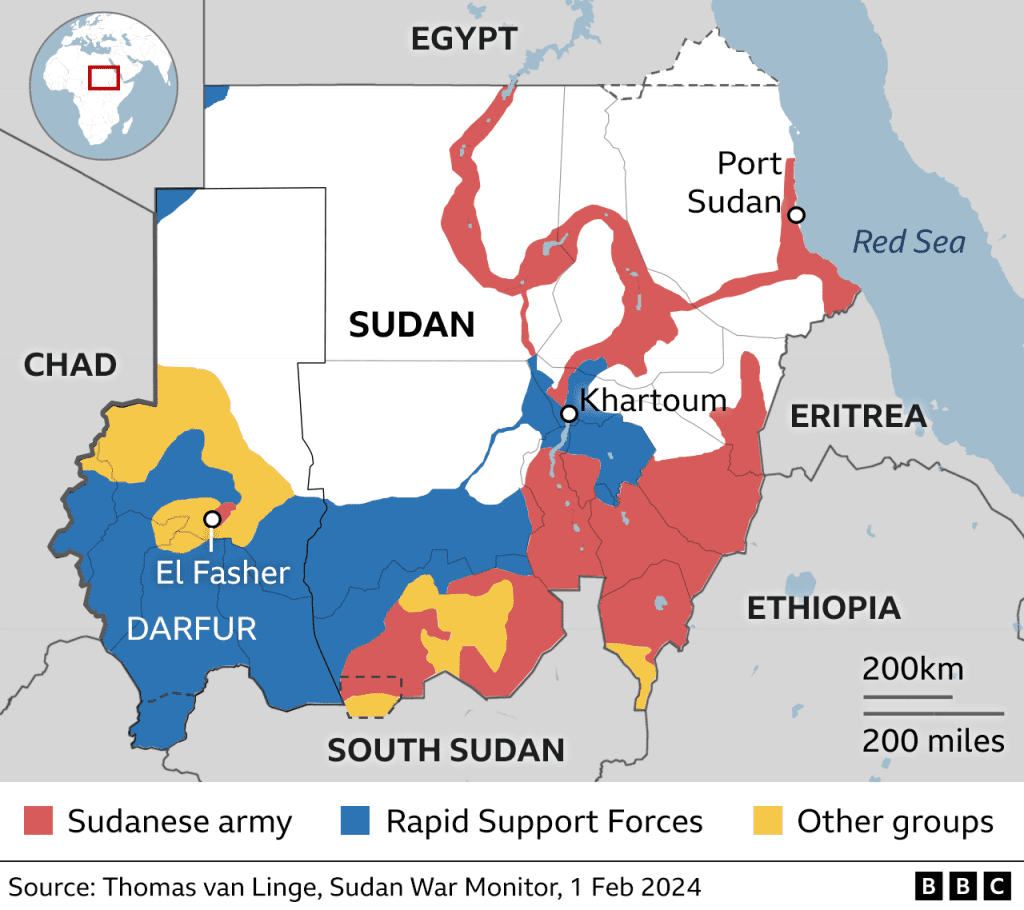
At the heart of the conflict lies the Sudanese Triangle, consisting of the SAF, the RSF, and the country’s diverse civilian actors. The SAF, led by General Abdel Fattah al-Burhan, has entrenched its military rule in Port Sudan, bolstered by Islamist networks. The RSF, under Mohamed Hamdan Dagalo (Hemedti), has consolidated power in Darfur and is accused of widespread atrocities. Both forces have rearmed and recruited extensively, preparing for a protracted war.
Yet civilians remain Sudan’s greatest hope for peace. Networks such as the Emergency Response Rooms (ERRs), largely run by the December Revolution youth and women, have provided essential humanitarian relief. Political coalitions, including Somoud (the Civil Democratic Alliance for Revolutionary Forces), are seeking to unite fragmented pro-democracy voices into a broad civilian front. Sudanese think tanks and research centers are also generating ideas for governance and reconstruction, even amid collapse.
However, these civilian actors face three obstacles: limited access to formal negotiations, deliberate efforts by the warring parties to divide and discredit them, and the international community’s tendency to default to “men with guns” in search of quick-fix power-sharing deals.
Breaking the Deadlock in New York
The General Assembly offers a critical test. If Western capitals treat Sudan as a secondary crisis, the war will drag on, deepening the humanitarian catastrophe and risking partition. But if the Western Triangle asserts leadership, three steps are possible:
- Overcoming the Arab veto by building coordinated pressure on Egypt, Saudi Arabia, and the UAE to support, rather than block, ceasefire talks.
- Prioritizing civilian inclusion, not as an afterthought but as the centrepiece of any diplomatic track.
- Designing a peace process that starts with a humanitarian ceasefire, expands civic space, and builds towards a political settlement rooted in justice and equal citizenship.
These are not abstract ideals. They are lessons drawn from Sudan’s own December Revolution, which toppled Omar al-Bashir without foreign mediation. They are echoed by civil society voices still risking their lives to deliver aid, organize communities, and envision a democratic state.
Three Triangles, One Choice
The interplay of the Arab, Western, and Sudanese triangles will determine whether Sudan descends into permanent fragmentation or charts a path towards peace. For now, the Arab Triangle’s reverse veto has set the terms, and the Sudanese Triangle remains squeezed between two predatory armies. Only the Western Triangle has the leverage to shift this balance by empowering Sudanese civilians and preventing another decade-long war on the Red Sea.
In New York, the choice is clear: either the General Assembly becomes yet another missed opportunity, or it becomes the moment when global diplomacy finally recognizes that Sudan’s war cannot be ended without Sudanese civilians at its core.