





Israel’s Military Actions in Gaza and the Debate Over Proportionality
Israel’s military operation in Gaza has led to significant loss of life, widespread destruction of infrastructure, and severe restrictions on humanitarian aid. The conflict began after Hamas launched a series of attacks on 7 October 2023, resulting in over 1,200 deaths and the capture of hundreds of hostages. The United Nations later stated that Hamas had committed war crimes and crimes against humanity.
Prime Minister Benjamin Netanyahu has defended the operation as a “just war” aimed at dismantling Hamas and securing the release of all hostages. He has also emphasized Israel’s commitment to international law. However, this commitment is increasingly being questioned by human rights organizations and some governments, which accuse Israel of ethnic cleansing and genocide. Netanyahu denies these allegations.
A key legal principle in assessing military actions is proportionality. According to the International Committee of the Red Cross, the effects of warfare must not be disproportionate to the military advantage sought. Experts interviewed by Viral In MediaVerify have largely concluded that Israel’s actions in Gaza do not meet this standard.
Prof Janina Dill from the University of Oxford stated that it is difficult to see how Israel’s conduct could be considered proportional. Similarly, Dr Maria Varaki from King’s College London said the use of force in Gaza was undeniably disproportionate. Prof Yuval Shany of Hebrew University noted that the campaign can no longer be viewed as proportionate. Prof Asa Kasher of Tel Aviv University argued that the number of non-combatant casualties appears too high to be justified under proportionality principles.
International law outlines rules governing the use of force, including the UN Charter and the Geneva Conventions, both of which Israel has ratified. These agreements require that military responses be proportionate to the threat faced. Additionally, each individual military action must be assessed for its potential civilian harm relative to its military benefit.
The overall impact of Israel’s campaign has been devastating. According to Gaza’s Hamas-run Ministry of Health, more than 64,500 people have been killed, with nearly half being women and children. While Israel disputes these figures, they are cited by the UN and other international bodies as the most reliable data available. UN Secretary General António Guterres described the level of death and destruction in Gaza as unprecedented.
Civilian casualties are not the only concern. Israel has imposed a total blockade on aid entering Gaza, a move condemned by the UN and many countries. Senior UN officials accused Israel of using food as a “weapon of war,” which violates international law. Despite this, Israel maintains that the blockage is necessary to prevent Hamas from exploiting aid supplies.
The situation has worsened, with the latest UN assessment indicating that a quarter of Palestinians in Gaza are suffering from famine. Israel’s Ministry of Foreign Affairs dismissed this report as fabricated, but aid agencies and UN officials continue to highlight the dire conditions.
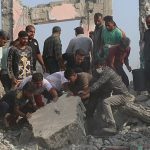
The destruction of buildings in Gaza has also raised concerns. A recent UN estimate suggests that up to 42% of structures in the Gaza Strip have been destroyed or damaged. Prof Emily Crawford from the University of Sydney Law School called this destruction clearly disproportionate, as it undermines the survival of the civilian population.
The debate over proportionality extends to specific military actions. For example, an airstrike near the Palestine Stadium in June 2024 resulted in the deaths of at least 11 people, including children. While the IDF claims it takes steps to minimize civilian harm, critics argue that targeting individuals poses an excessive risk to civilians.
The right to self-defence is central to Israel’s justification for its actions. Under Article 51 of the UN Charter, states have the right to defend themselves against armed attacks. However, experts like Francesca Albanese, the UN’s special rapporteur on human rights in the occupied Palestinian territories, argue that Israel has distorted the principles of distinction, military necessity, and proportionality.
Some experts question whether Israel’s goals go beyond self-defence. Statements by Israeli officials suggest a broader aim of destroying Gaza’s infrastructure and displacing its population. Prof Neve Gordon of Queen Mary University described the conflict as one of destruction rather than defense. Others, like Prof Gerry Simpson of the LSE, argue that the response resembles revenge or the erasure of Palestinian identity.
Legal proceedings are ongoing. In late 2024, the International Criminal Court issued arrest warrants for Netanyahu and others, alleging war crimes and crimes against humanity. The case brought by South Africa at the International Court of Justice, accusing Israel of genocide, remains unresolved.
Despite these developments, Israel continues to assert that its actions are lawful and proportionate. However, the majority of experts interviewed believe that aspects of the campaign have been grossly disproportionate, raising serious questions about compliance with international law.