


A Nation in Turmoil
South Korean politics is currently in a state of intense conflict, often described as a quasi-war. The ruling and opposition parties have been locked in a bitter struggle for nine months following the martial law incident at the end of last year. This division has extended beyond the political sphere, affecting the ruling party internally and creating a rift between the president and the party leader. Meanwhile, the opposition is struggling with its own disarray, and the public remains deeply divided. In line with Thomas Hobbes’ concept of a “war of all against all,” the nation is facing a challenging period.
The Path to Unity
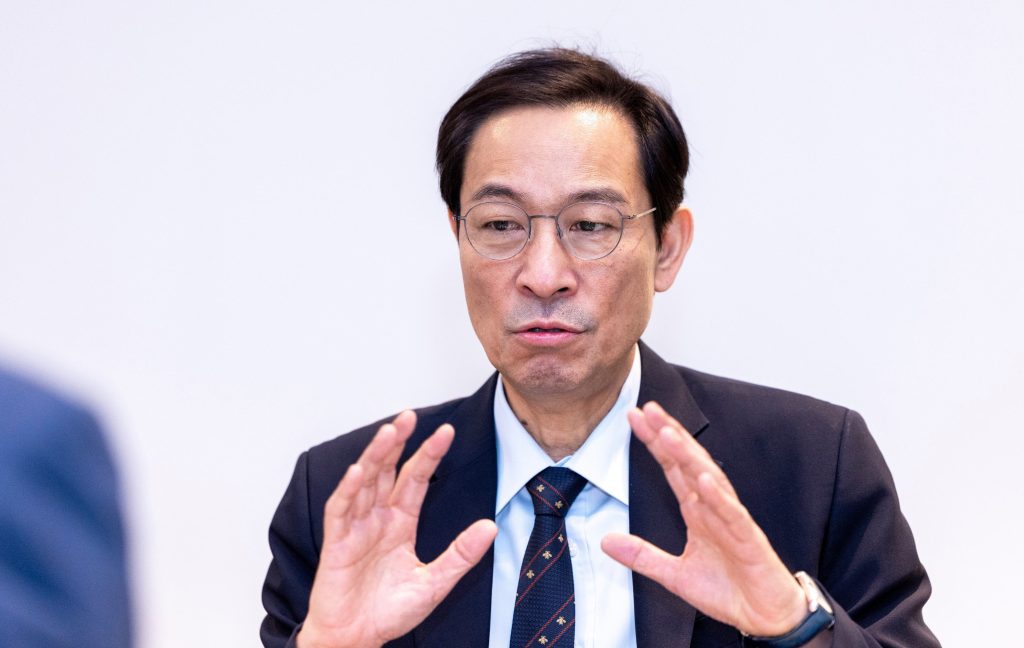
The responsibility of uniting the divided nation lies with the president. President Lee Jae-myung has appointed Woo Sang-ho, the Senior Secretary for Political Affairs, to lead this effort. Known for his rational and amicable nature, Woo approaches every interaction with a calm demeanor and a smile. His title as a “parliamentarian” has always preceded him. He believes that once the investigations into the martial law and rebellion are concluded, dialogue-based politics can be swiftly restored. Regarding the references to Representative Jung Chung-rae and YouTuber Kim Ou-joon as the “Yeouido·Chungjeong-ro Presidents,” he dismisses these claims as exaggerated, emphasizing that President Lee is the sole leader of the Republic of Korea.
Balancing Corporate and Labor Interests
One of the key challenges for the government is balancing corporate interests with labor concerns. Over the first 100 days in office, the government has managed to normalize the national system that was disrupted by martial law and has helped the economy recover. The pardon of Cho Kuk, the chairman of the emergency committee of the Rebuilding Korea Party, was an unavoidable decision, and the government seeks the public’s understanding.
President Lee has consistently advocated for pragmatic policies, aiming to both pressure and appease corporations. The government is pushing for corporate laws and labor standards to align with international norms while ensuring that businesses do not collapse due to these changes. The goal is to support businesses through national finances and R&D investments, enabling them to generate profits. This approach is often described as “catching two rabbits at once.”
Labor Reforms and Energy Policy
The government is also calling for reforms in labor unions, particularly regarding unfair practices such as preferential hiring of union members’ children. On the issue of nuclear energy, the government has stated that new reactors will not be built, but this does not constitute a “second round of nuclear phase-out.” Existing nuclear reactors will continue to operate at full capacity, and the focus will shift towards renewable energy. This strategy aligns with expanding nuclear exports without contradicting the move towards cleaner energy sources.
Judicial Reforms and Political Challenges
The Special Tribunal for Rebellion faces significant constitutional controversy. The government argues that if the Chief Justice appoints the judges for the rebellion tribunal, it is not unconstitutional. The political sphere is not designating specific judges, and eliminating unconstitutional elements would resolve the issue. The tribunal was proposed due to the slow pace of rebellion trials, and the court has promised to conclude trials by the end of the year. If trials proceed swiftly, the tribunal may become unnecessary.
There are concerns that expanding the judiciary could be used to control the Supreme Court or acquit the president. However, the president has suggested delaying legislation and proceeding cautiously after hearing the court’s position. While the president cannot directly instruct the ruling party on what to do, the Supreme Court and the ruling party should resolve the issue through dialogue.
Legislative Disputes and Future Steps
The ruling party broke an agreement on the Special Counsel Team Act with the opposition. There was communication between the presidential office and the ruling party, but when supporters protested, Representative Jung Chung-rae reversed the decision. The president expressed a principled stance to respect supporters’ opinions, accepting the opposition’s demands for a ruling-opposition-government livelihood consultative body and a 500 million won stock transfer tax threshold.
Regarding the dissolution of the PPP, the senior secretary refrained from commenting, as any answer would spark controversy. Despite being seen as the right person to lead dialogue and cooperation, the lack of results is a challenge. The fundamental limitations stem from the martial law incident, where the Yoon administration attempted to arrest lawmakers at gunpoint, leading to inevitable clashes until judicial processes are resolved.