


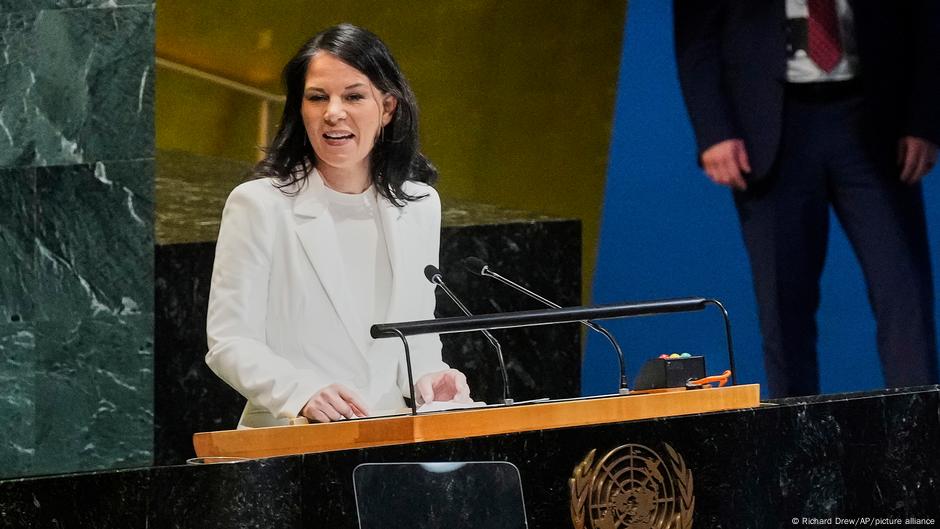
UN President Envisions Peacekeeping Role in Post-War Ukraine
Annalena Baerbock, the newly appointed president of the United Nations General Assembly, has expressed openness to the idea of deploying UN peacekeeping forces, known as Blue Helmets, to help secure a lasting peace in Ukraine following the ongoing war. This statement came during an interview with a German weekly newspaper, where she emphasized the importance of ensuring that any peace agreement is effectively enforced.
Baerbock, who previously served as Germany’s foreign minister and co-leader of the Green Party, assumed her new role on September 9. She highlighted the need for international cooperation to maintain peace, stating that if a majority of UN member states support the deployment of Blue Helmets, it could be a crucial step toward securing long-term stability.
The Role of UN Peacekeepers
UN peacekeeping missions are commonly referred to as Blue Helmets due to the distinctive blue headgear worn by personnel. These missions involve military and civilian staff from various UN member states, operating under the command and control of the United Nations. Their primary goal is to maintain peace and security in conflict zones.
However, the feasibility of such a mission in Ukraine remains uncertain. The UN Security Council, which has the authority to authorize peacekeeping operations, includes Russia, which holds a veto power over any decision. This means that any potential deployment of Blue Helmets would require Moscow’s approval, a challenge given the current geopolitical tensions.
Ongoing Ceasefire Efforts and Stalemate
Efforts to reach a ceasefire between Ukraine and Russia have been ongoing for months, but progress has been minimal. Russia has consistently refused to engage in talks until its demands regarding Ukraine’s aspirations to join NATO and the European Union are addressed. This stance has led to prolonged conflict, with the war in Ukraine beginning in February 2022 after years of unrest, including the annexation of Crimea in 2014.
Despite the challenges, Baerbock remains hopeful that international collaboration can lead to a resolution. She emphasized that peacekeeping missions are more necessary than ever, not just in Europe but globally. Her comments reflect a broader concern about the need for sustained international engagement in conflict zones.
Current Status of Talks and Regional Tensions
Recent developments indicate that ceasefire discussions between Ukraine and Russia remain stalled. Kremlin spokesman Dmitry Peskov stated that talks with Kyiv are currently paused, though he noted that communication channels remain open. This pause comes amid heightened tensions, particularly after Russian drones entered Polish airspace, prompting concerns among NATO members and leading to commitments to reinforce the alliance’s eastern flank.
Ukrainian President Volodymyr Zelenskyy has warned that Russian President Vladimir Putin aims to occupy all of Ukraine and will only end the war if forced to do so. His statements underscore the urgency of finding a diplomatic solution to the conflict.
Looking Ahead
While the prospect of UN peacekeepers in Ukraine may seem distant, Baerbock’s remarks highlight the importance of considering all possible avenues for achieving peace. As the situation continues to evolve, the role of international institutions like the UN will remain critical in shaping the future of the region.
The path to a lasting peace remains uncertain, but the dialogue initiated by figures like Baerbock underscores the global community’s commitment to addressing conflicts through diplomacy and cooperation. As the world watches the unfolding events in Ukraine, the need for sustained efforts to find a resolution becomes increasingly clear.