


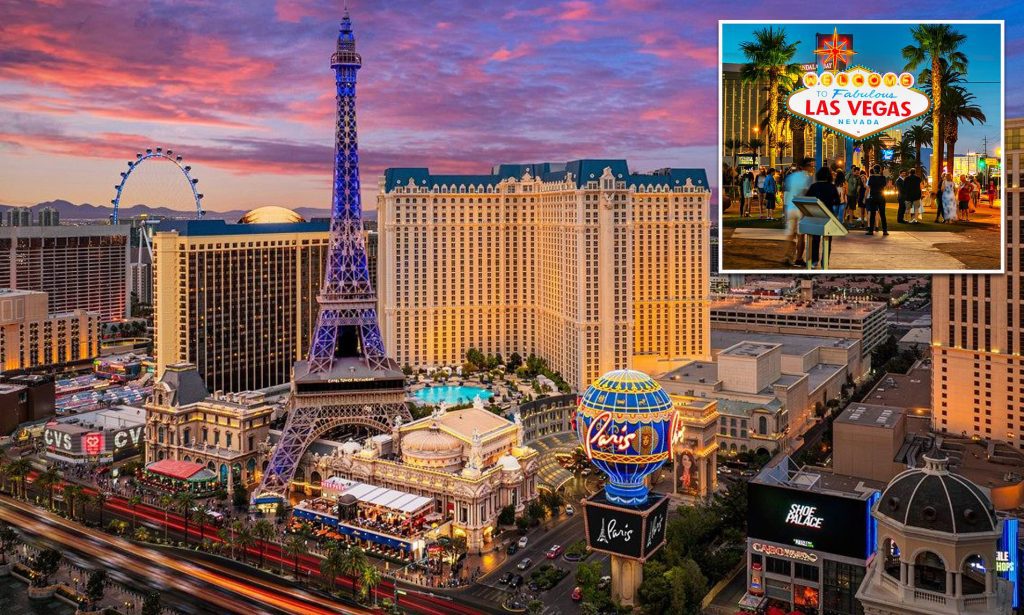
Las Vegas Struggles to Reclaim Its Appeal Amid Rising Costs and Declining Visitors
Las Vegas, once a vibrant hub of entertainment and luxury, is now in the midst of a significant downturn. Hotels across the city are taking drastic measures to attract visitors, including slashing prices, offering free amenities, and even providing complimentary parking. These efforts come as travelers increasingly perceive the city as an overpriced destination that no longer offers the value it once did.
The decline in visitor numbers has been steep, with the Las Vegas Convention and Visitors Authority (LVCVA) reporting an 11 percent drop in June and a 12 percent fall in July compared to the previous year. This marks the second consecutive month of double-digit declines, signaling a troubling trend for the city’s tourism industry. Hotel occupancy rates have fallen, airline traffic is on the decline, and retail and restaurant sales are slipping, all while the perception grows that Vegas has priced itself out of reach.
Major Casino Operators Launch Aggressive Promotions
In response to the downturn, major casino operators such as Caesars Entertainment and the Sahara have rolled out a series of eye-catching deals aimed at luring back both tourists and locals. These promotions include $300 stay-and-dine packages, $1.99 margaritas, 15 percent spa discounts, and even free rides on the High Roller observation wheel. The goal is to win back frustrated travelers and restore confidence in the city’s appeal.
Caesars Entertainment has taken the lead in these efforts, launching a limited-time promotion targeting Nevada residents. The initiative offers free self-parking from Sunday through Thursday at all eight of its Las Vegas resorts until October 30. Residents with a valid Nevada ID can also enjoy 25 percent off food and drinks at more than 100 restaurants, bars, and lounges, along with 15–20 percent discounts on spa treatments and attractions like the Eiffel Tower viewing deck and the Fly LINQ Zipline.
Additionally, Caesars is offering a $300 stay-and-dine package available through December 31 at Harrah’s, The LINQ, and Flamingo. This package includes a two-night stay with $200 in food and beverage credit, all taxes and resort fees included. Dan Walsh, senior vice president and general manager of the three properties, said, “There’s no better time to visit Vegas, and this package is an incredible value in the heart of The Strip.”
At the north end of the Strip, the Sahara Las Vegas is reviving its popular “All-In Experience,” which bundles perks such as $69 room rates, no resort fees, $25 daily dining credit, free room upgrades, late check-out, and discounted tickets to shows like Magic Mike Live. Paul Hobson, general manager of Sahara Las Vegas, stated, “The ‘All-In Experience’ struck a chord with our guests this summer. We’re bringing it back this fall to deliver even more value and ensure every stay feels effortless, memorable, and uniquely Las Vegas.”
Growing Frustration Among Travelers
Despite these efforts, many travelers are expressing frustration with the city’s pricing strategy. They claim that hidden resort fees, inflated drink prices, and bizarre surcharges have eroded the value proposition of a Las Vegas trip. In August, the Daily Mail revealed that the Bellagio Hotel was charging $25 just to eat off a plate when ordering room service—an additional fee for crockery on top of the food, tax, service, and delivery charge.
Michael Schoenberger, a professor of hospitality management, told Business Insider, “You’re starting to change the mentality of the visitor where they’re thinking, ‘Well, I could go to Las Vegas, but it’s going to be a pain in my neck — or I could go to Cancún.'”
Mixed Results: Casinos Thrive While Other Sectors Suffer
While the casinos themselves continue to see strong revenues, thanks to high rollers and gaming income, the broader economy outside the casinos is struggling. According to the Nevada Gaming Control Board, Nevada’s non-restricted gaming licensees won $1.36 billion in July, a 4 percent increase from the previous year. The Las Vegas Strip alone brought in more than $749 million, up 5.6 percent from July 2024, driven by a staggering 79 percent increase in baccarat revenue.
However, outside the casinos, the picture is grimmer. Food and beverage outlets have seen a $191 million decline in sales over the past 11 months, while clothing, shoe, and jewelry retailers are down another $140 million. Retail Association of Nevada president Bryan Wachter told the Las Vegas Review-Journal that declining tourist volume is hitting workers hard. He noted that with inflation, households are pulling back on non-essential spending, and trips to Vegas often get cut first.
International travel, especially from Canada, has also collapsed. Traffic from Canadian flights is down 18.5 percent year-over-year, with Mayor Shelley Berkley describing the once-steady stream of Canadian tourists as now a “drip.”
A City in Transition
Experts suggest that Las Vegas itself is partly to blame for the slowdown. Neil Saunders of Global Data told the Daily Mail, “What used to be a reasonable trip is now much more expensive. There are all kinds of fees that people have to pay at hotels and some of the service standards and generosity with things like free drinks while in casinos have tightened.” As a result, some people no longer see Vegas as worth the money, which directly impacts visitor numbers.
Recent stories highlight the growing frustration. A visitor was shocked to be charged $26/£19.11 for a bottle of Fiji water from the minibar at the Aria Resort & Casino, while a British magician was left outraged after being billed $74.31/£54.63 for two drinks at Sphere in Las Vegas.
Despite modest upticks in air travel from Mexico and the UK, it’s not enough to offset the broader slump. Industry forecasts predict that Las Vegas will lose out on $12.5 billion in international visitor spending in 2025.
Looking Ahead
Casino operators are betting big on bundling, transparency, and old-fashioned value. However, even $3 beers and free parking may not be enough to lure back visitors who feel burned by the city’s pricing strategy. Andrew Woods, director of the University of Nevada Las Vegas’s Center for Business and Economic Research, said, “It’s a cumulative effect that’s just now starting to show up. Vegas is one of the first markets hit when the economy tightens — and one of the last to recover.”