


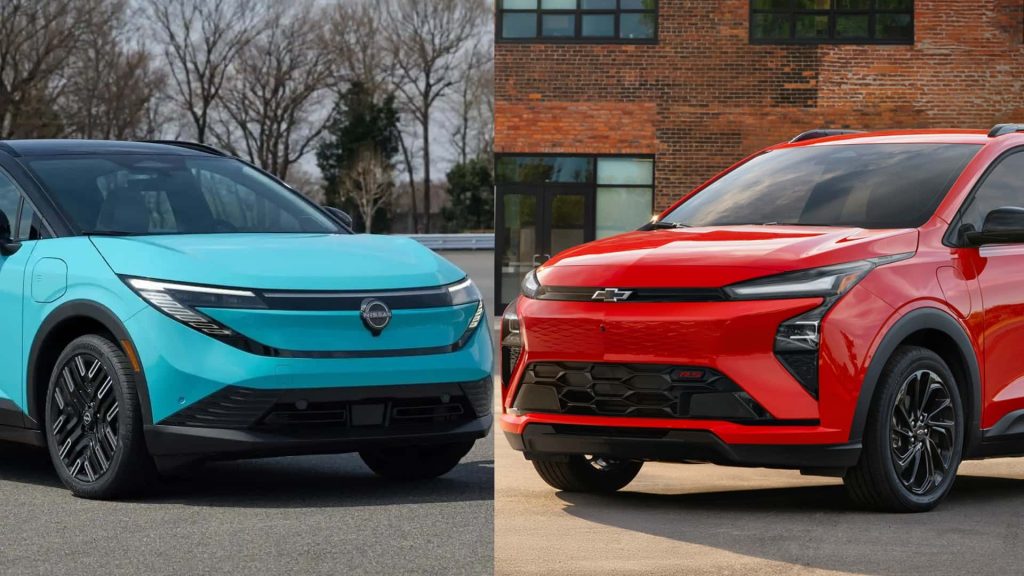
Introduction to America’s Most Affordable New EVs
The American electric vehicle (EV) market is witnessing a significant shift with the return of two iconic models: the 2027 Chevrolet Bolt and the 2026 Nissan Leaf. These vehicles are not only making a comeback but also offering some of the most affordable options for buyers looking to transition to electric mobility. The competition between these two models has become closer than ever, prompting a detailed comparison of their features, pricing, and performance.
Pricing & Availability
The 2027 Chevrolet Bolt is set to launch at $29,990, including all fees, in early 2026. A base LT model will follow a few months later at $28,995. On the other hand, the 2026 Nissan Leaf is already available at dealers across the country, starting at $31,485 for the S+ trim. While the Leaf offers an even more affordable version called the S, which will have a smaller battery and shorter range, the current base Bolt remains the cheapest battery-powered car in the U.S. until the S model debuts.
Overall Design
The design of the new Nissan Leaf reflects a complete redesign on a new platform, resulting in improved driving range, power, and charging capabilities. In contrast, the 2027 Chevrolet Bolt retains much of its previous body panels, though it includes substantial under-the-hood improvements such as a faster-charging battery and a revised interior.
Charging & Energy Features
Both the Bolt and the Leaf come equipped with a Tesla-style NACS charging port, allowing them to use Tesla Superchargers without an adapter. However, the Leaf also includes a separate J1772 port for Level 1 and Level 2 charging, which is a unique feature. The Bolt offers vehicle-to-home (V2H) capability, enabling it to power a house with the right hardware, while the Leaf provides vehicle-to-load (V2L) functionality through an AC port adapter.
Range & Battery Size
In terms of range, the Leaf S+ can deliver up to 303 miles on a full charge with a 75 kWh lithium-ion battery. The 2027 Bolt, on the other hand, comes with a 65 kWh lithium iron phosphate (LFP) battery, providing a GM-estimated range of 255 miles. Both models offer fast charging, with the Bolt achieving a 10-to-80% charge in 26 minutes, compared to the Leaf’s 35 minutes.
Power & Torque
Both vehicles are front-wheel drive and offer similar horsepower ratings. The Bolt produces 210 horsepower, while the Leaf delivers 214 hp. However, the Leaf has significantly more torque, with 261 lb-ft compared to the Bolt’s 169 lb-ft. The Bolt is lighter, weighing 3,766 pounds, while the Leaf weighs between 4,206 and 4,393 pounds.
Interior, Cargo Space & Infotainment
The Bolt offers slightly more passenger space, while the Leaf provides more cargo capacity. The Bolt features an 11-inch digital instrument display and an 11.3-inch infotainment screen with Google Built-in, though it lacks Apple CarPlay and Android Auto. The Leaf S+ includes wireless Apple CarPlay and Android Auto, with larger displays on higher trims.
Safety Tech
Both models come with advanced safety features. The Leaf includes Nissan’s Safety Shield 360 Suite, featuring automatic emergency braking, lane departure prevention, and blind spot intervention. The Bolt offers adaptive cruise control, front pedestrian braking, and lane keep assist, among other features.
Final Comparison
When comparing the 2027 Chevrolet Bolt and the 2026 Nissan Leaf, both models present solid options for budget-conscious buyers. The Leaf excels in range and offers Apple CarPlay, while the Bolt is more affordable and provides more passenger space. Ultimately, the choice between the two will depend on personal preferences and specific needs.
Key Specifications Comparison
| Feature | 2027 Chevrolet Bolt | 2026 Nissan Leaf |
|——–|———————|——————|
| Starting price (including freight charges) | $28,995 | $31,485 |
| Driving range | 255 miles (GM-estimated) | 259 to 303 miles (EPA-estimated) |
| Battery capacity | 65 kWh | 75 kWh |
| Maximum charging power (DC) | 150 kW | 150 kW |
| Maximum charging power (AC) | 11.5 kW | 7.2 kW |
| 10-to-80% fast charging | 26 minutes | 35 minutes |
| Heat pump | Yes | Yes, but not on the entry-level version |
| Power | 210 hp | 214 hp |
| Torque | 169 lb-ft | 261 lb-ft |
| Length | 169.6 in | 173.4 in |
| Width | 69.7 in | 71.3 in |
| Height | 63.9 in | 61.3 in |
| Wheelbase | 105.3 in | 105.9 in |
| Weight | 3,766 lbs | 4,206 to 4,393 lbs |
| Cargo capacity with seats up | 16.2 cu ft | 20 cu ft |
| Cargo capacity with rear seats folded | 56.3 cu ft | 55.5 cu ft |
| Front headroom | 39.1 to 40 in | 39.9 in |
| Front legroom | 44.3 in | 42.4 in |
| Rear headroom | 37.8 in | 36.6 to 37.2 in |
| Rear legroom | 39.1 in | 31.8 in |
These values do not include the cheapest versions of the Chevrolet Bolt and Nissan Leaf, which cannot be purchased yet. When they go on sale, we’ll update this article to reflect the changes.