


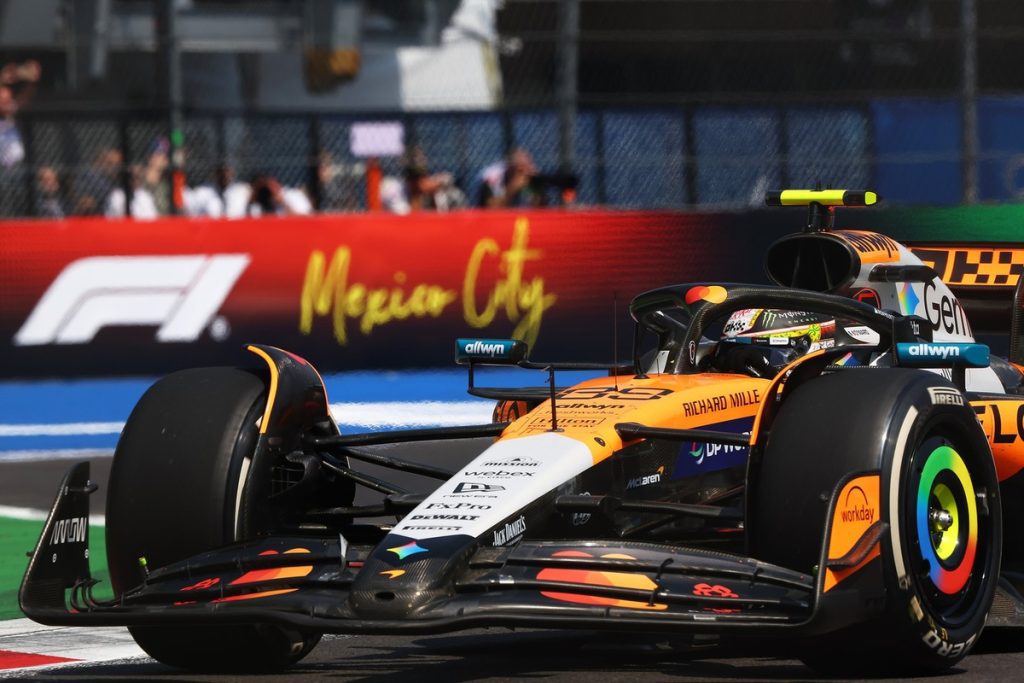
McLaren’s Strategic Shift to 2026: A Bold Move in the F1 Championship Race
McLaren has maintained its stance on halting development of its 2025 Formula 1 car early, a decision that has allowed Red Bull to gain momentum in the ongoing championship battle. Despite securing a second consecutive constructors’ title by Singapore, the team has chosen to focus its efforts on the 2026 project, even as it continues to make minor improvements on specific tracks.
The Woking-based team took a unique approach during the off-season, building upon the success of its 2024 car. This strategy paid off with significant upgrades at events in Canada, Austria, and Britain. However, after the Silverstone floor overhaul, McLaren shifted its full attention to the 2026 season, only making minor efficiency gains in Monza and other track-specific modifications.
This move came as Red Bull started to close the gap, particularly after introducing a new floor to its RB21 at the Mexico Grand Prix. The resurgence of Max Verstappen has put pressure on Oscar Piastri, who now leads the drivers’ championship by just 40 points with five rounds remaining. Despite this, McLaren team boss Andres Stella remains confident in their decision, emphasizing that the current car had reached a development plateau.
“We were already quite mature from an aerodynamic perspective,” Stella explained. “It takes weeks to add one point of aerodynamic efficiency because we were at a plateau. On the 2026 car, every week we add a lot of downforce. That’s where you have to make a call based on the best information available.”
The Impact of Aerodynamic Testing Restrictions
A key factor influencing McLaren’s decision was F1’s aerodynamic testing restrictions, which limit wind tunnel and CFD usage based on a team’s performance over the preceding six months. As reigning champions, McLaren faces the most stringent limitations, with a 70% multiplier for wind tunnel runs compared to other teams.
Here is a breakdown of the restrictions for the July–December 2025 period:
- McLaren: 70% multiplier, 224 wind tunnel runs, 56 hours of wind tunnel time, 280 hours of occupancy, 1400 geometries, 4.2 million CFD solving units.
- Mercedes: 75% multiplier, 240 wind tunnel runs, 60 hours of wind tunnel time, 300 hours of occupancy, 1500 geometries, 4.5 million CFD solving units.
- Ferrari: 80% multiplier, 256 wind tunnel runs, 64 hours of wind tunnel time, 320 hours of occupancy, 1600 geometries, 4.8 million CFD solving units.
- Red Bull: 85% multiplier, 272 wind tunnel runs, 68 hours of wind tunnel time, 340 hours of occupancy, 1700 geometries, 5.1 million CFD solving units.
- Williams: 90% multiplier, 288 wind tunnel runs, 72 hours of wind tunnel time, 360 hours of occupancy, 1800 geometries, 5.4 million CFD solving units.
- Haas: 95% multiplier, 304 wind tunnel runs, 76 hours of wind tunnel time, 380 hours of occupancy, 1900 geometries, 5.7 million CFD solving units.
- Racing Bulls: 100% multiplier, 320 wind tunnel runs, 80 hours of wind tunnel time, 400 hours of occupancy, 2000 geometries, 6.0 million CFD solving units.
- Aston Martin: 105% multiplier, 336 wind tunnel runs, 84 hours of wind tunnel time, 420 hours of occupancy, 2100 geometries, 6.3 million CFD solving units.
- Sauber: 110% multiplier, 352 wind tunnel runs, 88 hours of wind tunnel time, 440 hours of occupancy, 2200 geometries, 6.6 million CFD solving units.
- Alpine: 115% multiplier, 368 wind tunnel runs, 92 hours of wind tunnel time, 460 hours of occupancy, 2400 geometries, 6.9 million CFD solving units.
- Cadillac: 115% multiplier, 368 wind tunnel runs, 92 hours of wind tunnel time, 460 hours of occupancy, 2300 geometries, 6.9 million CFD solving units.
Stella noted that Red Bull initially struggled with finding the right setup window, but recent improvements have allowed them to optimize ride heights without sacrificing downforce or balance. This gives them more room for development than McLaren at this stage.
Strategic Considerations for Red Bull
Stella also speculated that Red Bull might be more willing to compromise on the 2026 season due to potential issues with their own power unit. “They might have other issues,” he said, hinting at Red Bull’s plans to introduce an in-house power unit under the new regulations.
He added, “When we look at Red Bull and consider some of the complaints they had at the start of the season, perhaps they had more margin to develop efficiently, focusing on 2025. And perhaps they are happier to give up a little bit of the 2026 because they might have some other issues for 2026 whereby they say: ‘Let’s focus on 2025.’”
Conclusion: No Regrets Over the Decision
Despite the possibility of missing out on the drivers’ title, Stella maintains that McLaren would not change its approach. “Not at all, because it’s not like if I spend three weeks more on the 2025, it is going to add one tenth of lap time. We were just plateauing.”
He emphasized that developing a car when it’s already performing well is far more challenging than addressing specific problems. “It’s much easier to develop when you have some specific problems. Red Bull, for instance, talked at times of struggling to rebalance with the front wing when they were using big rear wings. Then it’s easier to find lap time because you’re effectively fixing something rather than trying to improve something that already works well.”