


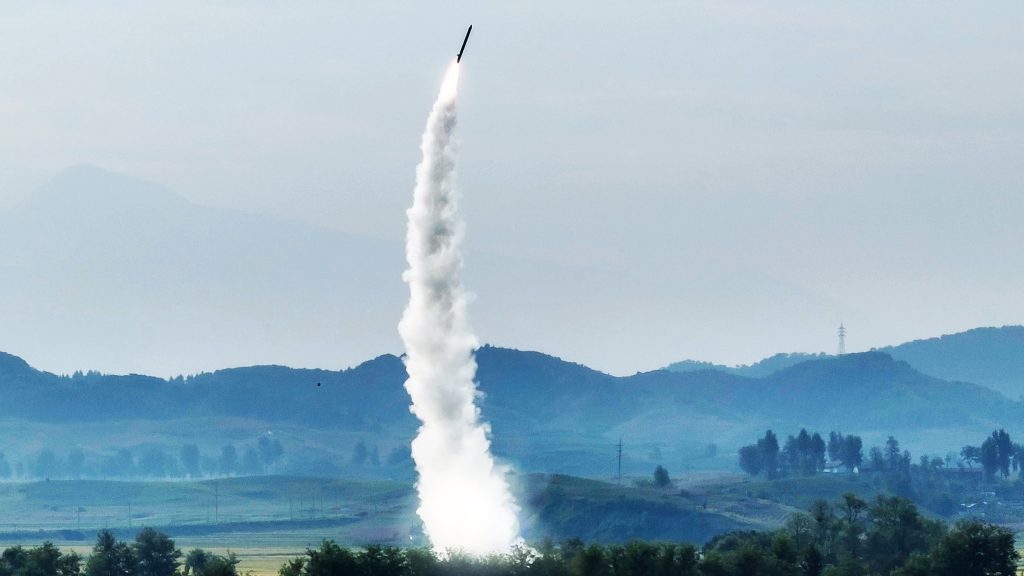
North Korea Conducts Missile Launch Amid Regional Tensions
North Korea carried out a significant military demonstration on the 4th, just one day before the South Korea-China summit between President Lee Jae-myung and Chinese President Xi Jinping. This missile launch, which took place shortly after the Trump administration removed Venezuelan President Nicolas Maduro, has sparked various interpretations. Some analysts believe that North Korea is sending a message to the United States by showcasing its nuclear capabilities, emphasizing, “We are different” from Venezuela.
The Joint Chiefs of Staff (JCS) announced on the 4th that North Korea launched an unidentified ballistic missile toward the East Sea. According to the JCS, “Around 7:50 a.m., we detected several launch vehicles, presumed to be ballistic missiles, fired from near Pyongyang, North Korea, toward the East Sea.” The missiles traveled approximately 900 km before landing in the East Sea. While detailed specifications remain under analysis, reports from Kyodo News and others suggest that Japan’s Ministry of Defense assessed that two ballistic missiles launched by North Korea appeared to have fallen outside Japan’s exclusive economic zone, the EEZ.
Experts are closely monitoring the possibility that North Korea conducted a maximum range test of the KN-23 series ‘Hwasong-11-Ma’ hypersonic missile. This missile launch marks the first of this year, occurring about two months after the short-range ballistic missile launch on November 7 of last year.
The timing of the missile launch coincided with the day President Lee Jae-myung began a three-night, four-day state visit to China at the invitation of Chinese President Xi Jinping. The South Korea-China summit scheduled for the 5th is expected to address the issue of North Korea’s denuclearization. Analysts interpret the missile launch as North Korea showcasing its presence ahead of the summit.
Amid the U.S. military operation to arrest and transport Venezuelan President Nicolas Maduro and his spouse, there are interpretations that North Korea’s launch may also reflect defiance toward the U.S. The U.S. announced on the 3rd that it ousted the anti-American Maduro, the Venezuelan president, through a military operation.
U.S. Forces Korea responded to North Korea’s missile launch by stating, “This incident does not appear to pose an immediate threat to U.S. personnel, territory, or our allies,” adding, “The U.S. remains firmly committed to the defense of its homeland and allied nations in the region.”
Key Details of the Missile Launch
- The missile was launched from near Pyongyang, North Korea.
- It traveled approximately 900 km before landing in the East Sea.
- Japan’s Ministry of Defense reported that the missiles fell outside its exclusive economic zone.
- Experts are analyzing whether the missile was part of the KN-23 series ‘Hwasong-11-Ma’ hypersonic missile.
- This is the first missile launch of the year, following a similar event in November of last year.
Implications and Regional Responses
The timing of the missile launch has raised concerns among regional powers. With the South Korea-China summit approaching, the launch could be seen as a strategic move by North Korea to assert its position in the ongoing discussions about denuclearization. The event also comes at a time when the U.S. is engaged in a military operation in Venezuela, leading some to speculate that North Korea might be testing the waters against U.S. influence.
U.S. Forces Korea emphasized that the launch does not currently pose a direct threat to American interests or allies. However, the situation remains under close watch, with continued efforts to assess the full implications of North Korea’s actions.
As the region grapples with these developments, the focus will likely remain on how North Korea’s actions affect diplomatic relations and security dynamics in East Asia. The upcoming summit between South Korea and China may provide an opportunity to address these issues directly, potentially shaping the future of regional stability.