


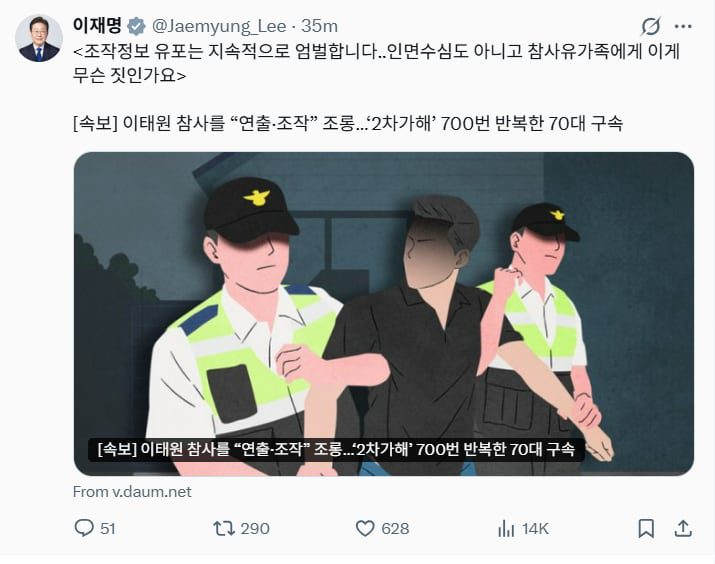
President Lee Jae-myung Addresses Fake News Spreaders
On the 4th, President Lee Jae-myung addressed the arrest of a man in his 70s who disseminated false information about the Itaewon crowd crush through social media. The president expressed strong disapproval, stating, “The spread of fabricated information will be continuously punished severely. How can this be done to the bereaved families of the tragedy, not even having a human face?” Since taking office, President Lee has consistently emphasized a policy of strictly punishing the dissemination of false and fabricated information, addressing the issue in Cabinet meetings and press conferences.
Arrest of Mr. A for Spreading False Information
According to police, the Seoul Western District Court issued a bench warrant on the 2nd for Mr. A, who is facing charges of defamation and insult. He is accused of repeatedly posting approximately 700 videos and posts containing false claims about the Itaewon crowd crush, including allegations such as “staged,” “drug terrorism,” and “bodies are real dolls.” This marks the first case of arrest since the launch of the National Police Agency’s “Second Victimization Crime Investigation Division” in July of last year, following President Lee’s directive.
President Lee’s Stance on Economic Sanctions
President Lee has maintained the position that economic sanctions stronger than criminal penalties are necessary for those who spread false and fabricated information. At a press conference marking his 100th day in office last September, he stated, “When fake news is used to achieve political goals, attack others, or gain economic benefits, the democratic system itself is undermined.” He added, “Even the U.S., which strongly protects freedom of expression, orders high-cost compensation for false information. The introduction of a punitive damages system with significantly increased compensation amounts is necessary for malicious fabricated information.”
Measures Against YouTubers Profiting from Fake News
In a Cabinet meeting last June, President Lee also instructed the Ministry of Justice to prepare measures against YouTubers who profit from spreading fake news for commercial purposes. At the time, he said, “Acts of illegality committed for profit must be fundamentally blocked. Just as selling fake food products should make sellers pay several times the sales amount to drive them bankrupt for control, punitive damages are the best method for fake news as well.”
Criticisms and Concerns Over the New Legislation
However, criticisms have arisen that President Lee’s stance on “strictly punishing fake news” and the recently passed Revised Information and Communications Network Act (Fake News Eradication Act) could be a means to suppress dissenting opinions. The bill does not exclude politicians, high-ranking officials, or large corporations from being subjects of lawsuits, effectively allowing them to use the law for strategic litigation against reporting. The National Union of Media Workers pointed out, “If a punitive damages system is introduced, politicians and high-ranking officials will abuse it to file excessive lawsuits to block unfavorable reporting.”
Key Points of the Revised Information and Communications Network Act
- Comprehensive Coverage: The act applies to all entities, including politicians, high-ranking officials, and large corporations.
- Potential for Abuse: Critics argue that the law could be misused to silence critical voices and limit free expression.
- Punitive Damages: The proposed system aims to impose significant financial penalties on those found guilty of spreading malicious fabricated information.
Ongoing Debate on Free Speech and Accountability
The debate surrounding the revised act highlights the tension between protecting free speech and holding individuals accountable for spreading false information. While President Lee and his administration argue that strict measures are necessary to prevent the erosion of public trust and democratic values, opponents fear that the legislation could be used to stifle legitimate criticism and restrict journalistic freedom.
Conclusion
As the discussion continues, the balance between combating misinformation and preserving fundamental rights remains a critical challenge for policymakers. The actions taken by President Lee and the implementation of the new legislation will likely shape the future of information integrity and freedom of expression in the country.