


National Tax Revenue Performance in 2024
Last year, national taxes such as income and corporate taxes fell short of the initial target by 8.5 trillion Korean won, marking the third consecutive year of tax revenue shortfalls. However, the deficit was significantly reduced due to a recovery in corporate taxes, increased wage income taxes, and gains from Seohak ants—Korean retail investors buying foreign stocks.
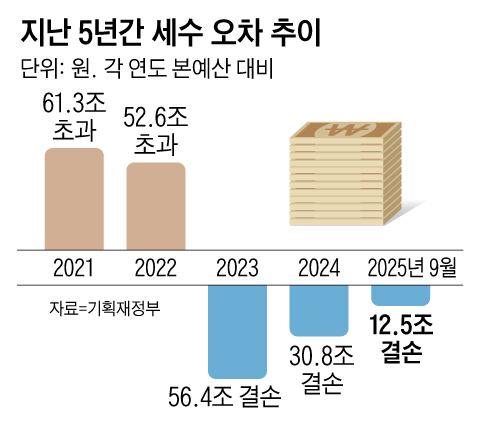
According to the Ministry of Economy and Finance’s announcement on the 10th regarding the “2025 National Tax Revenue Performance,” last year’s national tax revenue amounted to 373.9 trillion Korean won. This figure was 8.5 trillion Korean won less than the government’s projected tax revenue of 382.4 trillion Korean won in last year’s budget proposal. Following a 56.4 trillion Korean won shortfall in 2023 due to a corporate tax shock and a 30.8 trillion Korean won deficit in 2024, this marks the third consecutive year of budget-based tax revenue shortfalls. The cumulative deficit over the three years reached 95.7 trillion Korean won.
Despite the shortfall, last year’s tax revenue increased by 37.4 trillion Korean won compared to the previous year (336.5 trillion Korean won). It also exceeded the government’s revised projection of 369.9 trillion Korean won, announced in September of last year, by 4 trillion Korean won. At the time, the government had forecasted a 12.5 trillion Korean won shortfall compared to the original budget. Compared to the adjusted tax revenue projection of 372.1 trillion Korean won, approved by the National Assembly during the supplementary budget in June of last year, the actual revenue was 1.8 trillion Korean won higher. A source from the Ministry of Economy and Finance stated, “Unlike 2023 and 2024, last year’s tax revenue was adjusted downward through a supplementary budget revision, so it reflects normalized fiscal management rather than a ‘tax revenue shortfall.’”
Key Drivers of Tax Revenue Growth
Last year’s tax revenue growth was largely driven by a 22.1 trillion Korean won increase in corporate taxes due to improved corporate performance. The operating profit (individual basis) of KOSPI-listed companies surged by 67.5 trillion Korean won (174.4%) from 38.7 trillion Korean won in 2023 to 106.2 trillion Korean won in 2024. Consequently, corporate tax revenue last year reached 84.6 trillion Korean won, a 35.3% increase from the previous year.
Wage income taxes also rose by 7.4 trillion Korean won (12.1%) to 68.4 trillion Korean won. This was attributed to a 283,000-person (1.7%) increase in regular workers—from 16,353,000 in the previous year to 16,636,000—and higher wages. The average monthly wage per regular worker increased by 310,000 Korean won (7.4%) from 4,168,000 Korean won in October 2024 to 4,478,000 Korean won in October of last year.
Capital gains taxes (19.9 trillion Korean won) increased by 3.2 trillion Korean won due to a boom in overseas stocks, particularly in the U.S. The volume of overseas stock transactions surged by approximately 80% from 145.2 billion dollars (approximately 211 trillion Korean won) in 2023 to 260.4 billion dollars (approximately 380 trillion Korean won) in 2024, leading to larger capital gains.
In contrast, value-added taxes (79.2 trillion Korean won) decreased by 3.1 trillion Korean won as increased exports led to more transactions exempt from VAT and higher refund amounts.
Additional Information
For those interested in membership options, there are several plans available:
- A monthly membership for 5,900 won, with a discounted rate of 2,900 won for newspaper readers.
- A Chosun Membership plan offering access to 8 kinds of newspapers and magazines worth 55,000 won.
- A Chosun Membership plan that provides 7,000 points that can be used like cash for shopping.