


The growth of industry-specific loans reached its lowest level in 13 years last year, as the real estate market slowed down and manufacturing investment decreased due to global uncertainties. According to the Bank of Korea’s “Q4 2025 Deposit-Taking Institutions’ Industry-Specific Loans” report released on the 9th, the total outstanding industry-specific loans amounted to 2,026.1 trillion Korean won at the end of last year. This represents an increase of 8.6 trillion won from the previous quarter. Compared to the end of 2024, the annual increase was 60.7 trillion won, resulting in a 3.1% growth rate. This is the lowest annual growth rate for industry-specific loans since 2012, when it was recorded at 2.6%.
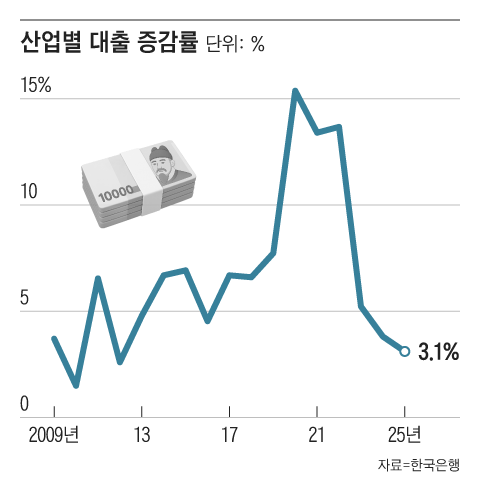

Industry-specific loans, as defined by the Bank of Korea, include corporate and government or non-profit organization loans, excluding household debt. Lee Hye-young, head of the Financial Statistics Team at the Bank of Korea, explained that the slowdown in industry-specific loan growth was attributed to sluggish construction activity and weakened manufacturing investment, which were influenced by expanded external uncertainties. The growth rate of these loans has been declining for three consecutive years since 2022.
By industry, construction sector loans saw the largest decline, decreasing by 4.4 trillion won to 99.9 trillion won year-on-year. In the fourth quarter alone, they fell by 2.9 trillion won. Manufacturing loans grew by 4.0% compared to the end of the previous year, which is lower than the 5.7% growth seen in 2024. Service sector loans increased by 3.2%, slightly higher than the previous year’s 3.0%. However, driven by a U.S.-led AI boom that boosted semiconductor sales and exports, loans for the electronic components and computer industry increased by 3.7 trillion won annually and 300 billion won in the fourth quarter. Lee Hye-young noted, “Loans for semiconductor companies rose primarily for facility funding.”
Key Trends in Industry-Specific Loans
-
Construction Sector:
The construction sector experienced the most significant decline in loans, with a year-on-year decrease of 4.4 trillion won. In the fourth quarter, this decline further accelerated to 2.9 trillion won. This trend reflects the ongoing challenges in the real estate market and reduced construction activity. -
Manufacturing Sector:
Despite the overall slowdown, manufacturing loans still showed a modest growth of 4.0% compared to the end of the previous year. However, this is a decline from the 5.7% growth recorded in 2024. The reduction in manufacturing investment is linked to global economic uncertainties and weaker demand. -
Service Sector:
The service sector witnessed a slight increase in loans, growing by 3.2% compared to the previous year. This is a marginal improvement over the 3.0% growth recorded in the prior year, indicating stable but limited expansion in this sector. -
Electronic Components and Computer Industry:
This sector saw a notable increase in loans, rising by 3.7 trillion won annually and 300 billion won in the fourth quarter. The growth is largely attributed to the surge in semiconductor sales and exports, fueled by the U.S.-led AI boom. These loans are primarily used for facility funding, reflecting the need for infrastructure development in this high-tech industry.
Broader Implications
The slowdown in industry-specific loan growth highlights the broader economic challenges faced by South Korea. The real estate market’s stagnation, combined with reduced manufacturing investment, signals a shift in economic dynamics. While certain sectors like semiconductors show resilience, others struggle to maintain momentum. This trend could have long-term implications for economic growth, employment, and financial stability.
The Bank of Korea continues to monitor these trends closely, aiming to provide insights into the health of the economy and guide policy decisions. As global uncertainties persist, the performance of key industries will remain a critical factor in shaping future economic outcomes.
Membership Offers
For those interested in accessing more content, there are various membership options available. One such option offers a monthly subscription for 5,900 won, with a discounted rate of 2,900 won for newspaper readers. Another membership provides access to 8 different newspapers and magazines worth up to 55,000 won, along with 7,000 points that can be used like cash for shopping.