


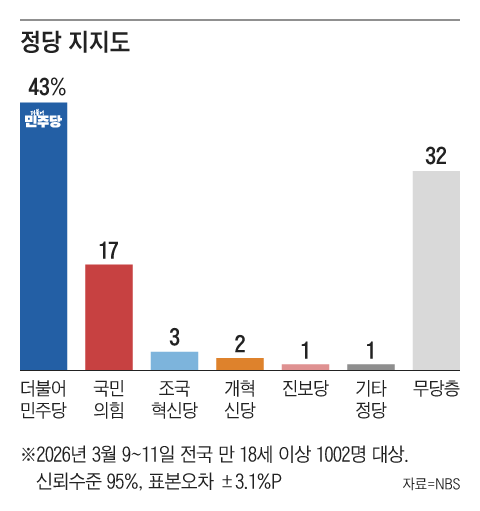
A recent public opinion survey revealed that the People Power Party’s approval rating has dropped to 17%, approaching its lowest level since its establishment. Despite the party’s lawmakers, including leader Jang Dong-hyeok, adopting a resolution opposing “Yoon Again,” the approval rating remains unchanged and has not shown any signs of recovery.
The National Benchmark Survey (NBS), conducted by Embrain Public, Kstat Research, Korea Research International, and Hankook Research from the 9th to the 11th among 1,002 adult men and women, found that the People Power Party’s approval rating remained at 17% compared to the previous survey two weeks earlier. The Democratic Party of Korea recorded 43%, which is a decrease of 2 percentage points from the last survey. The People Power Party’s lowest approval rating in the NBS survey was 16%, recorded immediately after its defeat in the presidential election last August.
Regionally, the People Power Party trailed behind the Democratic Party in all areas. In the Daegu-Gyeongbuk region, where both parties had equal approval ratings of 28% in the previous survey, the People Power Party’s rating fell by 3 percentage points to 25% in this survey. Meanwhile, the Democratic Party rose by 1 percentage point to 29%. Although within the margin of error, the Democratic Party led even in the Daegu-Gyeongbuk region.
In Seoul and Busan, where People Power Party leader Jang Dong-hyeok stated, “My political life depends on this local election,” the party showed a downward trend. In Seoul, the People Power Party’s approval rating was 17% (a 2 percentage point decrease from the previous survey), while the Democratic Party had 37%. In Busan, Ulsan, and Gyeongnam, the People Power Party recorded 21% (a 2 percentage point decrease), and the Democratic Party had 40%. Among respondents who identified as moderates, the People Power Party’s approval rating was 9%, showing a gap of nearly five times compared to the Democratic Party’s 42%.

In age-based surveys, the People Power Party lagged behind the Democratic Party across all generations. Even among those aged 70 and above, known for conservative leanings, the Democratic Party’s approval rating was 39%, while the People Power Party’s was 27%.
Since leader Jang Dong-hyeok’s election in August last year, the People Power Party’s approval rating had ranged between 20–25%. However, internal conflicts, including the expulsion of former leader Han Dong-hoon and the refusal to cut ties with former President Yoon Suk-yeol, caused the rating to plummet to 17%. Amid growing concerns within and outside the party, lawmakers adopted the “Yoon Again Opposition” resolution at the general meeting of lawmakers on the 9th. However, the subsequent survey showed no rise in approval ratings.
In a survey item asking about local election preferences, “support for the opposition party” slightly increased by 1 percentage point to 35% compared to the previous survey. During the same period, “support for the ruling party” decreased by 3 percentage points to 50%. Consequently, the gap between ruling and opposition party support narrowed from 19 percentage points to 15 percentage points.
The survey was conducted via telephone interviews using virtual mobile numbers (100%) provided by three domestic telecommunication companies. The response rate was 17.3%, and the sampling error was ±3.1 percentage points at a 95% confidence level. For details, refer to the Central Election Opinion Survey Deliberation Commission’s website.
월 5900원 멤버십, 신문 독자에게는 2900원, 조선멤버십
55000원 상당의 신문-잡지 8종 마음껏 보기, 조선멤버십
현금처럼 쓸 7000포인트 받아 알뜰한 쇼핑, 조선멤버십