


Major Study Confirms Vaccines Do Not Cause Autism and May Offer Protection
A comprehensive study has reaffirmed that childhood vaccinations do not cause autism and may even provide some protective benefits. Researchers analyzed the health records of over 1.2 million children born in Denmark between 1997 and 2018, all of whom had received routine immunizations. The findings, published in the Annals of Internal Medicine, offer strong evidence against long-standing claims linking vaccines to developmental disorders.
The research focused on a range of chronic conditions, including autoimmune diseases such as type 1 diabetes, allergies, asthma, and neurodevelopmental disorders like autism and attention deficit-hyperactivity disorder (ADHD). Scientists also examined the levels of aluminum, a common vaccine additive used to enhance immune response. Anti-vaccine advocates have raised concerns about aluminum’s potential harm, particularly to developing brains, but this study found no significant increase in risk for any of the conditions examined.
Interestingly, for some conditions—including autism—the risk was slightly lower in children who received higher amounts of aluminum through their vaccinations. This suggests that the presence of aluminum in vaccines does not pose a danger and may even be associated with reduced risks.
Professor Anders Hviid, a senior author of the study and an epidemiology expert at Statens Serum Institut, emphasized the importance of the findings. “As a parent, I understand the concerns about vaccine safety,” he said. “Our study addresses many of these concerns and provides clear and robust evidence for the safety of childhood vaccines.”
The study also highlighted that even when children reached the age of eight and had been exposed to more vaccinations—and therefore more aluminum—there was no increased risk of neurodevelopmental disorders. In Denmark, children are vaccinated against a wide range of diseases, including diphtheria, tetanus, pertussis, polio, Haemophilus influenzae type b, hepatitis B, meningitis B, pneumococcal disease, measles, mumps, and rubella.
For decades, parents have feared a link between the measles, mumps, and rubella (MMR) vaccine and autism. This concern was fueled by discredited research from former doctor Andrew Wakefield in 1998, who claimed the vaccine was linked to an increase in autism cases. His findings were later thoroughly debunked, and he lost his medical license in 2010 for unethical conduct. Despite numerous studies disproving the claim, the legacy of his work continues to influence public perception.
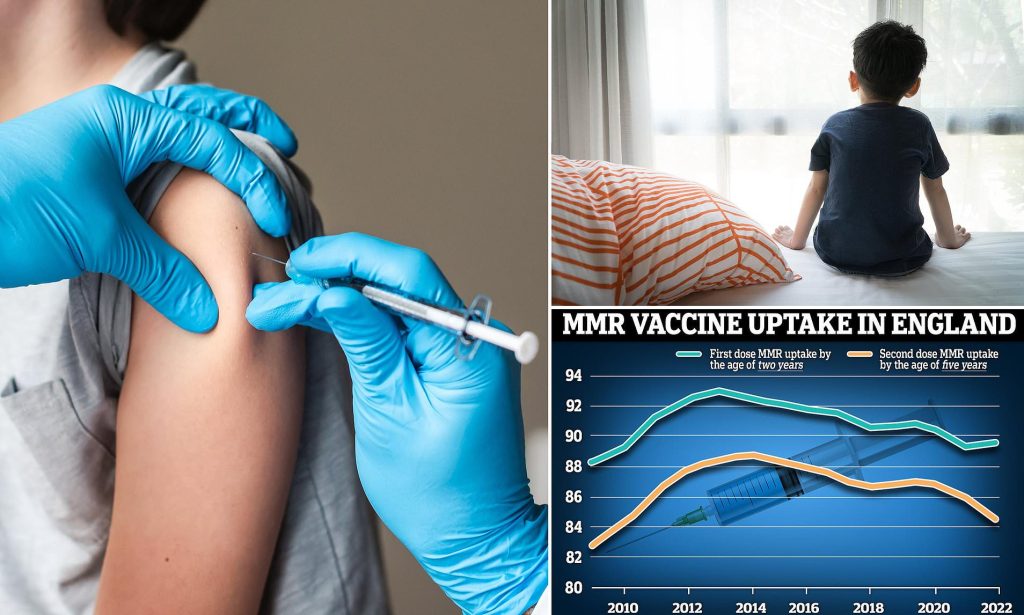
Recent data shows a decline in MMR vaccination rates, prompting health officials to urge parents to check their child’s immunization status. In the UK, MMR vaccination coverage stands at 85.2%, which is still below the 95% threshold needed to prevent outbreaks. In certain areas, such as parts of London, Liverpool, Manchester, and Birmingham, only around half of children have received both doses of the vaccine. Tragically, a child recently died of measles in Liverpool, highlighting the dangers of low vaccination rates.
Experts warn that without concerted efforts to improve vaccination uptake, recurrent outbreaks are likely to occur, leading to further loss of life. While the latest study reinforces the safety of vaccines, there has been a noticeable rise in autism diagnoses in recent years. Researchers suggest this increase could be due to greater awareness of the condition, changes in diagnostic criteria, or over-diagnosis in some regions.
In England, autism diagnoses have surged over the past three years, with more than 200,000 people waiting for an assessment. Children often face long waits—over a year—for evaluations, according to the Department of Health and Social Care, which has criticized the NHS for failing to support autistic children adequately.
The World Health Organization (WHO) has identified vaccine hesitancy as one of the top global health threats. Addressing misinformation and improving public trust in vaccines remain critical steps in protecting communities from preventable diseases.