








Devastating Flash Floods in Northern Pakistan and Kashmir
Flash floods have swept through northern Pakistan and India-controlled Kashmir, resulting in the loss of at least 344 lives over the past 48 hours. The impact has been particularly severe in Khyber Pakhtunkhwa, where local authorities reported 328 deaths. Eleven more people were killed in Kashmir, while five others perished in the Gilgit-Baltistan region.
The situation worsened when a local government helicopter crashed during a relief mission on Friday due to adverse weather conditions. The crash claimed the lives of five individuals, including two pilots. Rescue operations are now in their third day, with teams searching for survivors in Khyber Pakhtunkhwa and the Kishtwar district of Kashmir.
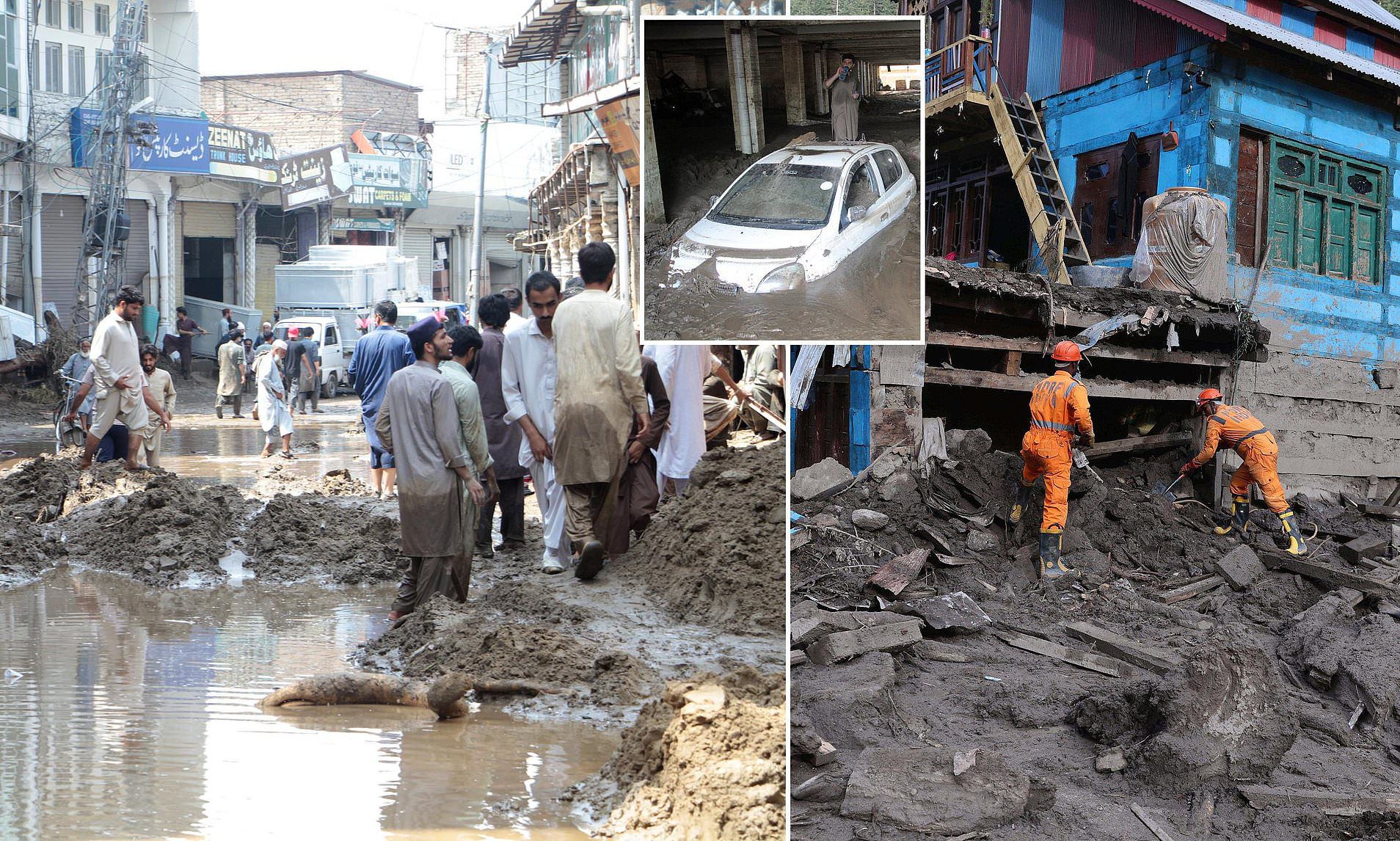
In Buner, one of the hardest-hit areas, mass funerals were held as local officials confirmed 184 fatalities. Most of the victims were either killed by flash floods or collapsed houses, with over 120 others injured. An eyewitness described witnessing floodwaters carrying hundreds of boulders and “tons of rocks” crashing down, causing widespread destruction.
Rescue workers continue to search for survivors in Buner, where torrential rains and cloudbursts caused massive flooding. Mohammad Suhail, a spokesman for emergency services, said that hundreds of homes were swept away. First responders are working to recover bodies from the worst-hit villages of Pir Baba and Malik Pura, where most of the fatalities occurred.
Local police officer Imtiaz Khan, who narrowly escaped the deluge, recounted how floodwaters struck and flattened homes within minutes. He described a stream near Pir Baba village that swelled without warning, leading to the destruction of 60 to 70 houses in moments. Many bodies were left mutilated, and his police station was also washed away.
Pakistan’s Meteorological Department has predicted torrential rains in the coming days, with monsoon activity expected to intensify from Sunday onwards. Rescuers have seen large swathes of Pir Baba village destroyed, with wrecked homes and giant rocks filling the streets as water recedes.
Sultan Syed, 45, who suffered a broken arm, said the floods were unlike anything he had seen before. He described the event as a “flood of boulders,” which he and others witnessed for the first time in their lives. Similarly, Mohammad Khan, 53, noted that the floods came so fast that many could not leave their homes.
Most victims died before reaching the hospital, according to Mohammad Tariq, a doctor in Buner. He mentioned that many of the deceased were children and men, while women were away in the hills collecting firewood and grazing cattle.
Pakistani leaders, including the prime minister and president, have offered condolences to the families of the deceased and expressed hope for the speedy recovery of the injured. The chief minister of Khyber Pakhtunkhwa, Ali Amin Gandapur, stated that efforts are underway to repair roads and other damaged infrastructure.
This year, Pakistan has experienced higher-than-normal monsoon rainfall, which experts attribute to climate change. Since June 26, the National Disaster Management Authority has reported over 541 deaths due to floods and mudslides. Mourners attended mass funerals on Saturday, while authorities provided tents and food to those affected in Buner.
Local cleric Mufti Fazal led funeral prayers at multiple locations since Friday morning. He lamented the transformation of the area from bustling life to grief and sorrow. Schoolteacher Suleman Khan lost 25 members of his extended family, surviving only because he and his brother were away from home when the floods hit his village.
In Pir Baba, mourners laid out the covered bodies of their loved ones on wooden bedframes or bore them aloft ahead of burials. In a hospital, paramedics placed blocks of ice next to the deceased or comforted the injured.
According to the provincial disaster management authority, at least 351 people have died in rain-related incidents this week across Khyber Pakhtunkhwa and the northern region of Gilgit-Baltistan. In India-controlled Kashmir, rescuers scoured the remote village of Chositi in the district of Kishtwar on Saturday, looking for dozens of missing people after it was hit by flash floods two days earlier, killing 60 and injuring some 150, about 50 in critical condition.
Thursday’s floods struck during an annual Hindu pilgrimage in the area. Authorities have rescued over 300 people, while some 4,000 pilgrims have been evacuated to safety. Such cloudbursts are increasingly common in India’s Himalayan regions and Pakistan’s northern areas, with experts citing climate change as a contributing factor.
Pakistani officials said rescuers since Thursday have evacuated more than 3,500 tourists trapped in flood-hit areas across the country. Many travelers have ignored government warnings about avoiding vulnerable regions in the north and northwest.
Pakistan witnessed its worst-ever monsoon season in 2022, which killed more than 1,700 people and caused an estimated $40 billion in damage.