








A Dramatic Rescue Amidst Hurricane Erin
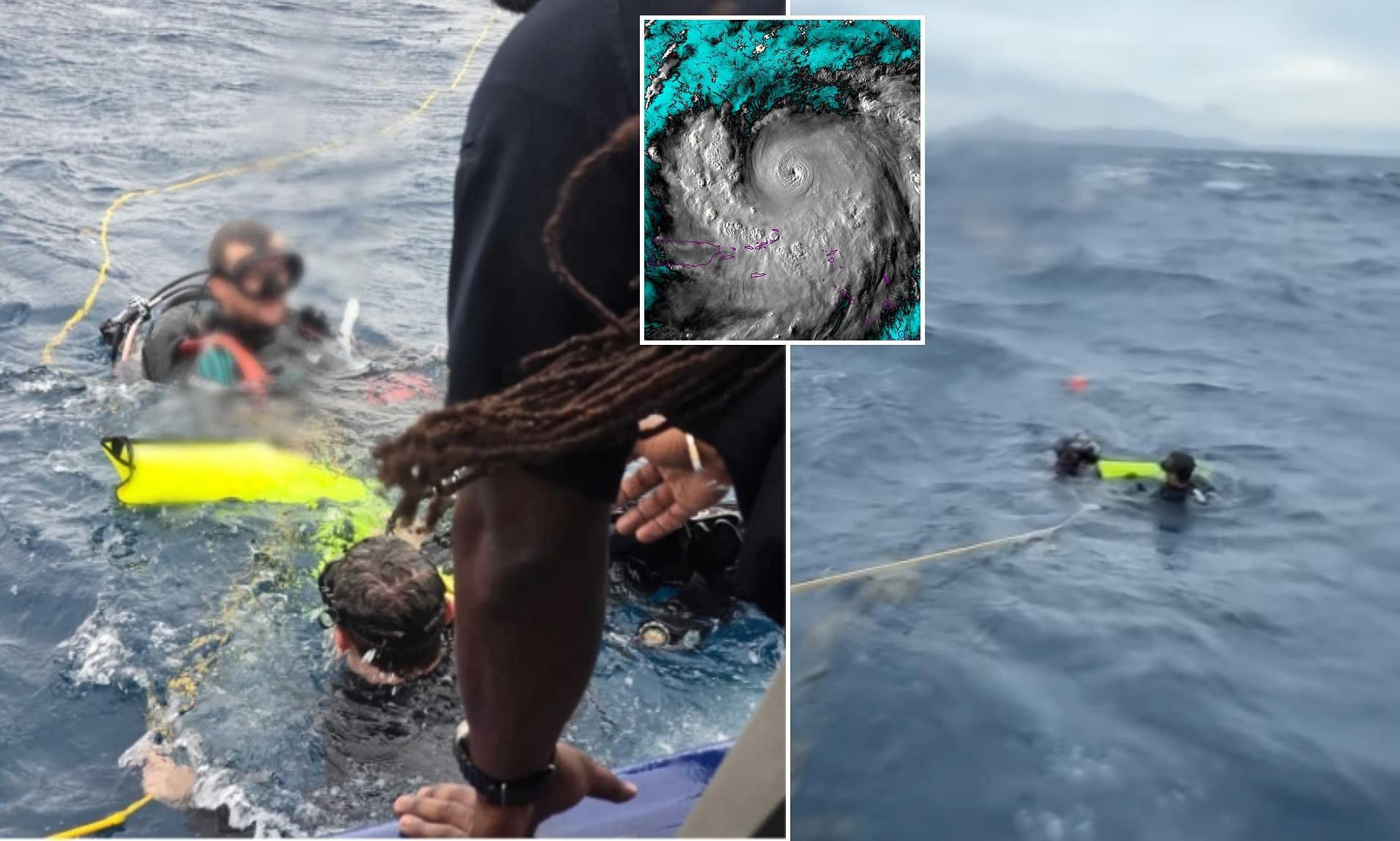
Heart-stopping footage captured the intense rescue of two divers who were swept away in the treacherous, turbulent waters of a Caribbean island during Hurricane Erin. The storm rapidly escalated into a catastrophic Category 5 hurricane over the weekend, with sustained winds of 160 mph and the potential to generate waves over 30 feet, depending on the storm’s size.
The Virgin Islands are currently facing the brunt of the storm, as Hurricane Erin unleashes powerful winds and relentless downpours across the region. On Saturday afternoon, two men were rescued in the waters off St. Croix, the largest of the Virgin Islands, after being swept away by rough surf while diving.
The high-stakes rescue was first shared by a local outlet, showcasing the two men being pulled from the storm-tossed sea after they failed to return to their vessel amid the fury of Erin. According to the outlet, the two men ventured roughly seven miles north of St. Croix with a third companion on Saturday morning. Before diving, they had agreed on a return time in case they became separated. However, when two of the men failed to return by the agreed time, their friend immediately called for help.
Just after 1:30 pm, the US Coast Guard activated both St. Croix Rescue and the Virgin Islands Department of Planning and Natural Resources (DPNR) to assist in the search. “A helicopter was on the way to assist,” said Jason Henry of St. Croix Rescue. “However, we found them before the chopper arrived.”
In the rescue footage, the crew’s boat is seen crashing over the choppy waves, momentarily airborne as it leaps beneath a fading blue-gray sky — a clear warning of the storm closing in. Thanks to GPS tracking data, rescue crews pinpointed the men’s location at sea around 3:24 pm. The harrowing footage shows two men, tiny against the vast, gloomy ocean, bobbing helplessly atop the violent waves.
A rescuer threw the men a yellow rope attached to a platform, which the men managed to grab. Rescuers then pulled them in, ultimately bringing them back to safety. Once rescued, the divers told officials they couldn’t get back onto their vessel because of the high waves, and that the rough currents caused them to drift away.
The National Weather Service and local authorities continue to warn residents to avoid the ocean during the storm. Swells from the hurricane are expected to cause ‘life-threatening surf and rip currents’ on the East Coast, as well as the northern Leeward Islands, the Virgin Islands, Puerto Rico, Hispaniola, the Turks and Caicos Islands, the Bahamas, and Bermuda.
Hurricane Erin was upgraded from a tropical storm to a Category-5 hurricane — with winds exceeding 157 mph — in just 24 hours. “By the middle of next week, Erin is forecast to at least double or triple in size, which will result in rough ocean conditions over the Western Atlantic,” the National Hurricane Center said. Outer bands of the storm are expected to produce heavy rainfall until Sunday, with around two to four inches of rainfall in some areas, and up to six inches in others.
“Locally considerable flash and urban flooding, along with landslides or mudslides, are possible,” according to the NHC. Hurricane Erin is expected to continue strengthening, curving toward the East Coast and Bermuda. “Fluctuations in intensity are expected for the rest of the weekend,” the hurricane center said.
AccuWeather warned that the worst-case scenario would see Erin guided directly onshore, “packing high winds, flooding rain and storm surge flooding.” Meteorologist Max Schuster shared on X that while the odds of a US landfall are low, “it cannot be ruled out still.” “Hurricane Erin has dropped 80mb of pressure in less than 24 hours,” he wrote early Saturday afternoon, accompanied by a shocked-face emoji.
Erin formed on August 15, becoming the first of the Atlantic season after four tropical storms. The season runs from June to November, with the peak hitting in September. The National Oceanic and Atmospheric Administration (NOAA) said in May that they were predicting an ‘above average’ season that would likely result in more named storms than there were in 2024, when 18 such storms were tracked.