






A New Era of Tree Planting in Uganda
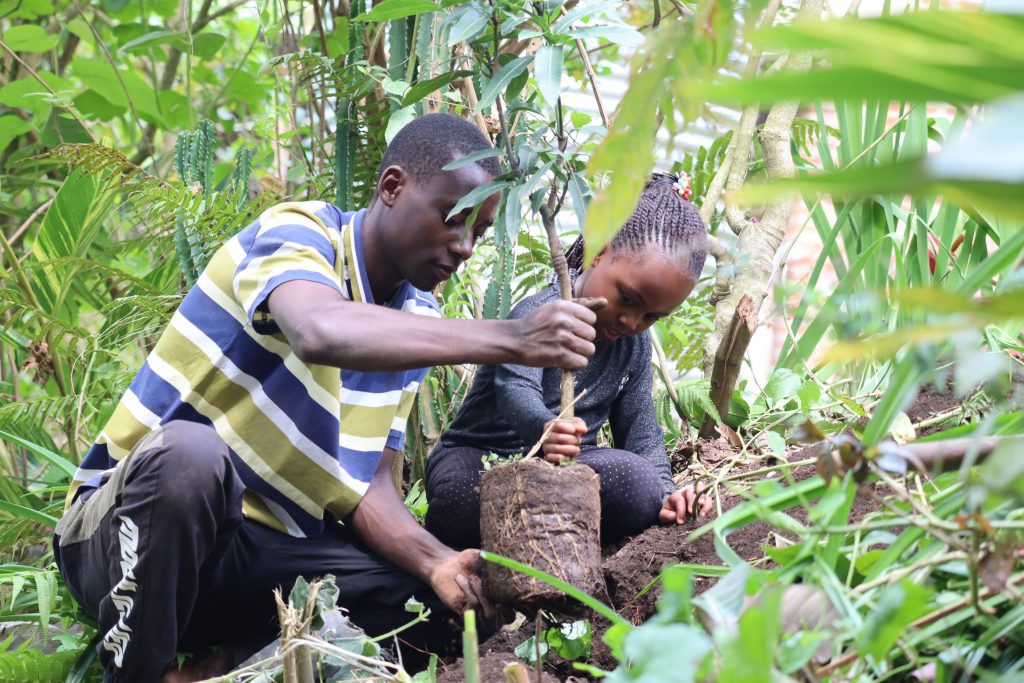
When Yudaya Nabaka plants a seedling, she doesn’t just cover it with soil; she gets a friend with a phone to take a few photos. These images are uploaded to an app used by Rotaractors and university students across Uganda, tracking the tree’s location and growth details. For Nabaka, it’s not just about planting trees—it’s about ensuring they live long enough to cool the villages she grew up in.
“I used to see people plant trees during community drives, but after a few months, most would wither because no one followed up,” Nabaka says, scrolling through photos of young seedlings her group monitors. “Now we can check which trees survive and which ones need extra care.”
Nabaka is a second-year literature student at Makerere University and is visually impaired, but she can still perceive some things. She walks clearly with the support of her friend, who helps her upload photos of tree seedlings whenever they plant.
Nabaka is deeply passionate about tree planting, especially fruit trees. She is one of hundreds of youths leading a quiet digital revolution in environmental conservation. Instead of planting and walking away, they are using smartphones and GPS mapping to track the survival of newly planted trees, ensuring that well-intentioned campaigns do not wither in the dry season.
The Challenge of Forest Loss
Uganda loses an estimated 200,000 hectares of forest cover every year, according to the National Forestry Authority. Campaigns to restore the country’s green cover are common, but activists say many efforts stop at photo opportunities. Trees are planted with no follow-up, and within months, they dry up or are cut down.
That is the gap Rotaractors, youth members of Rotary International, and university students are trying to close. Using an app called the Forest app, developed by the United Nations’ Food and Agriculture Organisation, they geo-tag every tree planted, photograph its condition, and upload data into a shared platform. The information is then analyzed to see how many trees survive, what areas need replanting, and which species thrive in certain soils.
“We call it moving from tree planting to tree tracking,” says Jeremiah Kwesiga, a Rotary member of Kampala Central. “Technology gives us evidence. It helps us tell whether our effort is just a ceremony or a real impact.”
Learning in the Field
For many students, the project is more than volunteering; it doubles as a practical lesson. Agriculture and environmental science students use the collected data for research on soil quality, rainfall patterns, and biodiversity. IT students develop software to make data collection easier, while communication students handle awareness campaigns on social media.
Kwesiga believes it is like having a classroom in the field where students learn not just how to plant but how to protect a tree through its life cycle.
Changing Community Perspectives
The initiative is also changing how local communities view tree planting. In Mpigi district, where youth groups have planted over 15,000 seedlings, farmers now receive SMS alerts reminding them to water or weed around their trees. Some are even given small solar-powered sensors that notify them when soil moisture is too low.
“We feel proud that the youth are involving us in the monitoring,” says 56-year-old farmer John Kato. “Before, people just came, planted trees, and disappeared. Now they call us to ask, ‘How is your tree doing?’ It makes us feel part of the project.”
Overcoming Challenges
Still, the work is not without hurdles. Poor internet connectivity in rural areas often means data is uploaded late. Smartphones and drones are costly, and students sometimes rely on borrowed gadgets. There is also the challenge of convincing local communities to protect trees instead of cutting them for firewood.
Yet, the youth say these setbacks only strengthen their resolve. “We may not save every tree, but every tree we save is a step closer to a greener Uganda,” Nabaka says.
Seeds of the Future
Environmentalists believe the combination of youth energy and technology could transform Uganda’s reforestation efforts. Unlike large campaigns that fade after a few days, digital tracking creates accountability and ensures continuity.
“Tree survival is what matters, not just the numbers planted,” says Lillian Nambalirwa, a Rotaractor and a botanist. “If young people can lead with technology, then Uganda has hope for long-term forest restoration.”
Nabaka understands that the mango tree she has planted will still stand tall in two years, its leaves deep green. “It’s not just about this one tree,” she says. “It’s about showing that with care and technology, our small actions can outlive us.”
For these youth, every planted seedling is more than just a statistic; it is a promise to the future. And with a phone in hand, they are determined to keep that promise alive.
Legacy of the Old Trees
Makerere University has one of the oldest trees, planted years ago. One of the mango trees opposite Nkrumah Hall stands strong with a huge trunk. It is still bearing fruit and providing shade to students who sometimes need fresh air after classes.
Kwesiga says that the big old tree could not have been planted alone; many could have withered and died, but this one still stands strong. He believes that with technology, the majority of the trees planted will survive the wrath of nature.
Miracle Nassazi, a climate change activist and a student of quantitative economics in her third year, says social responsibility will keep these young trees alive for years and years. She believes that the planted trees are fruit trees, which will provide fruits, helping students balance their diet, but also help combat climate change.
A Call to Action
Nassazi challenges the Government to support groups that are interested in nature, conservation, and champion condemning people who encroach on forests.